A new puppy will chew. Tablecloths, table legs, your favourite shoes, the corner of the sofa — if it is at puppy height, it is fair game. The trick is not to stop the chewing; it is to give your puppy something better to chew than your house. Done right, the right toy keeps small teeth busy, builds confidence and sleep-trains a young dog faster than any command we have ever tried.
This guide brings together the puppy toys we keep recommending to UK pet parents in 2026 — from teething chews and freezeable rubber to first-puzzle boards and snuffle mats. Every pick below is widely available from Amazon UK, Pets at Home or Zooplus UK and sized for puppies under twelve months.
Quick Comparison
| Product | Best For | Price Range | Rating |
| Kong Puppy | Teething & treat-stuffing | £7-£15 | ★★★★★ |
| Nylabone Puppy Teething Keys | Heavy chewers in teething stage | £5-£10 | ★★★★ |
| KONG Wubba Puppy | Tug, fetch and bonding play | £8-£14 | ★★★★ |
| PAW5 Wooly Snuffle Mat | Slow feeding & calm enrichment | £20-£28 | ★★★★★ |
| Outward Hound Hide-A-Squirrel (Junior) | Soft hide-and-seek games | £10-£18 | ★★★★ |
| Trixie Activity Flip Board | First-puzzle introductions | £12-£20 | ★★★★ |
Our Top Picks
1. Kong Puppy
Best for: every new puppy — the toy we recommend first.
The pink-or-blue Kong Puppy is the softer cousin of the famous Kong Classic, formulated for the gentler bite of milk teeth and developing adult teeth. The rubber is more forgiving than the standard red Classic — kinder on sore gums while still tough enough to survive the average puppy’s chewing budget. The hollow centre takes wet food, soaked kibble or a smear of nut butter, and the whole thing freezes beautifully: a frozen Kong Puppy is one of the best teething aids you can offer a UK puppy in 2026.
We use Kong Puppy as part of crate training and ‘settle’ work. Stuffed, frozen and offered in the crate, it gives a puppy a calm reason to be alone, which is far more useful than any shouting we could do from the next room. Size up early — most Labrador and Spaniel pups jump from Small to Medium around four months.
Worth flagging: this is a ‘puppy-only’ formulation. As your dog grows out of teething (typically six to eight months), graduate to the red Kong Classic for adult chewers, or the black Kong Extreme for power-chewing breeds. Leaving a Kong Puppy with a strong-jawed adult dog will eventually wear it down.
What we like:
- Soft, gum-friendly rubber designed for puppy teeth
- Freezeable — turns into a brilliant teething soother
- Five sizes from XS to L cover virtually every breed
- Inexpensive and very easy to clean (dishwasher-safe)
Worth knowing:
- Not built for adult chewing — graduate to the Classic after teething
- Size up if your puppy will use it unsupervised in a crate
- Needs proper stuffing to last more than a few minutes
Specifications:
- Sizes available: XS, S, M, L (XL on request from Pets at Home)
- Material: natural rubber, softer ‘puppy’ formula
- Suitable for: puppies up to 9 months (size dependent)
- Dishwasher-safe (top rack)
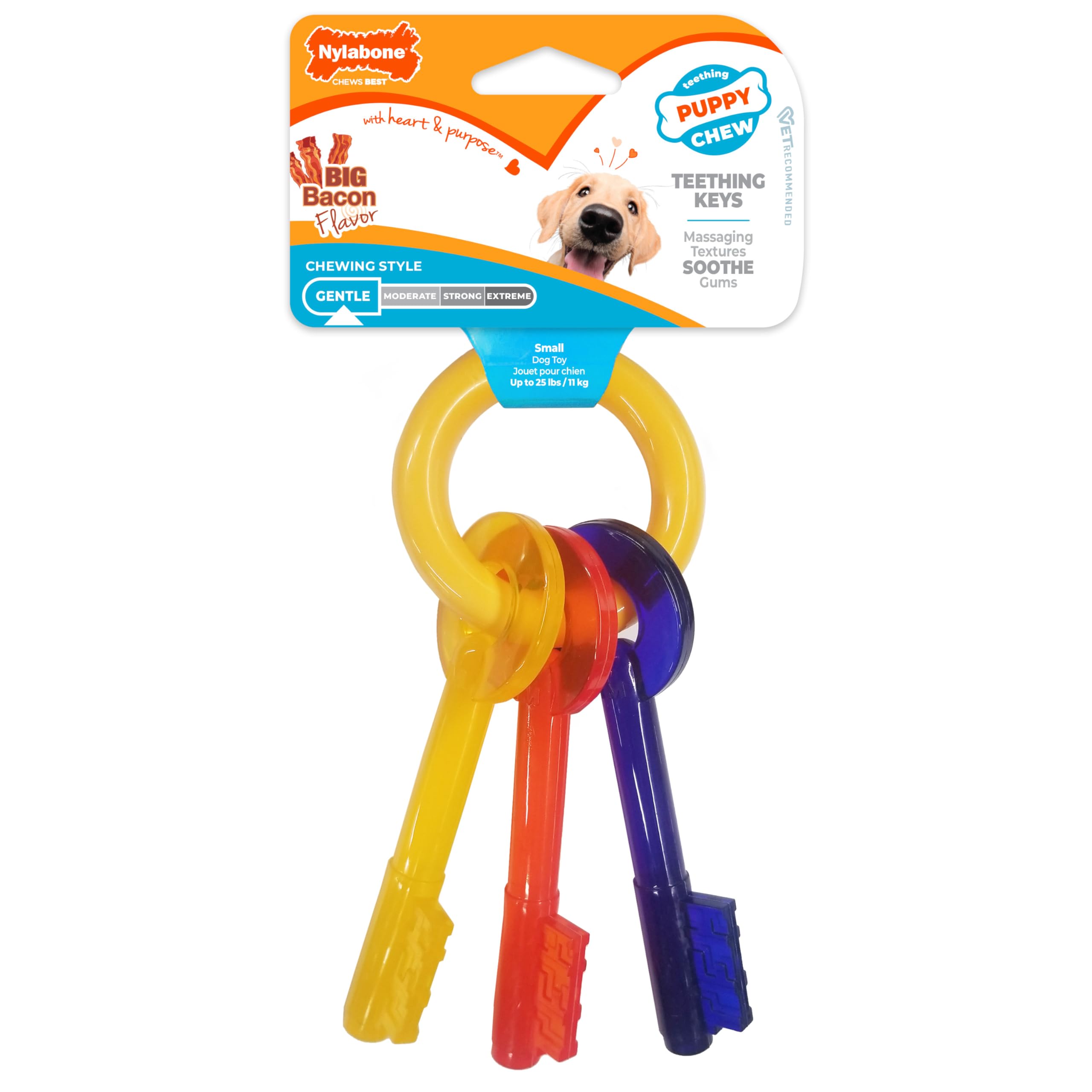
2. Nylabone Puppy Teething Keys
Best for: heavy chewers between three and six months.
Nylabone’s puppy range is a UK staple for a reason. The Teething Keys design is shaped to fit into the awkward corners of a puppy’s mouth where new molars are pushing through, and the soft-but-durable nylon material gives a satisfying chew without splintering. Unlike a rawhide or a real bone, you can wash the keys, hand them to a four-month-old Labrador and still see them next month.
We tend to recommend the Teething Keys as a ‘background’ chew — something your puppy can pick up and put down independently while you work. Pair them with a stuffed Kong Puppy for high-value moments (crate, alone time, vet visits) and use the Nylabone for general daytime chewing.
Worth knowing: Nylabone is meant to be gnawed, not eaten in chunks. Replace any chew once it fits entirely inside the dog’s mouth, or once the surface has worn down to a smooth nub. Always supervise the first few sessions with any new chew.
What we like:
- Designed specifically for the teething stage
- Hard-wearing — outlasts most fabric and plush toys
- Affordable: usually under £8 at Pets at Home
- Mild bacon or chicken scent encourages reluctant chewers
Worth knowing:
- Not a substitute for treat-stuffing or puzzle work
- Inspect regularly and bin once worn down
- Some puppies prefer rubber over nylon — try both
Specifications:
- Sizes available: X-Small (under 7kg), Small (7-11kg), Regular (11-16kg)
- Material: durable nylon with flavour infusion
- Suitable for: puppies 3-9 months
- Made in the USA, widely stocked in UK
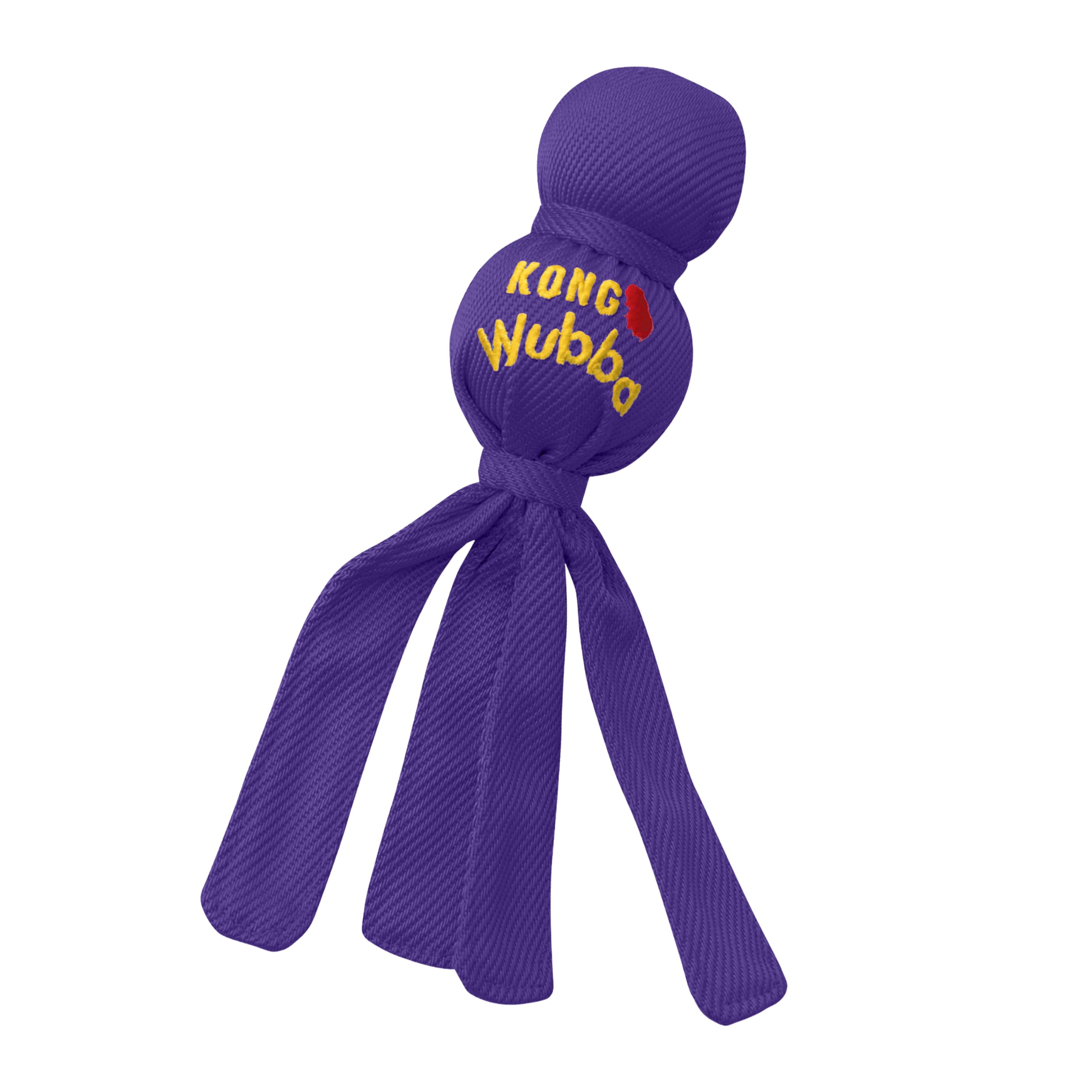
3. KONG Wubba Puppy
Best for: tug, fetch and building a recall.
The Wubba Puppy is a soft, squeaker-and-tail toy designed for the gentler play of a young dog. The body is a rounded, reinforced ball wrapped in soft fabric, with long flapping ‘tails’ that make it easy for a small mouth to grab. We use the Wubba as our default ‘training currency’ for puppies — it is light enough to throw for a tiny retriever and sturdy enough to take a few rounds of tug.
Tug is one of the best things you can teach a puppy. It builds engagement, drains energy and gives you a portable ‘on/off’ switch for arousal. The Wubba Puppy is sized so that you can comfortably hold one end while your puppy takes the other, without your hand and your puppy’s teeth fighting for the same patch of fabric.
Worth flagging: the squeaker inside is intended for interactive use, not as a solo chew. Some puppies will work very hard to extract it. Use the Wubba as a ‘with you’ toy and put it away between sessions — that also keeps it novel and exciting.
What we like:
- Easy for a puppy to grip and carry
- Doubles as fetch toy and tug rope
- Floats — useful for confidence-building near water
- Available in puppy-friendly colours (pink, blue, purple)
Worth knowing:
- Not a chew toy — supervise tug and fetch only
- Squeaker can be punctured by determined chewers
- Fabric tails wear down on rough garden surfaces
Specifications:
- Sizes available: Small and Large
- Material: rubber-cored ball wrapped in reinforced fabric
- Suitable for: puppies 3-12 months under supervision
- Floats: yes
4. PAW5 Wooly Snuffle Mat
Best for: calm enrichment and slow feeding.
A snuffle mat is a tangle of fleece strips on a rubber base, designed to hide kibble in plain sight. Your puppy ‘finds’ breakfast by sniffing through the fleece — the same nose-led work a dog would naturally do foraging outdoors. Five minutes on a snuffle mat is, in our experience, more settling than a twenty-minute walk in the rain, which is exactly what you want from a young dog at 7pm on a Tuesday.
PAW5’s Wooly mat is one of the more robust UK options — the fleece is tightly tied (not loosely woven) and the rubber base is sturdy enough that a puppy cannot flip it like a frisbee. We use it for at least one meal a day with new puppies, replacing the bowl entirely. Done over a few weeks this ‘eat to sniff’ habit pays back tenfold in calmer indoor behaviour.
Worth knowing: snuffle mats are interactive, not solo, toys. Put it away between meals so your puppy does not start chewing the fleece for fun. Wash it in the machine on a cool cycle every couple of weeks, more often if your puppy is using wet food.
What we like:
- Genuinely settles excitable puppies after five minutes
- Slows down fast eaters — useful for breeds prone to bloat
- Machine-washable on a cool cycle
- Made of recycled fleece — no plastic ‘grass’ fronds
Worth knowing:
- Use under supervision — do not leave with chewers
- Bulky to store; not as travel-friendly as a Kong
- Mid-range price, but lasts much longer than budget mats
Specifications:
- Dimensions: approximately 30cm x 45cm
- Material: recycled polar fleece on rubber base
- Suitable for: puppies 8 weeks and up (supervised)
- Care: machine-wash cool, air-dry
5. Outward Hound Hide-A-Squirrel (Junior)
Best for: soft hide-and-seek play and bonding sessions.
The Hide-A-Squirrel set is a plush tree-trunk and three (or four) squeaking squirrels — your puppy’s first ‘puzzle’ is to fish each squirrel out of the trunk. It plays to the natural interest a young dog has in soft, squeaking things, while keeping the play structured rather than chaotic. The Junior version is softer, smaller and a sensible introduction for puppies.
We particularly like it for socialised hide-and-seek games. Hide a squirrel under a cushion, behind the sofa or in another room, and let your puppy find it; once your puppy understands the game, you can scale up to teaching a basic ‘find it’ cue, which becomes a brilliant indoor brain-game on rainy afternoons.
Worth flagging: plush toys are interactive, not unsupervised. Some puppies enjoy ‘killing’ their squirrels by tearing the seams — that is fine while you are watching, but do not leave loose stuffing or squeakers within reach if you step out of the room.
What we like:
- Encourages structured, nose-led play
- Squirrels can be used as solo fetch toys too
- Soft enough for teething mouths
- Replacement squirrels are sold separately
Worth knowing:
- Plush construction will not survive heavy chewing
- Supervise — small squeakers can be a hazard if extracted
- Hand-wash only for longest life
Specifications:
- Sizes available: Junior (small) and Large
- Pieces: tree trunk plus 3-4 plush squeaker squirrels
- Material: plush fabric over polyester filling
- Suitable for: puppies 8 weeks and up under supervision
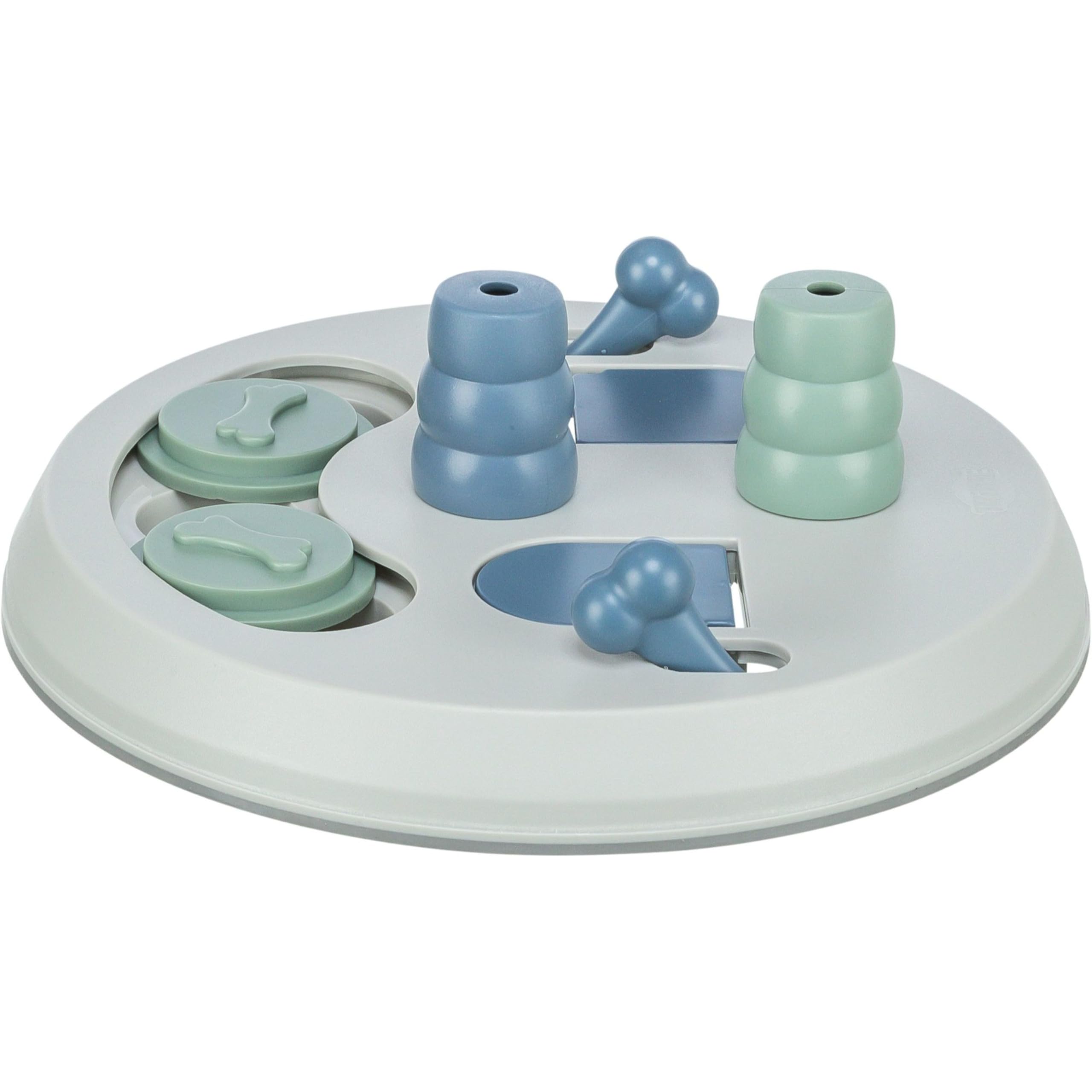
6. Trixie Activity Flip Board
Best for: a puppy’s first proper food puzzle.
The Trixie Flip Board is a Level 1 puzzle — meaning it is designed for absolute beginners. Four sliding compartments, two tilting cones and a couple of flap-lids give your puppy several different ‘how do I get the treat?’ problems on one board. We rate it as the best entry-level puzzle currently sold in the UK and the natural next step after a snuffle mat.
Use the Flip Board as a once-a-day mental warm-up. Five minutes of focused puzzling, ideally with kibble or low-value treats, will visibly tire a young dog. Start with covers removed so your puppy gets easy wins, then add the lids one at a time over a fortnight. The point is to build a ‘I can solve this’ mindset — frustration will switch a puppy off the puzzle for good.
Worth flagging: Trixie’s puzzles have small removable parts. They are not solo toys. Put the board away the moment your puppy starts trying to chew the cones rather than slide them.
What we like:
- Three different mechanisms on a single board
- Beginner-friendly — wins come quickly
- Non-slip rubber feet keep the board steady
- Lays the foundations for Level 2 and 3 puzzles later
Worth knowing:
- Plastic — not a chew toy
- Hand-wash only (avoid the dishwasher)
- Small parts mean strictly supervised use
Specifications:
- Difficulty: Level 1 (beginner)
- Dimensions: approximately 23cm diameter
- Material: food-safe ABS plastic with rubber feet
- Suitable for: puppies 12 weeks and up under supervision
Buying Guide: How to choose the best puppy toys
What to look for
Puppy toys do four jobs: they soothe sore teething gums, channel chewing onto the right objects, build engagement with you, and tire out a young brain. A good toy box has at least one of each — usually a freezeable rubber for teething, a hard chew for general use, a tug or fetch toy for bonding play, and a snuffle mat or puzzle for mental work. Avoid filling the box with five versions of the same thing — variety is what keeps a puppy interested.
Types of puppy toy
There are five broad categories worth knowing about. Teething toys (soft rubber, often freezeable) soothe gums. Chews (nylon, rubber or natural) channel chewing onto something durable. Tug and fetch toys (Wubbas, fleece tugs, soft balls) build interactive play. Snuffle mats and lick mats deliver calm, low-arousal enrichment. Puzzle toys (Trixie, Nina Ottosson, Outward Hound) build problem-solving. A typical UK household needs two or three at most to start — over-buying is a common new-pup mistake.
Size guide
Dog size reference:
- Small (under 10kg adult): Chihuahuas, Yorkies, Pugs — XS Kong Puppy and Small Wubba
- Medium (10-25kg adult): Spaniels, Beagles, French Bulldogs — Small Kong Puppy moving to Medium at 4-5 months
- Large (25-40kg adult): Labradors, Golden Retrievers, German Shepherds — Medium Kong Puppy, sized up at 4-5 months
- Extra Large (40kg+ adult): Great Danes, Mastiffs, Newfoundlands — Large Kong Puppy from week one
Size up rather than down for any toy a puppy will eventually chew without you watching. A toy small enough to be swallowed becomes a vet visit very fast.
How much should you spend?
- Budget (under £15): A Kong Puppy and a Nylabone Teething Keys covers most of the first three months
- Mid-range (£15-£30): A Wubba Puppy, a snuffle mat and a Level 1 puzzle round out a complete toy box
- Premium (£30+): Multi-piece puzzle sets, branded snuffle mats and ‘starter kits’ from John Lewis or Lords & Labradors
Frequently asked questions
How many toys does a new puppy actually need?
Far fewer than the internet would have you believe. Three or four good toys, rotated every few days, will out-perform a basket of fifteen. A Kong Puppy, a Nylabone chew and a snuffle mat or Wubba is a complete starter set for most UK households.
When can I start using toys with my puppy?
From the day they come home (typically eight weeks). Start with the softest options — a Kong Puppy and a snuffle mat — and supervise everything for the first few weeks. Tug and fetch can begin in earnest from around twelve weeks, once your puppy understands taking and giving the toy.
How do I stop my puppy chewing the wrong things?
Make the right thing more interesting than the wrong thing. Stuff a Kong with wet food and freeze it; offer it the moment your puppy starts mouthing the table leg. Over a few weeks, your puppy learns that the Kong (or the snuffle mat, or the Nylabone) is where the good stuff lives — and the table leg loses its appeal.
Are squeaky toys safe for puppies?
Yes, under supervision. The squeaker itself is small enough to be a swallowing risk if a puppy works it free of the toy, so squeaky plush toys (the Wubba, the Hide-A-Squirrel set) are interactive toys you play with together, not solo chews. Put them away between sessions.
Final Verdict
For most UK puppies, a freezeable Kong Puppy plus a PAW5 Wooly Snuffle Mat covers ninety per cent of what you actually need in those first six months — teething soother, settle tool and brain game in two purchases. Add a KONG Wubba Puppy for bonded play and a Nylabone Teething Keys for background chewing, and you have a toy box that will see your puppy comfortably through to adulthood without breaking £40.