There is a particular moment familiar to anyone with a small dog: two miles into a walk, the little legs give out, and the rest of the route is spent with an unhappy terrier tucked awkwardly under one arm. A backpack carrier solves that neatly, and it turns out to be useful far beyond long walks — for senior dogs who tire quickly, for puppies not yet fully vaccinated, for crowded train stations and for vet trips where a nervous dog is calmer off the floor.
The catch is that carriers vary enormously in weight limit, ventilation and how comfortable they are on your own back for more than ten minutes. Below we round up the best dog backpack carriers in the UK, from featherweight slings to structured hiking packs, with a buying guide on sizing, safety and getting a reluctant dog used to being carried.
Quick Comparison Table
| Product | Best For | Price Range | Rating |
| Ventilated Mesh Backpack Carrier | Best all-rounder for everyday use | £35-70 | ⭐⭐⭐⭐⭐ |
| Structured Hiking Carrier | Best for long walks and heavier dogs | £90-180 | ⭐⭐⭐⭐⭐ |
| Front-Facing Sling Carrier | Best for toy breeds and short trips | £20-40 | ⭐⭐⭐⭐ |
| Expandable Bubble Backpack | Best for anxious dogs wanting a den | £40-80 | ⭐⭐⭐⭐ |
| Convertible Trolley Backpack | Best for airports and long distances | £60-110 | ⭐⭐⭐⭐ |
The Best Dog Backpack Carriers Reviewed
Ventilated Mesh Backpack Carrier
Best for: most small dogs, and owners who want one carrier that does everything.
A soft-sided backpack with large mesh panels on three sides is the format we would point most owners towards first. It is essentially a padded fabric box with shoulder straps, a top or side zip entry, a padded base and an internal tether clip that stops a dog leaping out when the zip opens. Airflow is the main design job here, and a carrier with mesh on the back, sides and top keeps a dog noticeably cooler than a bag with a single small window.
What makes it the sensible default is versatility. It sits on your back for walking, on your lap on a train, on the floor at the vet as a familiar enclosed space, and folds reasonably flat for storage. Most models take dogs up to around 7kg, which covers Chihuahuas, Yorkies, Miniature Dachshunds, Pomeranians and smaller Jack Russells, and the better ones have a stiffened base so the dog is not sagging into a hammock shape. Look for a chest strap and a waist strap, because a loaded carrier pulls backwards off your shoulders without one.
The honest limitations are load and heat. Soft straps that feel fine for twenty minutes start to bite at the hour mark once there is 6kg in the bag, and a mesh carrier in direct summer sun still traps warmth, so it is not a hot-day solution on its own. Cheaper versions also skimp on the base padding, which is the first thing to check, since a dog sitting on a thin unsupported panel will not settle. For occasional carrying rather than serious distance, it is hard to beat for the money.
What we like:
- Mesh on multiple sides keeps airflow up
- Internal safety tether stops escapes at the zip
- Works as a backpack, a lap bag and a vet-room den
- Folds down small when not in use
Worth knowing:
- Soft straps get uncomfortable over an hour
- Still warm in direct sun despite the mesh
- Check the base is stiffened, not just padded fabric
Specifications:
- Material: ripstop polyester or nylon with mesh panels
- Typical weight limit: 6-8kg
- Entry: top and side zips, internal clip tether
- Suitable for: toy and small breeds, short to medium outings

Structured Hiking Carrier
Best for: long walks, rough ground and dogs at the heavier end of carryable.
A structured hiking carrier borrows its design from human hiking rucksacks rather than from pet bags, and the difference is obvious the moment you put a real weight in one. It has an internal frame or a rigid moulded back panel, a padded hip belt that transfers most of the load onto your hips instead of your shoulders, load-lifter straps at the top and a proper adjustable torso length. The dog usually sits upright with its head and front legs out of the top, secured by an adjustable collar opening and a tether.
This is the format for anyone actually covering distance. Weight limits run considerably higher than soft carriers — commonly up to 12kg and, on the largest models from specialists such as K9 Sport Sack, up to around 15 to 20kg — and the hip belt makes a heavier dog feel manageable in a way a shoulder-strap bag never does. Head-out designs also suit dogs that dislike being enclosed, and being at your eye level tends to keep a nervous dog calmer than being zipped into a box. Most have a rain cover and a couple of small pockets for keys, poo bags and a water bottle.
You are paying for the frame and the harness, and prices reflect that. These carriers are bulky, do not fold away, and are overkill if you only need to carry a dog from the car park to the vet’s door. They also need fitting properly, since a hip belt sitting in the wrong place is worse than no hip belt at all. Dogs need building up to it too, with short sessions at home before a five-hour hike. For hill walking with a small or medium dog, though, nothing else comes close.
What we like:
- Hip belt moves the weight off your shoulders
- Highest weight limits of any carrier type
- Head-out design suits dogs that hate being enclosed
- Rain covers and useful pockets on most models
Worth knowing:
- Expensive compared with soft carriers
- Bulky and does not pack away
- Needs proper torso and hip fitting to work
Specifications:
- Material: reinforced nylon with internal frame or rigid back panel
- Typical weight limit: 12-20kg depending on size
- Entry: side or front loading, head-out opening with adjustable collar
- Suitable for: small and medium dogs, hiking and long-distance carrying
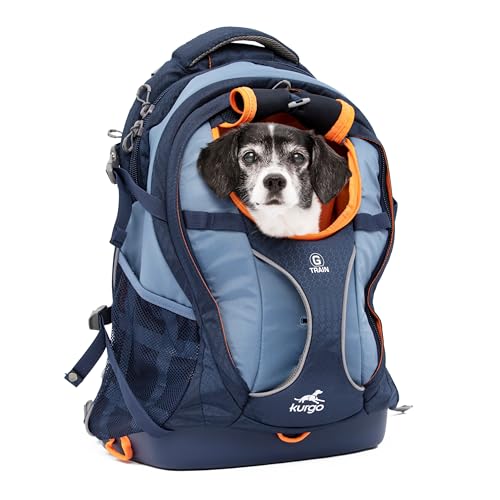
Front-Facing Sling Carrier
Best for: toy breeds, puppies and quick trips where a full backpack is too much.
A sling is the simplest carrier there is: a fabric pouch on a single adjustable shoulder strap, worn across the body so the dog sits against your chest or hip with its head out. There is no frame, no zip and usually just one internal clip. For a 3kg dog and a twenty-minute errand, that simplicity is exactly right, and it goes on and comes off in seconds rather than requiring you to take a rucksack off your back.
The real advantage is contact. A dog carried against your chest can feel you and see your face, which settles anxious and elderly dogs far more effectively than being zipped into a bag behind your head. Slings are also the easiest option for puppies during the pre-vaccination weeks, when getting a young dog out to see traffic, buggies and other people matters enormously for socialisation but they should not be walking on the ground. Most fold into a coat pocket and cost very little.
Set against that, load is limited and one shoulder takes all of it. Above about 5kg a sling becomes uncomfortable quickly and starts pulling your posture sideways, and there is far less security than a zipped carrier, so a wriggly dog needs the internal clip attached to a harness rather than a collar. It offers no protection either, which rules it out for cycling or anywhere a fall is likely. Within its limits, though, it is the carrier owners of tiny dogs actually use day to day.
What we like:
- On and off in seconds
- Close body contact calms anxious and elderly dogs
- Ideal for pre-vaccination puppy socialisation
- Folds into a pocket and costs very little
Worth knowing:
- All the weight sits on one shoulder
- Not secure enough for a dog that wriggles hard
- No structural protection in a fall
Specifications:
- Material: cotton canvas, polyester or mesh-panelled fabric
- Typical weight limit: 4-6kg
- Entry: open-top pouch with internal clip
- Suitable for: toy breeds, small puppies and short trips
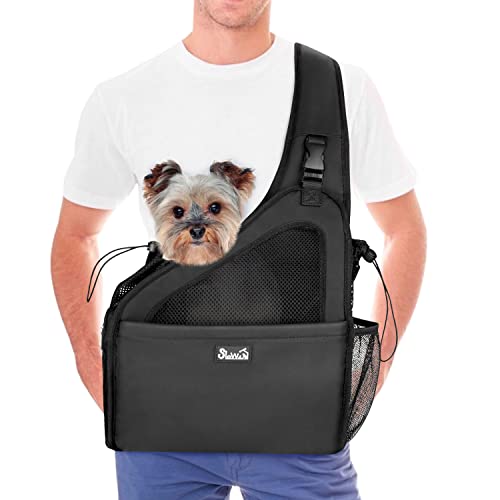
Expandable Bubble Backpack
Best for: nervous dogs that settle better with a den, and longer stationary waits.
The bubble backpack is the one with a clear domed window on the back, and many now expand outwards at the rear to roughly double the internal floor space when unzipped and set down. Originally designed for cats, they have been adopted widely by owners of small dogs that prefer somewhere enclosed to hide rather than an open head-out carrier. Ventilation comes through mesh side panels and holes around the dome rather than through the bubble itself.
Where these earn their place is waiting time. On a train, in a waiting room or at an outdoor table, expanding the rear section gives the dog room to lie down flat rather than sit hunched, and a genuinely enclosed space is what many anxious dogs want in a busy environment. The rigid shell also protects better than soft fabric if the bag gets knocked, and most have a solid flat base and a top handle as well as backpack straps.
The drawbacks are heat and bulk. A clear plastic dome acts like a small greenhouse in sunshine, so these need siting in shade and are a poor choice on a warm day, and the semi-rigid shell means the bag does not compress for storage. They are heavier empty than a soft carrier, and the expanded section is only usable when the bag is on the ground, not on your back. Judged as a travel-and-waiting carrier rather than a hiking one, they work well.
What we like:
- Expands to let a dog lie flat when set down
- Enclosed design suits dogs that prefer to hide
- Semi-rigid shell offers real impact protection
- Flat base and top handle as well as straps
Worth knowing:
- Clear dome heats up fast in direct sun
- Heavier and bulkier than a soft carrier
- Expansion only usable when the bag is down
Specifications:
- Material: EVA or polycarbonate shell with fabric and mesh panels
- Typical weight limit: 6-8kg
- Entry: side and top zips, expandable rear section
- Suitable for: small dogs and cats, travel and stationary waits

Convertible Trolley Backpack
Best for: airports, stations and anywhere with long stretches of flat floor.
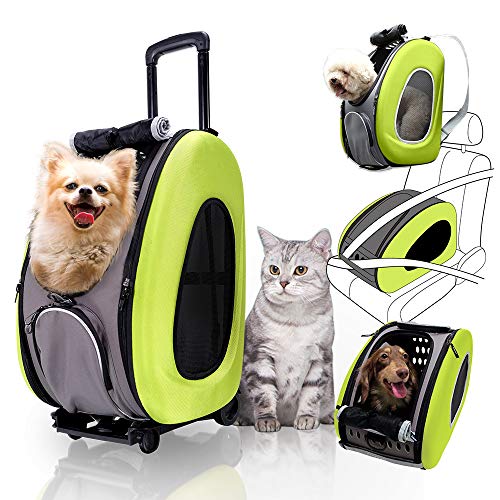
A convertible carrier has a telescopic handle and wheels tucked into the base, so it wheels along like cabin luggage and converts to a backpack when you hit stairs or rough ground. For anyone moving a dog through an airport terminal or a big railway station, that combination removes the main problem with carriers, which is that even 6kg becomes tiring across a mile of concourse.
The best of them are built to soft-sided airline cabin dimensions, typically around 45 x 30 x 25cm, which is worth checking against your specific airline before booking since limits vary and most UK carriers restrict live animals in the cabin altogether. Beyond flying, they are genuinely useful for long train journeys and for owners who cannot comfortably carry weight on their back for medical reasons. Wheels are usually recessed to keep the base flat when it is worn as a pack.
The compromises are weight and noise. The frame, handle and wheels add perhaps a kilo before the dog gets in, which makes it the heaviest option to wear once you do switch to backpack mode, and dogs can find the rumble and vibration of hard wheels on rough paving unsettling until they get used to it. Wheeling also puts the dog low down at ankle height in crowds. For airport use it is the obvious choice; for a country walk it is the wrong tool.
What we like:
- Wheels take the weight across long flat distances
- Converts to a backpack for stairs and kerbs
- Often built to soft-sided cabin dimensions
- Good option if you cannot carry weight on your back
Worth knowing:
- Around a kilo heavier empty than a soft carrier
- Wheel rumble unsettles some dogs at first
- Puts the dog at ankle height in crowds
Specifications:
- Material: reinforced polyester over a semi-rigid frame
- Typical weight limit: 8-10kg
- Entry: top and front zips, telescopic handle and recessed wheels
- Suitable for: air and rail travel, small dogs up to about 8kg
Budget Mesh Backpack Carrier
Best for: occasional use, and finding out whether your dog will tolerate a carrier at all.
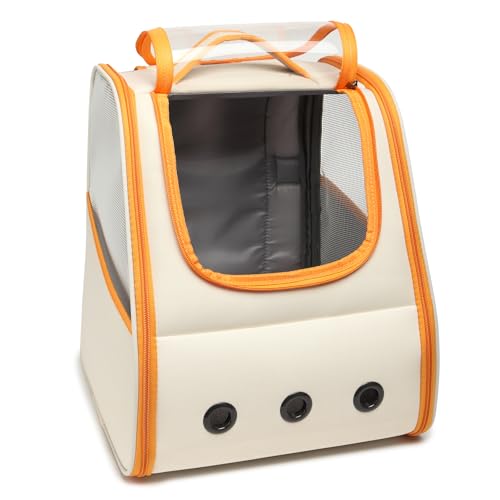
Not every owner needs a carrier often enough to justify £70, and a basic mesh backpack answers the question cheaply. These are simple unframed fabric bags with mesh on the front and sides, a top zip, a thin padded base and plain webbing straps. The fundamentals are usually present, including an internal tether clip, and for a dog that needs carrying for the last half mile of a walk once a fortnight that is genuinely enough.
Buying at this level also makes sense as a trial. Plenty of dogs simply refuse to settle in a carrier, and finding that out for £25 rather than £120 is a better outcome. A cheap carrier is also a reasonable thing to keep permanently in the car boot for emergencies, where a good one would rarely be used and would just deteriorate in the heat and cold.
The savings show up in the straps and the base. Thin unpadded webbing digs into shoulders within fifteen minutes with any real weight in the bag, there is rarely a proper waist strap, and the floor panel tends to sag so the dog never quite sits level. Zips are the usual failure point, so check them before every outing. Used for short carries and treated as semi-disposable, it does the job; used daily, it will not last a year.
What we like:
- Cheapest way to try a carrier with your dog
- Still includes mesh ventilation and a safety tether
- Light enough to leave in the car permanently
- No great loss if the dog refuses to use it
Worth knowing:
- Thin webbing straps dig in quickly
- Base sags without proper stiffening
- Zips are the common failure point
Specifications:
- Material: lightweight polyester with mesh panels
- Typical weight limit: 5-7kg
- Entry: top zip with internal clip
- Suitable for: short, occasional carries with small dogs
Dog Backpack Carrier Buying Guide
What to look for when buying a dog backpack carrier
Weight limit is the number that matters most, and it should be treated as a maximum rather than a target. A carrier rated to 8kg carrying an 8kg dog will sag, strain its seams and sit badly on your back, so aim for a dog around two thirds of the stated limit. Weigh your dog rather than guessing, since owners routinely underestimate by a kilo or more, and remember that you are carrying the bag as well.
After that, look hard at ventilation, the base and the harness. Mesh on at least two sides is the minimum, and mesh on three is much better in a British summer. The base should be stiffened, not merely padded, so the dog sits level instead of sinking into a sling shape. On your side, a chest strap is essential and a padded waist strap makes a substantial difference above about 5kg. Finally, check there is an internal tether, and clip it to a harness rather than a collar so a sudden jump cannot pull on your dog’s neck.
Dog backpack carrier types explained
Soft mesh backpacks are the everyday default: light, ventilated, affordable and easy to store, but limited to roughly 8kg and uncomfortable over long distances. Slings are the minimal option for toy breeds and puppies, unbeatable for quick trips and close contact but hard on one shoulder and short on security. Bubble or capsule backpacks add a semi-rigid shell and an expanding rear section, which suits nervous dogs and long waits at the cost of heat build-up and bulk.
Structured hiking carriers are the serious end, with an internal frame, a hip belt and weight limits that stretch into the teens of kilos, and they are the only type genuinely suited to a full day out. Convertible trolley carriers add wheels for airports and stations. There are also front-and-back combination packs that let you carry a dog on your chest with a rucksack behind, which are worth knowing about if you are carrying kit as well as a dog.
Size guide
As a rough guide, dogs under 5kg — Chihuahuas, Toy Poodles, Yorkshire Terriers, Papillons — are comfortable in a sling or any small carrier. Dogs of 5 to 8kg, including Miniature Dachshunds, Pomeranians, Bichons and smaller Jack Russells, want a soft mesh backpack rated to at least 10kg. From 8 to 12kg, covering many Cocker Spaniel puppies, Shih Tzus and Miniature Schnauzers, you are into structured carrier territory, and above 12kg only the largest hiking packs will do.
Measure your dog from chest to tail base and from floor to shoulder while standing, then compare against the internal dimensions rather than the external ones. A dog should be able to stand up, turn around and lie down in an enclosed carrier, and in a head-out hiking pack should sit with its shoulders clear of the opening without the collar section pressing on its throat. Long-backed breeds such as Dachshunds need particular care, since a carrier that curls the spine is not suitable for extended use.
How much should you spend?
A budget mesh backpack costs around £20 to £35 and is a reasonable trial purchase or a car-boot spare. Slings sit at roughly £20 to £40 and are worth owning alongside a backpack rather than instead of one, since they cover different situations. Neither is a mistake at this level, but neither will be comfortable for long carries.
The useful middle is £35 to £70, which buys a properly ventilated soft backpack with a stiffened base, a chest strap and zips that survive daily use. Bubble carriers run £40 to £80 and convertible trolley models £60 to £110. Structured hiking carriers start around £90 and reach £180 for the specialist brands, which is a lot of money but justified if you genuinely walk a small dog into terrain it cannot cover. For most owners, a good £50 mesh backpack plus a £25 sling covers nearly everything.
Frequently asked questions
Is it safe to carry a dog in a backpack?
Carried correctly, yes, for the great majority of healthy dogs. The important points are staying well within the weight limit, keeping the dog upright rather than curled, making sure it can breathe freely with its head unrestricted, and never leaving a dog zipped in a carrier unattended. Watch for panting, drooling or scrabbling, all of which mean it is time to stop and let the dog out. If your dog has a spinal condition, breathing difficulties or is a flat-faced breed, ask your vet before using a carrier regularly.
How long can a dog stay in a backpack carrier?
Aim for no more than an hour at a stretch, then let the dog out for a stretch, a drink and a toilet break before continuing. Confinement in one position is tiring for a dog even when it looks settled, and on a long hike most people find a rhythm of carrying for a section and walking for a section works better for both parties. In warm weather, cut those intervals substantially and check the dog far more often.
My dog will not settle in the carrier — what should I do?
Build up in very small steps at home first. Leave the carrier open on the floor for a few days with treats scattered inside so it becomes an ordinary piece of furniture rather than a trap, then feed a meal in it, then close the zip for thirty seconds while the dog is eating. Only once the dog is relaxed at that stage should you lift it, and the first lift should last a few seconds. Rushing this is the usual reason a carrier ends up unused in a cupboard.
Can I take a dog backpack carrier on a plane or a train?
Rules vary and need checking directly with the operator before you travel. Most UK airlines do not allow dogs in the cabin at all, with assistance dogs the main exception, so a cabin-sized carrier is more useful on European and long-haul carriers that do. UK train operators are generally far more relaxed and allow small dogs in carriers at no charge, though it is worth confirming the specific policy. Never rely on a carrier being described as airline-approved without checking the airline’s own dimensions.
Are backpack carriers suitable for puppies?
They are one of the most useful things you can own during the pre-vaccination window, because a puppy can see traffic, crowds, buggies and other dogs from the safety of a carrier without its paws touching the ground. Keep sessions short and positive, and make sure the puppy can see out. Bear in mind that a puppy will outgrow a small carrier quickly, so for a breed heading past 10kg it may be worth borrowing rather than buying.
What is the weight limit on a dog backpack carrier?
Soft mesh backpacks are typically rated to 6 to 8kg, slings to 4 to 6kg, bubble carriers to 6 to 8kg, convertible trolley models to 8 to 10kg and structured hiking carriers to 12kg and up, with the largest specialist packs handling around 20kg. Whatever the rating, your own comfort is usually the real limit, and carrying more than about a tenth of your own body weight for any distance is optimistic without a hip belt.
Conclusion
For most owners, a well-ventilated soft mesh backpack at around £35 to £70 is the right buy. It carries a dog of up to about 7kg comfortably for the sort of distances people actually need, the multi-panel mesh keeps things cool enough for a British summer, and it doubles as a lap carrier on trains and a familiar den in the vet’s waiting room.
If you genuinely hike with a small dog, spend the extra on a structured carrier with a hip belt — the difference over a full day is enormous. Choose a sling instead if your dog is under 5kg and your trips are short, and a convertible trolley model if most of your carrying happens on airport and station floors.