Dogs are problem-solvers. Left with nothing to think about, a bright Labrador or a busy spaniel will invent their own job — usually one that involves the bin, the postman or the corner of the rug. Puzzle toys give that nose-and-brain energy somewhere useful to go, and most UK pet parents are amazed how five minutes of nosework can settle a dog more reliably than an hour’s walk.
This guide rounds up the puzzle toys we keep recommending to UK dog owners in 2026 — from beginner sliders that build confidence to advanced multi-step puzzles for clever dogs who solve everything on the first try. We have used each one with real dogs, in real living rooms, and flagged where each is worth your money and where a cheaper alternative does the same job.
Quick Comparison
| Product | Best For | Price Range | Rating |
| Outward Hound Nina Ottosson Dog Brick | Beginners & first puzzles | £18-£25 | ★★★★★ |
| Trixie Activity Flip Board | Intermediate problem-solvers | £15-£22 | ★★★★ |
| Nina Ottosson Dog Tornado | Advanced clever dogs | £25-£35 | ★★★★★ |
| KONG Wobbler | Slow feeders & food-motivated dogs | £18-£26 | ★★★★ |
| LickiMat Buddy | Calm enrichment & anxious dogs | £5-£10 | ★★★★★ |
Our Top Picks
1. Outward Hound Nina Ottosson Dog Brick
Best for: a first puzzle for a dog who has never been asked to think.
The Dog Brick is the puzzle we hand to nearly every new client. The board has sliding tiles and lift-up bone-shaped covers, with treat wells underneath. A dog quickly works out that nudging the slider or pawing the bone reveals food, and from there you can rotate the difficulty by hiding kibble in different combinations. It is plastic, dishwasher-safe, and survives years of normal use.
We like it for nervous or under-stimulated rescue dogs in particular. The reward is immediate, the mechanics are obvious, and there is no scary noise or wobble. Once a dog ‘gets’ puzzle work on the Dog Brick, you can graduate them to harder boards without rebuilding their confidence from scratch.
Worth flagging: the sliders can be lifted off entirely by a determined dog, which short-circuits the puzzle. Sit with your dog the first few sessions, both to coach the behaviour and to spot any chewing on the plastic edges.
What we like:
- Clear, intuitive mechanics — most dogs solve it within ten minutes
- Two difficulty modes on one board (level 2 of Nina Ottosson’s range)
- Plastic is BPA-free and dishwasher-safe (top rack)
- Compact — stores flat in a drawer
Worth knowing:
- Sliders can be removed by paws; supervise heavy chewers
- Not a substitute for solo enrichment — this is interactive only
- Some larger breeds find the treat wells too shallow for kibble
Specifications:
- Difficulty level: 2 (intermediate-beginner) on Nina Ottosson’s 1-4 scale
- Dimensions: approximately 38cm x 26cm
- Material: BPA-free plastic on a non-slip base
- Suitable for: all breeds 5kg and above; not for puppies under 4 months
2. Trixie Activity Flip Board
Best for: intermediate dogs who have mastered a simple slider board.
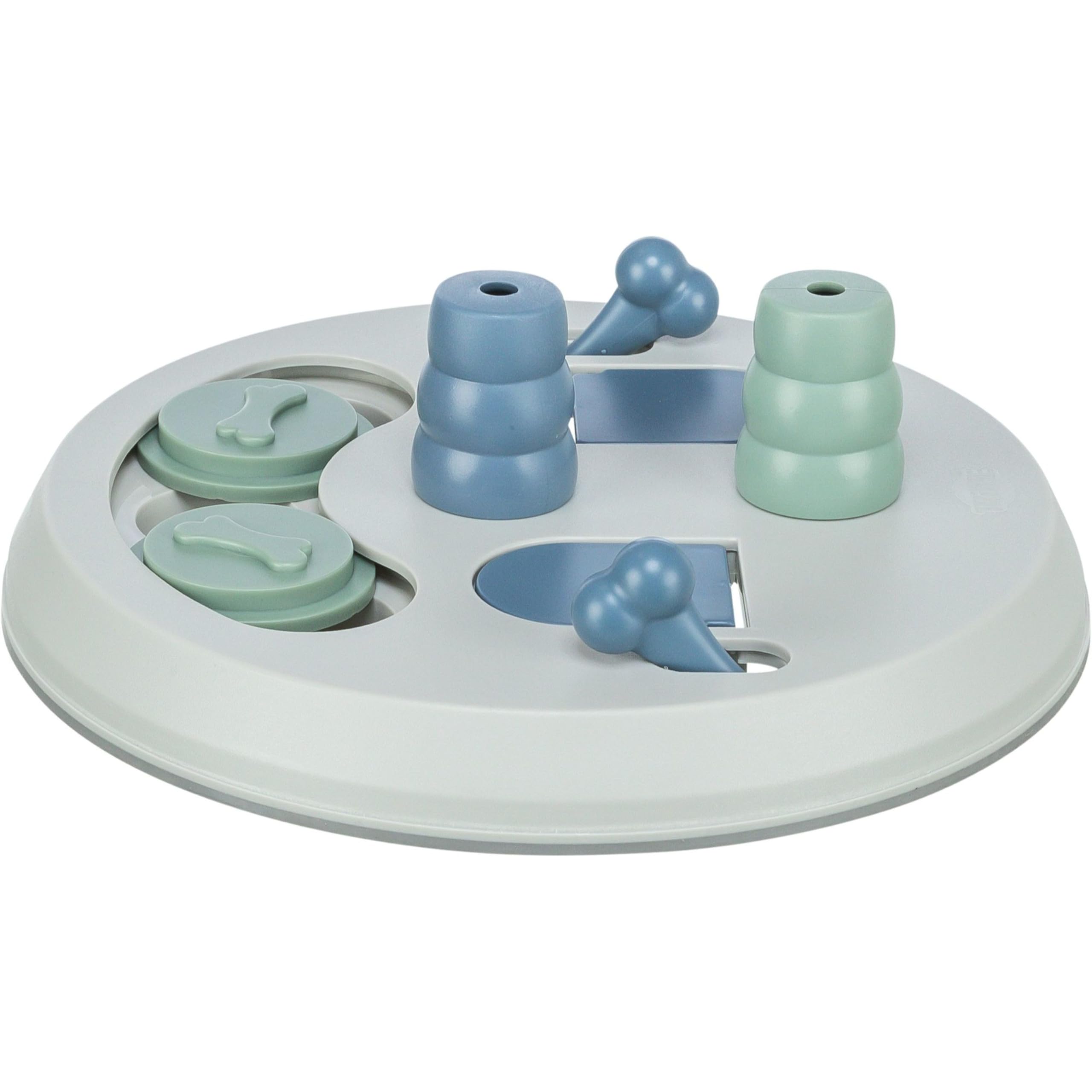
Trixie’s puzzle range is the best value on the UK market, and the Activity Flip Board is the one we reach for second. It combines four different mechanisms — a sliding cone, a hinged flap, a lift-up cup and a rotating wheel — on a single board. Each compartment hides a treat, and your dog has to work out which mechanism applies to which compartment.
Because the four mechanisms are mechanically different, this is the puzzle that teaches dogs to try different strategies rather than repeating the one that worked last time. We have seen working line spaniels and collies particularly enjoy it because there is real variety to the problem-solving.
Worth knowing: the flip board is wood-effect plastic, not actual wood, which is fine in normal use but does scuff if dragged across a hard floor. The non-slip base helps, but a tea towel under the board on tile or laminate adds a useful layer.
What we like:
- Four genuinely different mechanisms in one puzzle
- Excellent value — usually under £20
- Removable pieces are bigger and harder to chew than on cheaper boards
- Stays put on carpet thanks to the rubber feet
Worth knowing:
- Hand-wash only — not dishwasher-safe
- Wood-effect surface scuffs on hard floors
- Some dogs flip the entire board rather than using the mechanisms — coach the behaviour
Specifications:
- Difficulty level: 2 (intermediate)
- Dimensions: approximately 32cm diameter
- Material: ABS plastic with non-slip rubber base
- Suitable for: small to large dogs; supervise under 4 months
3. Nina Ottosson Dog Tornado
Best for: clever dogs who solve the Dog Brick in under two minutes.
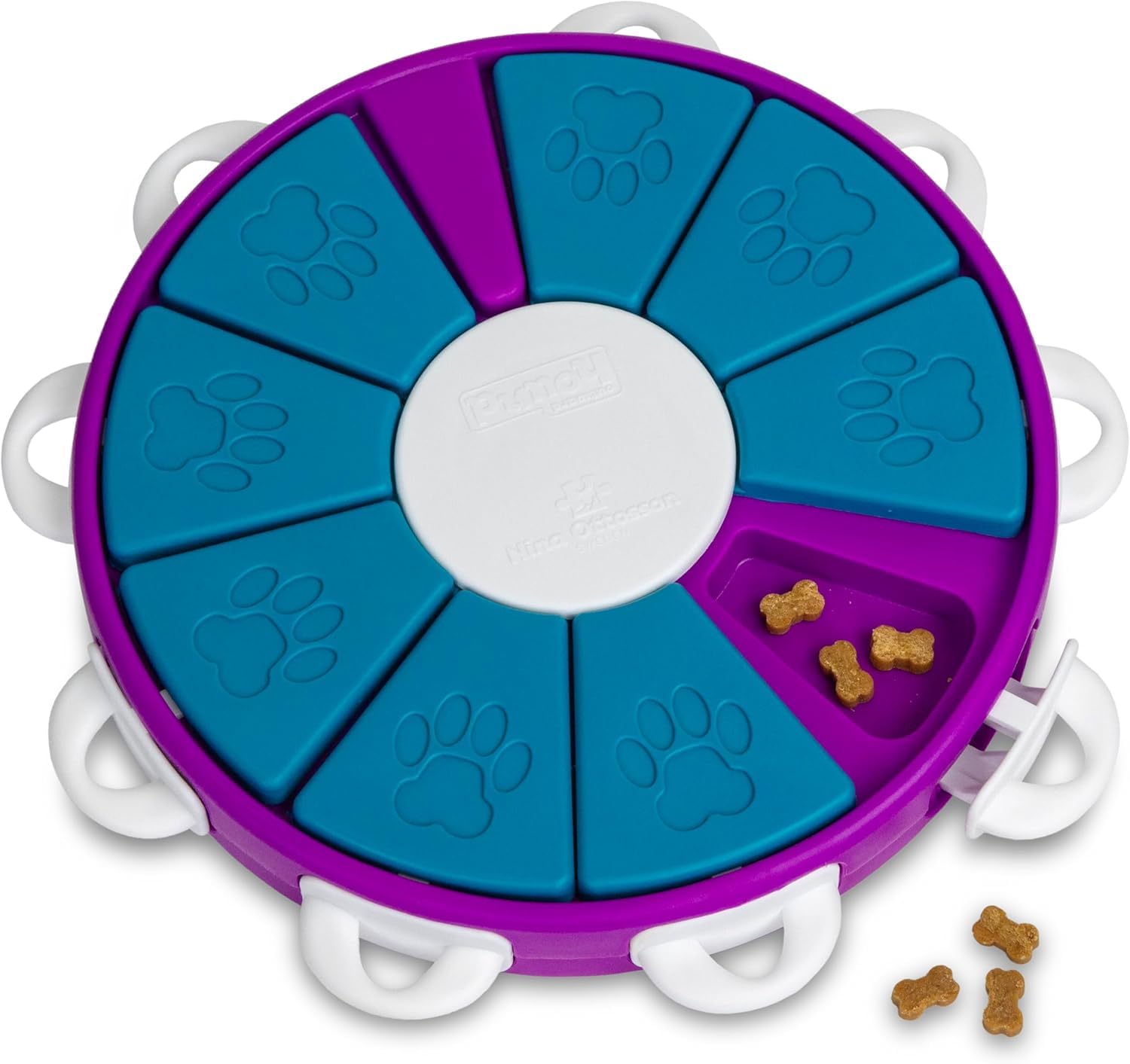
The Dog Tornado is the step-up puzzle: three stacked rotating layers with treat compartments that only line up when the dog rotates each layer in the right direction. Some compartments have removable bone-shaped covers for an extra layer of difficulty. It is the puzzle we recommend for working line breeds, border collies, poodles and any dog who has ‘solved’ a beginner puzzle.
Build the difficulty gradually. Start with the bones off and only one or two layers used; as your dog gets the idea, add the bones and use all three layers. By the highest setting, a clever dog will take five to ten minutes of focused work to clear it — which is far more mental tiredness than the same time on a walk.
Worth flagging: the layers can be lifted clean off if your dog is large enough to mouth the central spindle. Once that happens the puzzle is solved. Trim the difficulty by removing layers rather than allowing your dog to dismantle the whole toy.
What we like:
- Genuinely difficult, even for puzzle veterans
- Three difficulty modes built into one toy
- Same quality plastic as the Dog Brick — dishwasher-safe
- Compact for the difficulty level it delivers
Worth knowing:
- Pricier than other Nina Ottosson puzzles
- Lift-up bones can be chewed by determined dogs
- Too challenging as a first puzzle — frustration is real
Specifications:
- Difficulty level: 3 (advanced)
- Dimensions: approximately 34cm diameter
- Material: BPA-free plastic, dishwasher-safe (top rack)
- Suitable for: confident puzzle-solvers, 5kg and above
4. KONG Wobbler
Best for: solo enrichment, slow feeding and food-motivated dogs.
The Wobbler is a weighted, hollow Kong that you fill with kibble. The dog pushes, paws or nudges it to release a few pieces at a time through the slot in the side. Unlike a board puzzle, this one is genuinely solo — you can fill it with breakfast, hand it over, and walk away. We use it as a working dog’s morning routine in households where free-feeding from a bowl is too quick.
Mechanically, the Wobbler is a fixed challenge — the dog cannot make it harder or easier — so it suits dogs who like a predictable problem and dislike learning new mechanisms. It is also a good ‘rainy day’ tool for active breeds who would otherwise be climbing the walls after a missed walk.
Worth knowing: the Wobbler is noisy. The hollow plastic body clatters across a hard floor in a way that some dogs love and some find unsettling. If your dog is sound-sensitive, try the LickiMat first or use the Wobbler on a rug.
What we like:
- Genuinely solo enrichment — no supervision required for non-chewers
- Holds a full meal for medium breeds
- Unscrews for easy cleaning
- Heavy weighted base resets the wobble correctly every time
Worth knowing:
- Loud on hard floors — use on carpet or a rug
- Single difficulty level — cannot be adjusted
- Not a thinking puzzle — more of a slow feeder with brains
Specifications:
- Sizes available: Small (under 10kg) and Large (10kg+)
- Material: thick-walled food-safe plastic
- Suitable for: all but the most determined chewers
- Dishwasher-safe: top rack only
5. LickiMat Buddy
Best for: calm enrichment, settle work and anxious or recovering dogs.
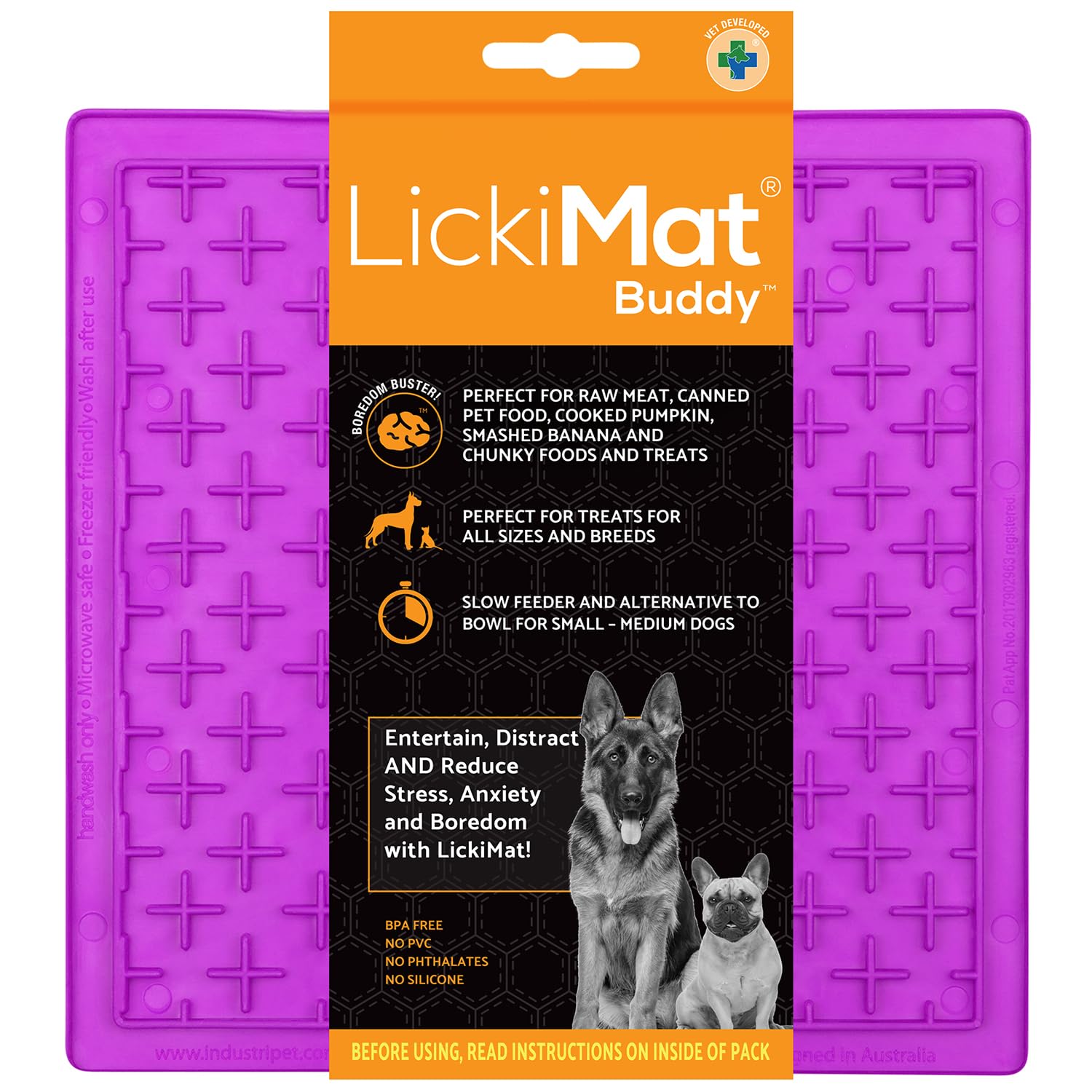
Strictly speaking, a LickiMat is a slow feeder rather than a puzzle — but it earns its place here because the act of licking is genuinely calming for dogs, and it solves the same ‘my dog cannot settle’ problem that puzzles often do. Spread wet food, plain yoghurt or a thin layer of softened kibble across the textured rubber surface, and your dog will work it off methodically over five to ten minutes.
We recommend the LickiMat Buddy in particular for dogs on crate rest, dogs recovering from surgery, and anxious dogs who cannot cope with the frustration of a real puzzle. It also doubles as a brilliant grooming distraction — stick it to the side of the bath with the suction cups and your dog has something to focus on through nail trims or a brush-out.
Worth knowing: the rubber surface holds onto smells after wet food, even after washing. Most owners give it ten minutes in the dishwasher rather than a hand-wash.
What we like:
- Genuinely settles excitable or anxious dogs
- Doubles as a bath, grooming or vet-visit distraction
- Cheap — usually under £10 even for the branded LickiMat version
- Dishwasher-safe
Worth knowing:
- Not a problem-solving puzzle — no real challenge
- Rubber holds onto fishy smells after sardine or oily food
- Cheap supermarket copies do not have the same texture — buy the brand
Specifications:
- Dimensions: approximately 20cm x 20cm
- Material: food-safe rubber
- Suitable for: all ages including puppies and seniors
- Suction cups on the underside for sticking to bath or floor
6. Outward Hound Hide-A-Squirrel
Best for: soft, plush problem-solving — and dogs who prefer fabric to plastic.
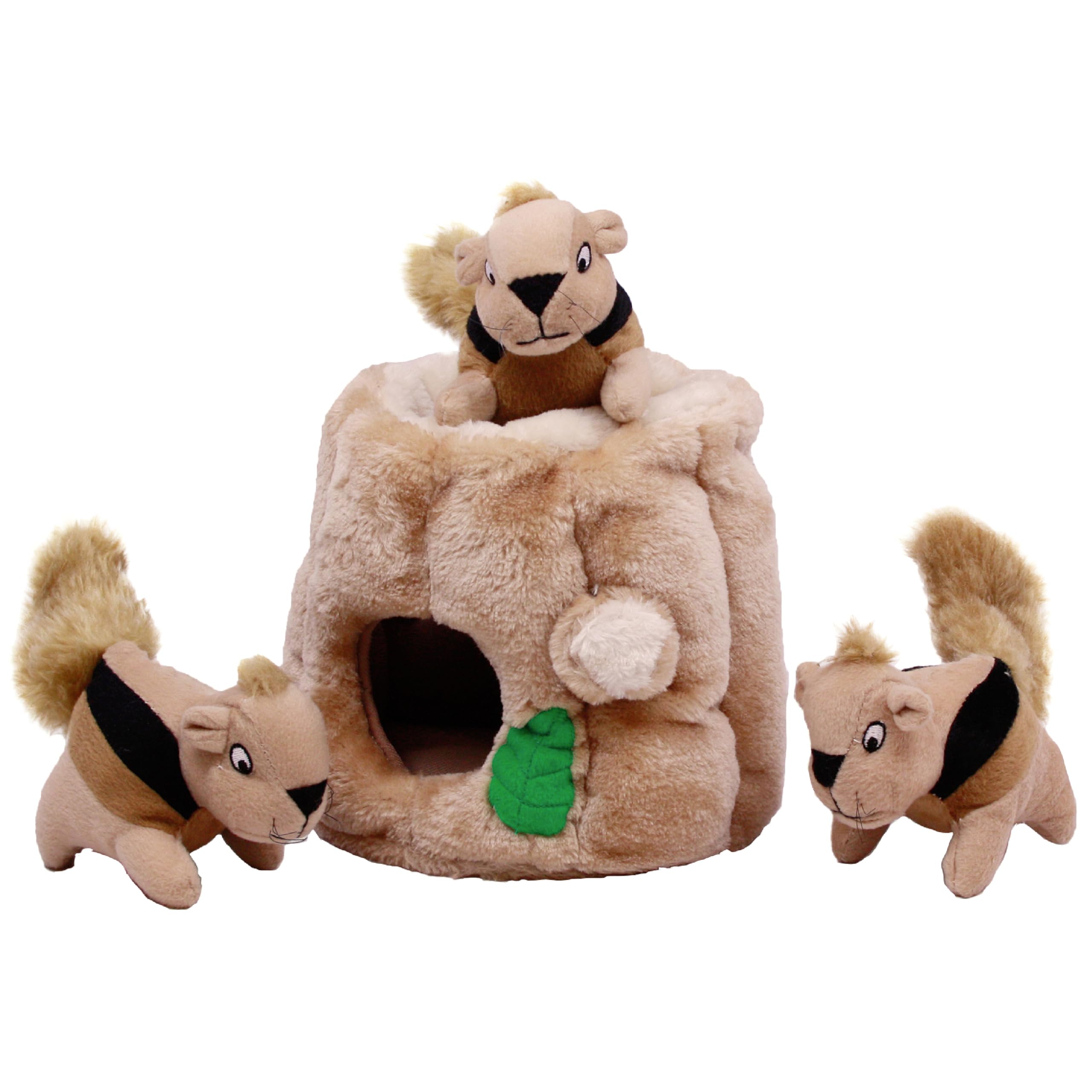
This is a plush ‘tree trunk’ with three squeaky squirrels tucked inside. Your dog pulls the squirrels out, you stuff them back in, and the game repeats. It is not the hardest puzzle on this list — the mechanism is identical every time — but it is the one fearful dogs and toy-driven breeds enjoy most, because it feels like ‘hunting’ rather than ‘working’.
We recommend it for dogs who are nervous of plastic-clattering puzzles, for small breeds who find the rotating-disc puzzles too physical, and for the early stages of confidence-building. Pair it with a refused-treat reward (you ‘find’ a treat in the trunk after the squirrels come out) and even reluctant dogs catch on quickly.
Worth flagging: this is a fabric toy with squeakers. It is not built for chewing, and a determined Labrador will dismember it in an afternoon. Use it as an interactive game and put it away between sessions.
What we like:
- Soft and unintimidating — good for nervous dogs
- Squeakers genuinely motivate — great for low-drive dogs
- Three difficulty sizes (Junior, Small, Large, Ginormous)
- Replacement squirrels sold separately
Worth knowing:
- Not chew-proof — supervise destructive dogs
- Hand-wash only — fabric and squeakers are not dishwasher-safe
- Mechanism is the same every time — limited long-term challenge
Specifications:
- Sizes available: Junior (3 squirrels), Small (3), Large (6), Ginormous (6)
- Material: plush polyester with squeakers
- Suitable for: small breeds and gentle medium breeds
- Hand-wash on a cool cycle
7. Trixie Mad Scientist
Best for: advanced puzzle veterans and households happy to supervise.
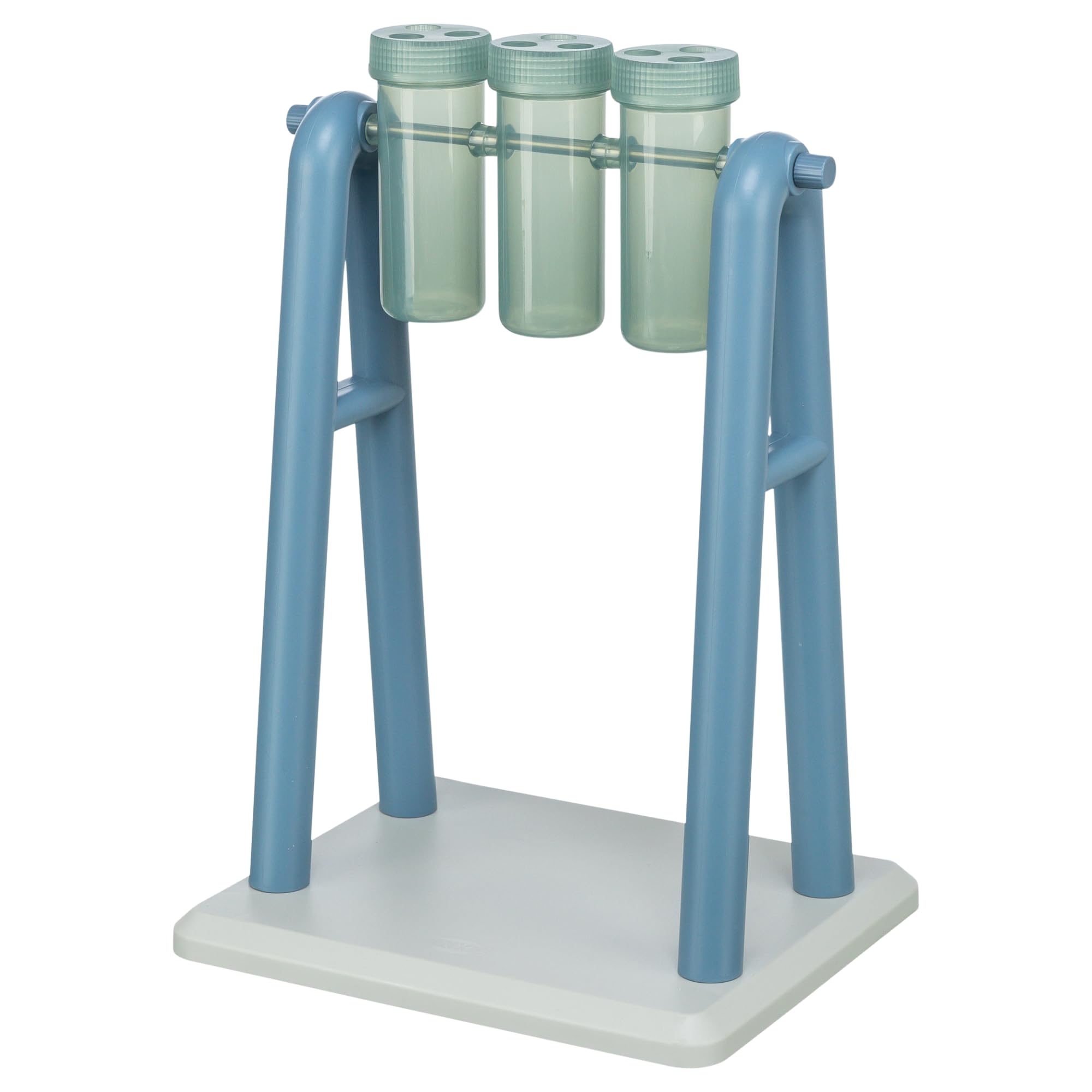
Mad Scientist is a single base with three rotating ‘flasks’ that the dog has to spin upside-down to release the treats. There is no real way to solve it by brute force — the dog has to work out that nudging the flask in the right direction tips the food out. We tend to recommend it after the Dog Tornado, for dogs whose owners are running out of ways to challenge them.
Plan to supervise. The flasks come off the base, which is part of the cleaning design, but a clever dog will work out that they can simply lift the entire flask, walk away with it, and chew it open. Used in front of you, it is one of the most interesting puzzles on the UK market.
Worth knowing: it is at the pricier end of the Trixie range, and the difficulty is genuinely high. Do not buy this as a first puzzle — you will create frustration rather than enrichment.
What we like:
- True advanced puzzle — clever dogs cannot solve it in one go
- Multiple flasks let you stagger difficulty per session
- Replacement flasks available if any get chewed
- Same value-for-money pricing as the rest of the Trixie range
Worth knowing:
- Flasks are removable — supervise to prevent chewing
- Not for beginners — frustration is real
- Hand-wash only
Specifications:
- Difficulty level: 4 (expert)
- Dimensions: approximately 32cm diameter base
- Material: ABS plastic
- Suitable for: medium and large breeds, 6 months and up
What to look for when buying a dog puzzle toy
Match the difficulty to your dog
A puzzle that is too hard is not enrichment — it is frustration. A puzzle that is too easy will be solved in thirty seconds and never picked up again. Start one level below where you think your dog is and build up. Nina Ottosson and Trixie both label their puzzles 1 (beginner) to 4 (expert), and those labels are honest.
Interactive versus solo
Most dog puzzles are interactive — you supervise, refill and coach. Only a small number, like the Kong Wobbler, are designed to be left with the dog alone. Decide which problem you are solving. If you need something to occupy your dog while you take a Zoom call, a solo puzzle or a LickiMat is the answer. If you want to spend ten focused minutes with your dog after work, a board puzzle is better.
Puzzle types explained
- Slider boards (e.g. Dog Brick): treats hide under sliding tiles or lift-up covers
- Rotating puzzles (e.g. Dog Tornado, Mad Scientist): layers or flasks turn to reveal compartments
- Roll-and-release feeders (e.g. Kong Wobbler): kibble drops out as the dog pushes the toy around
- Snuffle and lick mats (e.g. LickiMat): texture-based ‘find the food’ enrichment
- Plush hide-and-seek (e.g. Hide-A-Squirrel): soft toy components hidden inside a larger toy
Size guide
Match the puzzle to your dog’s mouth and paw size, not just their weight:
- Small dogs (under 10kg): Trixie Activity Flip Board, LickiMat Buddy, Hide-A-Squirrel Junior
- Medium dogs (10-25kg): Dog Brick, KONG Wobbler Small, Dog Tornado
- Large dogs (25-40kg): Dog Tornado, KONG Wobbler Large, Mad Scientist
- Giant dogs (40kg+): Use the largest version available, and always supervise — most puzzles are not built for giant breed strength
How much should you spend?
- Budget (under £15): A LickiMat Buddy and a Trixie Activity Flip Board covers most beginner needs
- Mid-range (£15-£30): The full Nina Ottosson Dog Brick and a KONG Wobbler make a complete enrichment toolkit
- Premium (£30+): Nina Ottosson Dog Tornado, Trixie Mad Scientist, or one of the wooden Karlie puzzles for advanced dogs
Frequently asked questions
How often should I use a puzzle toy?
Daily is fine, but rotate. Three or four puzzles used on rotation will keep a dog engaged far longer than one puzzle used every day. A bored brain stops trying — variety is the point.
My dog gives up after thirty seconds. What now?
The puzzle is too hard, or the food is not interesting enough. Drop a difficulty level (remove the bones from a Nina Ottosson, only use a couple of the compartments on a Trixie board), and use higher-value food — cooked chicken, cheese cubes or freeze-dried treats rather than dry kibble.
Can I use puzzle toys with puppies?
Yes, from about four months, with supervision. Use the simplest puzzles (LickiMat, Hide-A-Squirrel Junior, the lift-up covers on a Dog Brick without the sliders) and keep sessions short. Puppies tire quickly mentally.
Are wooden or plastic puzzles better?
Plastic puzzles are easier to clean, more durable and cheaper. Wooden puzzles (Karlie, some Trixie ranges) look better and feel more premium, but they cannot be dishwashed and they soak up smells from wet food. For most UK households, BPA-free plastic is the practical choice.
My dog destroys puzzle toys. What can I do?
Switch to puzzles without removable parts. The KONG Wobbler is one piece of thick plastic with no chewable components, which makes it the best choice for destructive dogs. Avoid plush puzzles like Hide-A-Squirrel entirely for any dog who has form for dismembering toys.
Final Verdict
For most UK dogs, a Nina Ottosson Dog Brick plus a LickiMat Buddy is the kit we would buy on day one — between them they cover beginner problem-solving and calm enrichment, and you will not outgrow them quickly. Step up to the Dog Tornado or the Trixie Mad Scientist once your dog has earned it; reach for the KONG Wobbler if what you actually need is solo enrichment rather than a thinking puzzle. Spend your money on the mechanisms, not the brand names — Trixie at £18 will out-deliver some premium puzzles at £40.