If you share your home with a spaniel, setter or any long-eared breed, you will know the daily battle of soggy, muddy ears trailing through the food bowl and dragging through wet grass. A dog snood is the simple fabric tube that solves it, gently gathering those ears up and out of harm’s way at mealtimes, on walks and in the car. The same stretchy tube also keeps a dog’s neck and ears warm on frosty mornings, and can take the edge off a nervous dog during fireworks or a stressful journey.
Snoods are inexpensive and easy to use, but the right one depends on the job, from a feeding snood to a cosy fleece or a high-visibility version for dark walks. Below we round up the best dog snoods in the UK for 2026, with a buying guide to help you choose the right size, material and style.
Quick Comparison Table
| Product | Best For | Price Range | Rating |
| Stretch Feeding Snood | Best all-rounder for long-eared breeds | £8-16 | ⭐⭐⭐⭐⭐ |
| Fleece Winter Snood | Best for warmth on cold walks | £10-20 | ⭐⭐⭐⭐⭐ |
| Adjustable Toggle Snood | Best for a secure, custom fit | £9-18 | ⭐⭐⭐⭐ |
| Budget Cotton-Blend Snood | Budget pick for everyday use | £4-9 | ⭐⭐⭐⭐ |
| High-Visibility Reflective Snood | Best for dark and winter walks | £10-18 | ⭐⭐⭐⭐ |
The Best Dog Snoods Reviewed
Stretch Feeding Snood
Best for: spaniels, setters and other long-eared dogs at mealtimes.
The stretch feeding snood is the one we would reach for first, because it does the single most useful job a snood can do: it keeps those long, feathered ears out of the food and water bowl. Made from a soft, four-way-stretch jersey or lycra-blend fabric, it slips over the head and gently gathers the ears against the neck, so a cocker or springer can tuck into dinner without dunking its ears in gravy or trailing them through the water. That means less mess, fewer soggy ears and far less need for constant ear cleaning.
The stretchy material is the key to why it works so well. It is snug enough to stay put while your dog eats or pads around the garden, but soft and light enough that most dogs forget they are wearing it within moments. A good feeding snood covers just the ears and upper neck without pulling on the throat, and because it is a simple tube of fabric it slips on and off in seconds. Many are machine washable, so when it inevitably picks up a splash of dinner it goes straight in the wash and comes out fresh.
The main things to weigh up are size and fabric weight. Too loose and it slides off, too tight and your dog will resist wearing it, so getting the measurement right around the head and neck matters more than with almost any other accessory. A lightweight stretch fabric is ideal indoors and in mild weather, though it offers little warmth outdoors in winter. For keeping ears clean and dry at feeding time, though, this is the standout everyday choice.
What we like:
- Keeps long ears out of food and water bowls
- Soft four-way stretch stays put without pulling
- Slips on and off in seconds
- Machine washable for easy cleaning
Worth knowing:
- Needs accurate measuring for the right fit
- Lightweight fabric offers little winter warmth
- A determined dog may paw at it at first
Specifications:
- Material: four-way-stretch jersey or lycra blend
- Use: mealtimes, drinking, muddy garden trips
- Suitable for: cockers, springers, setters, dachshunds
- Care: machine washable on most models
Fleece Winter Snood
Best for: warmth on cold-weather walks and frosty mornings.
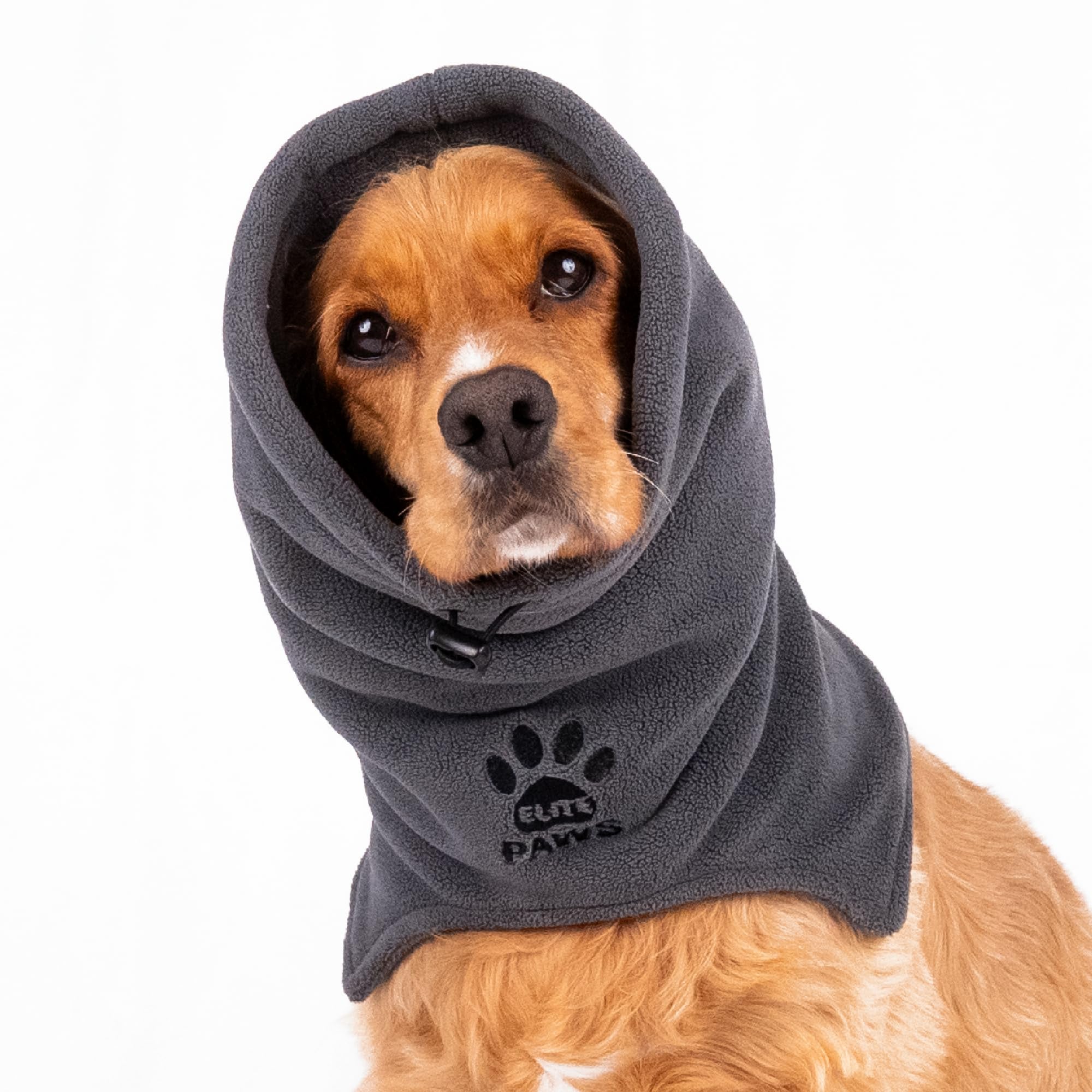
When the temperature drops, a fleece winter snood turns the humble ear-tube into a proper piece of cold-weather kit. Made from soft, insulating polar fleece, it wraps warmly around the neck and ears, protecting the areas that lose heat quickly on fine-coated and short-haired dogs. For whippets, greyhounds, Italian greyhounds and other lean breeds that feel the cold, a fleece snood paired with a coat makes winter walks far more comfortable, and it is a favourite for older dogs that struggle to keep warm.
Fleece is light, cosy and quick to dry, so it warms without the bulk or weight of thicker fabrics, and it does not soak up water the way cotton does. The stretch in most fleece snoods means it still slips on easily and hugs the neck without a fastening to fuss with, while the double layer of fabric traps a good amount of warmth. Many owners also find a fleece snood handy in the car and at home, giving a shivery dog a bit of extra comfort without wrapping it in a full coat.
The considerations are mostly about matching it to the weather. Fleece is warm but not waterproof, so in driving rain it will eventually get damp, though it still insulates better than most fabrics when wet and dries quickly afterwards. It is also more than most dogs need indoors in a heated home, where a lightweight stretch snood is plenty. As a warm, cosy layer for cold walks and chilly older dogs, though, a fleece winter snood is hard to beat.
What we like:
- Soft polar fleece keeps the neck and ears warm
- Light and cosy without heavy bulk
- Quick-drying and warm even when damp
- Ideal for lean breeds and older dogs in winter
Worth knowing:
- Not waterproof in heavy, driving rain
- Too warm for indoors in a heated home
- Fleece can attract fur and fluff
Specifications:
- Material: insulating polar fleece, stretch fit
- Use: cold walks, frosty mornings, car journeys
- Suitable for: whippets, greyhounds, senior dogs
- Care: machine washable, dries quickly
Adjustable Toggle Snood
Best for: dogs between sizes or those who need a secure fit.
If your dog sits awkwardly between standard sizes, or simply wriggles out of a plain stretch tube, an adjustable toggle snood gives you the control to get the fit just right. Instead of relying on stretch alone, it uses a drawstring and toggle at the neck opening that you cinch to your dog’s exact measurements. That means you can loosen it to slip over the head easily, then tighten it enough to hold the ears in place without it slipping off mid-walk or mid-meal.
This adjustability is genuinely useful for hard-to-fit dogs, whether that is a dog with a broad head and slim neck, a growing puppy, or a breed whose ears sit differently to the norm. A good toggle snood uses a soft cord and a smooth spring stopper so there is no rubbing, and the fabric is usually a comfortable cotton or fleece blend. Being able to fine-tune the fit also makes it more likely your dog will actually tolerate wearing it, since a snood that pinches or slides is one a dog quickly learns to dislike.
The trade-offs are simplicity and supervision. The toggle adds a small part that can, in theory, be chewed, so it is best used under supervision rather than left on an unattended dog, and you should always leave it comfortably loose around the throat. It is also marginally more fiddly than a pull-on snood, though only by a few seconds. For a dog that never quite suits an off-the-peg size, though, the custom fit is well worth it.
What we like:
- Drawstring toggle dials in a precise fit
- Holds position on hard-to-fit dogs
- Easy to loosen over the head, then tighten
- Comfortable cotton or fleece blend fabric
Worth knowing:
- Toggle is a small part best used supervised
- Slightly more fiddly than a plain pull-on
- Must be left loose around the throat
Specifications:
- Material: cotton or fleece blend with drawstring
- Feature: adjustable toggle for custom fit
- Suitable for: between-size and hard-to-fit dogs
- Care: machine washable; check toggle after washing
Budget Cotton-Blend Snood
Best for: a cheap, cheerful everyday snood for keeping ears clean.
If you just want to keep your dog’s ears out of the dinner without spending much, a budget cotton-blend snood covers the basics for the price of a coffee. These simple stretch tubes come in a wide range of colours and prints, wash easily and are widely stocked online and in pet shops. For a first snood, a spare to keep by the food bowl, or a second one for the car, it is an easy, low-risk buy that does the core job perfectly well.
Cotton-blend fabric is soft, breathable and comfortable against the skin, which suits dogs that are new to wearing a snood and might resist something heavier. Because they cost so little, you can keep two or three in rotation, so there is always a clean one ready while the others are in the wash, which is genuinely handy given how often a feeding snood picks up splashes. The cheerful designs also make them popular with owners who like to match the snood to a collar or coat.
The compromises are what you would expect at the price. A cotton blend has less stretch and recovery than a technical lycra or fleece fabric, so over time it can loosen or bobble, and it soaks up more water than synthetic fabrics, making it less suited to wet-weather warmth. The fit tends to be more basic too, with fewer size options. For everyday ear protection at home on a tight budget, though, it is a sensible and cheerful choice.
What we like:
- Very affordable and widely available
- Soft, breathable and comfortable to wear
- Lots of colours and prints to choose from
- Cheap enough to keep several in rotation
Worth knowing:
- Less stretch and recovery than technical fabrics
- Cotton soaks up water, so poor for wet warmth
- Basic fit with fewer size options
Specifications:
- Material: cotton-blend stretch fabric
- Use: everyday indoor ear protection at mealtimes
- Suitable for: dogs new to wearing a snood
- Care: machine washable, quick to wash and rotate
High-Visibility Reflective Snood
Best for: dark early-morning and winter evening walks.
For anyone walking a dog in the dark half of the year, a high-visibility reflective snood adds a valuable safety layer to the usual ear protection and warmth. Made in bright fluorescent fabric, usually orange or yellow, and trimmed with reflective strips or piping, it makes your dog far easier to see for drivers and cyclists at dusk, dawn and after dark. On a lean, dark-coated dog that vanishes into a hedgerow, that extra visibility around the head and neck is genuinely reassuring.
Many high-vis snoods pair the reflective fabric with a fleece or fleece-lined construction, so they keep the neck and ears warm as well as visible, which makes them a natural choice for cold-weather walks specifically. The reflective elements catch headlights and torch beams and throw the light back brightly, while the fluorescent base colour does the work in the low daylight of a grey winter afternoon. Worn alongside a reflective harness or collar, a hi-vis snood helps build a head-to-tail visible outline.
The considerations are that visibility works best as a complete package, so a snood alone is no substitute for a proper reflective harness, lead or light on a truly dark route. The bright colours are also less to everyone’s taste for daytime wear, though that is purely cosmetic. As an affordable way to add warmth and a meaningful boost to how easily your dog is seen on dark walks, though, a high-visibility reflective snood earns its place in the winter kit bag.
What we like:
- Bright fluorescent fabric stands out in low light
- Reflective strips catch headlights and torches
- Often fleece-lined for warmth as well as visibility
- Adds a safety layer for dark-coated dogs
Worth knowing:
- Not a substitute for a full reflective set-up
- Bright colours less popular for daytime wear
- Reflective effect needs a light source to work
Specifications:
- Material: fluorescent fabric with reflective trim
- Use: dawn, dusk and after-dark winter walks
- Suitable for: dogs walked in low-light conditions
- Care: machine washable; check reflective strips
Calming Compression Snood
Best for: nervous dogs during fireworks, storms and travel.
Some snoods are designed to soothe rather than protect ears, and a calming compression snood works on the same principle as a swaddle or an anxiety wrap. Made from a firm, gently stretchy fabric, it applies light, even pressure around the neck and ears, which many dogs find reassuring in the way a snug hug can be calming. For dogs that struggle with fireworks, thunderstorms, vet visits or car travel, it offers a drug-free bit of extra comfort that some owners find takes the edge off the worst of the anxiety.
The gentle compression also muffles sound a little around the ears, which can help with noise-sensitive dogs on firework night, and the snug, enclosed feeling gives an anxious dog a sense of security. It is easy to slip on when you can see a stressful event coming, whether that is a long journey or an approaching storm, and just as easy to remove once your dog has settled. Because it is soft and light, most dogs accept it readily once they are used to the sensation.
The honest caveat is that results vary from dog to dog: pressure wraps help some anxious dogs noticeably and do little for others, so it is worth thinking of it as one tool among several rather than a guaranteed fix. It is best introduced calmly and positively before a stressful event, not forced on in the middle of a panic, and severe anxiety is always worth discussing with your vet. As a gentle, non-medical aid for a worried dog, though, it is well worth trying.
What we like:
- Gentle even pressure can soothe anxious dogs
- Helps muffle sound around the ears
- Drug-free comfort for fireworks, storms and travel
- Quick to slip on before a stressful event
Worth knowing:
- Effect varies from dog to dog
- Best introduced calmly, not during a panic
- Not a replacement for veterinary advice on anxiety
Specifications:
- Material: firm, gently stretchy compression fabric
- Use: fireworks, thunderstorms, vet and car trips
- Suitable for: mildly to moderately anxious dogs
- Care: machine washable on a gentle cycle
Dog Snood Buying Guide
What to look for when buying a dog snood
Start with the job you need the snood to do, because it points you straight to the right type. If the aim is keeping long ears out of the food and water bowl, a lightweight stretch feeding snood is ideal. If it is warmth on cold walks, choose an insulating fleece. If your dog is anxious, a calming compression snood is worth trying, and if you walk in the dark, a high-visibility reflective version adds a safety layer to whichever of those jobs matters most.
Whatever the type, fit and comfort come first. A snood should be snug enough to stay in place and hold the ears without pulling on the throat, but never tight around the neck, and you should always be able to slip two fingers underneath comfortably. Look for soft, non-rubbing fabric, a good four-way stretch or an adjustable fastening for an accurate fit, and easy machine washing, since a feeding snood in particular will need frequent cleaning.
Dog snood types explained
Feeding snoods are the everyday standard: light stretch tubes that gather the ears out of the food and water, ideal for spaniels, setters and dachshunds. Fleece snoods add warmth, wrapping the neck and ears against the cold, and suit lean and older dogs on winter walks. Adjustable toggle snoods use a drawstring for a custom fit, which helps hard-to-fit or between-size dogs.
High-visibility snoods use bright, reflective fabric to make a dog easier to see in low light, often with a fleece lining for warmth too. Calming compression snoods apply gentle pressure to soothe anxious dogs during fireworks, storms or travel. There is no single best type; the right one depends on whether your priority is clean ears, warmth, a secure fit, visibility or comfort, and many owners end up with more than one for different situations.
Getting the size right
A snood only works if it fits, so measure before you buy rather than guessing from your dog’s breed. The key measurements are the circumference of the neck where the snood will sit, and the length from behind the ears down the neck, and most makers provide a size chart matching these to small, medium and large. If your dog falls between two sizes, an adjustable toggle snood is the safest bet, otherwise size to the neck measurement and check the length covers the ears.
Fit should be snug but never tight. The snood needs to be close enough to hold the ears gently in place and stay put while your dog eats or walks, but you should always be able to slide two fingers between the fabric and the neck. Watch a new snood in use for the first few wears to make sure it is not slipping off or riding up over the throat, and check a growing puppy’s fit regularly, as they will outgrow a snug snood surprisingly quickly.
How much should you spend?
Snoods are inexpensive, so there is no need to overspend to get a good one. A basic cotton-blend snood costs around £4 to £9 and covers the essentials, while a quality stretch feeding snood, which is where most owners land, typically runs £8 to £16 depending on size and fabric. A fleece winter snood, an adjustable toggle version or a high-visibility reflective one sits a little higher, usually £10 to £20.
For most homes the sweet spot is a mid-priced stretch feeding snood at around £8 to £16, which buys a soft, durable, well-fitting tube that keeps ears clean for a long time. It is worth adding a fleece snood if you have a cold-sensitive dog, or a high-vis one for dark walks, since each does a job a plain feeding snood cannot. Buying two inexpensive snoods to rotate is often more useful than spending big on a single premium one.
Frequently asked questions
What is a dog snood actually for?
A dog snood is a soft fabric tube that slips over the head to gather a dog’s ears and cover the neck. Its most common use is keeping long, feathered ears out of the food and water bowl at mealtimes, which stops them getting soggy and dirty. Snoods are also used to keep the neck and ears warm in cold weather, to add high-visibility on dark walks, and, in compression versions, to help calm anxious dogs.
Which breeds benefit most from a snood?
Long-eared breeds benefit most at feeding time, including cocker and springer spaniels, setters, basset hounds, dachshunds and afghan hounds, whose ears hang straight into the bowl. For warmth, lean and fine-coated breeds such as whippets, greyhounds and Italian greyhounds get the most from a fleece snood, along with older dogs that feel the cold. Any breed can use a snood, but these are the ones owners reach for most.
How should a dog snood fit?
A snood should be snug enough to stay in place and hold the ears gently, but never tight around the neck. As a rule, you should be able to slide two fingers comfortably between the fabric and your dog’s neck. Measure the neck circumference and the length from behind the ears down the neck, and use the maker’s size chart. If your dog is between sizes, choose an adjustable toggle snood for the safest fit.
Can my dog wear a snood all day?
A lightweight snood can be worn for extended periods at home, but it is best to give your dog breaks and to remove it overnight or when unsupervised, particularly any snood with a toggle or drawstring. Always check the fit is not too tight and that your dog is comfortable and behaving normally. For feeding, many owners simply pop the snood on at mealtimes and take it off again afterwards.
How do I clean a dog snood?
Most snoods are machine washable, which is just as well given how often a feeding snood picks up splashes of dinner. Wash it on a gentle cycle with your dog’s other washable kit, avoid harsh detergents that could irritate the skin, and air-dry or tumble on low. Fleece dries especially quickly. Check any toggle or reflective trim after washing, and keeping a spare snood in rotation means there is always a clean one ready.
Conclusion
For most dogs a stretch feeding snood is the one to buy: it keeps long ears clean and dry at mealtimes, slips on and off in seconds, washes easily and costs very little. Measure carefully for a snug but comfortable fit, and it will save you endless soggy-ear clean-ups.
If your dog feels the cold, add a fleece winter snood for walks, while a high-visibility reflective version is the smart pick for dark mornings and evenings. Choose an adjustable toggle snood for a hard-to-fit dog, a budget cotton-blend snood for cheap everyday use, and a calming compression snood if fireworks or travel leave your dog anxious.