Choosing a guinea pig cage in the UK is harder than it should be. Most pet shop cages are still too small, the welfare guidance has tightened, and a wave of imported plastic-base “starter kits” muddies the picture. The RSPCA and the Rabbit and Guinea Pig Welfare Fund (RWAF) recommend a minimum of 120 cm × 60 cm of floor space for a bonded pair — and most experienced owners and rescues now push that to 150 cm × 60 cm or larger. Guinea pigs are sociable and surprisingly active, and they need room to popcorn, zoom and pick a favourite hidey-hole.
We’ve spent weeks comparing the best-known guinea pig cages on the UK market — from the Cubes-and-Coroplast (C&C) systems used by most rescues, to plastic-base pet shop classics, to outdoor options for households with no indoor space. Below are six cages we’d genuinely recommend in 2026, with honest notes on what each does well and where it falls short.
Quick Comparison
| Product | Best For | Price Range | Rating |
| Kavee C&C 2×5 Cage with Stand | Best overall — bonded pair indoors | £130–£170 | ★★★★★ |
| Ferplast Cavie 100 Plus | Best traditional pet shop starter | £45–£65 | ★★★ |
| Pets at Home Mansion Indoor Cage | Best high-street pick to see in store | £85–£110 | ★★★★ |
| Liberta Retreat Tall Wide Cage | Best multi-level indoor cage | £80–£100 | ★★★★ |
| Omlet Eglu Go Guinea Pig Hutch | Best outdoor option, year-round | £230–£310 | ★★★★ |
| Trixie natura Wooden Outdoor Hutch | Best budget outdoor hutch with run | £120–£170 | ★★★★ |
Our Top Picks
1. Kavee C&C 2×5 Indoor Cage with Stand and Coroplast Base
Best for: a bonded pair of indoor guinea pigs and the closest off-the-shelf option to UK welfare guidelines.
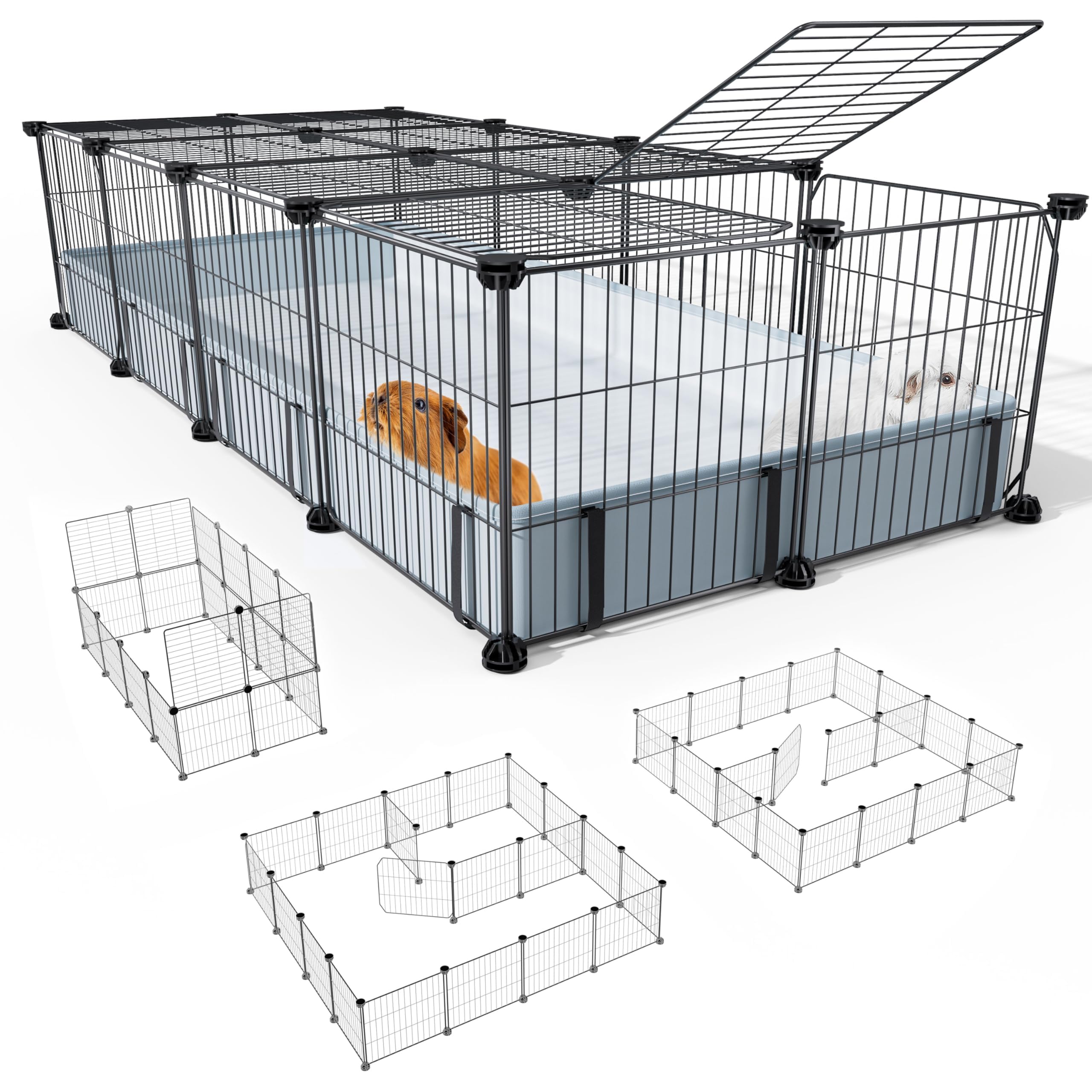
If you ask any UK guinea pig rescue what cage they’d recommend, the answer is almost always a Kavee C&C — and for good reason. The “cubes and coroplast” system uses interlocking grid panels that build up into a sturdy enclosure, lined with a single piece of food-safe corrugated plastic that contains bedding without seams that hold odour. The 2×5 footprint (around 147 × 76 cm) clears the RSPCA minimum and gets close to the more spacious RWAF guidance for two adult guinea pigs.
What sets Kavee apart from generic Amazon C&C kits is the quality of the components. The grids are 14-gauge welded wire (not the thinner 16-gauge that bows under heavy hidey-holes), the coroplast is genuinely UK-sourced, and the included stand keeps the cage at a comfortable cleaning height. You can extend it with add-on grids, add a second-storey loft, or change the colour of the base. It’s the cage we’d buy if we were starting again.
What we like:
- Modular design — extend, reshape or split for floor-time
- Welded steel grids feel reassuringly solid
- Coroplast base lifts out for thorough cleaning
- Closest off-the-shelf option to UK welfare guidance for a pair
- Strong UK customer support and replacement parts
Worth knowing:
- Higher upfront cost than plastic-base cages
- Requires assembly — about 30–40 minutes for the 2×5
- Open-top design means cats and dogs need supervision
- Footprint is large — measure your space before ordering
Specifications:
- Dimensions: 147 × 76 × 38 cm (cage); stand approximately 90 cm tall
- Materials: 14-gauge welded steel grids, corrugated polypropylene base, powder-coated steel stand
- Suitable for: 2 guinea pigs (RSPCA-compliant for a bonded pair)
- Indoor/outdoor: indoor
2. Ferplast Cavie 100 Plus
Best for: an entry-level plastic-base cage you can find at most pet shops and on Amazon UK.
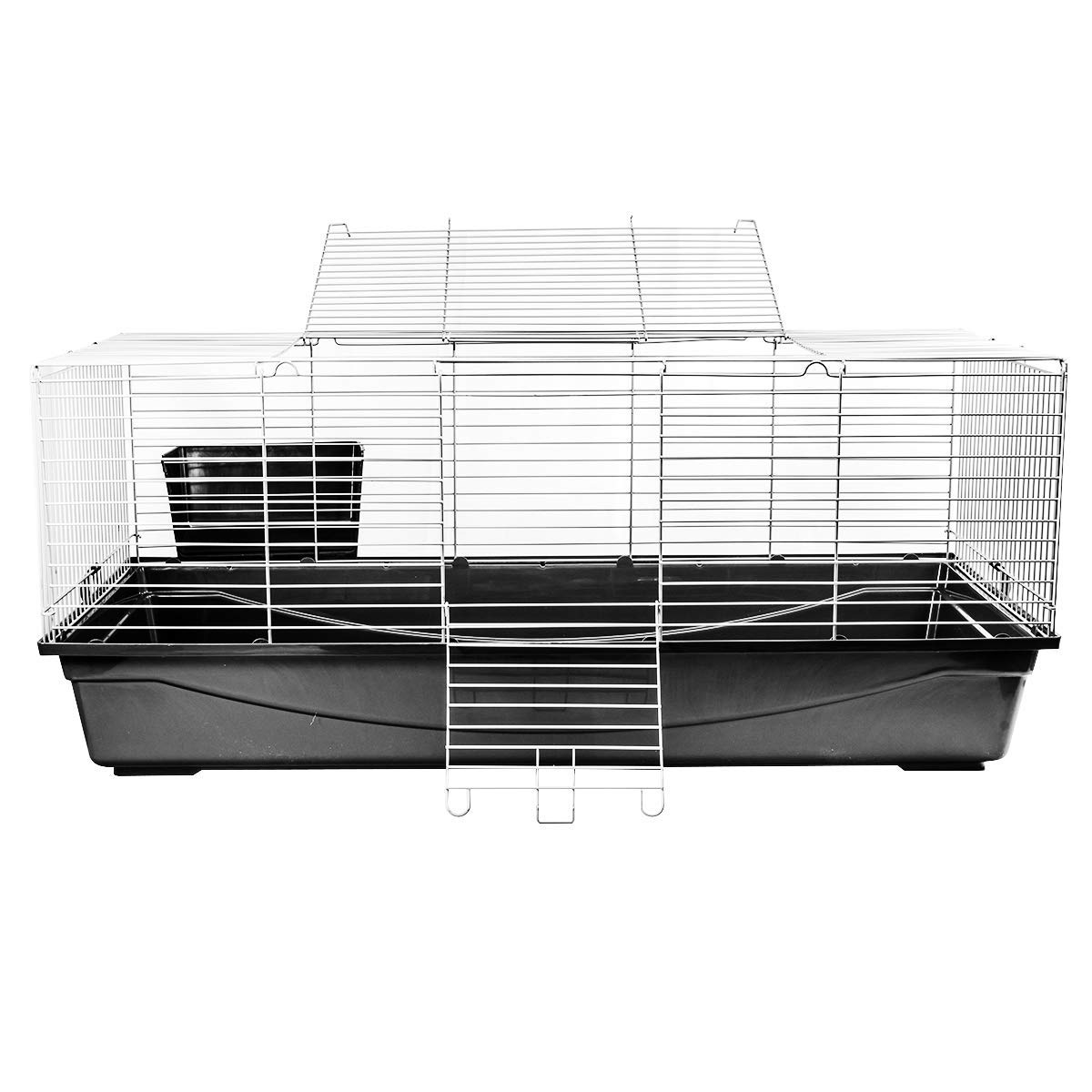
The Cavie 100 Plus is the cage many UK owners start with — it’s stocked widely, costs around £55, and arrives with a starter pack of accessories (water bottle, hayrack, food bowl, plastic shelter). The 100 cm width is also the cage’s biggest weakness: it falls short of the RSPCA minimum for a pair, and we’d only recommend it for a single guinea pig with regular floor-time, or as a temporary base while you build out a larger setup.
The build quality is decent for the money. The plastic base is deep enough to contain shavings or fleece, the wire top latches securely with metal clips, and a top-opening hatch makes daily handling easier than fully wire cages. Cleaning is straightforward — unclip the top, tip out the base, wash with a pet-safe disinfectant. As a starter cage that will need upgrading, it’s hard to fault for the price.
What we like:
- Affordable entry point at around £55
- Includes basic accessories — useful for first-time owners
- Top-opening hatch makes lifting guinea pigs easier
- Widely stocked at Pets at Home, Jollyes and Amazon UK
Worth knowing:
- 100 cm is too small as a permanent home for a pair
- Plastic clips wear over time — check during deep cleans
- Included water bottle is small (350 ml) — plan to upgrade
- Wire spacing isn’t suitable for very young pups
Specifications:
- Dimensions: 100 × 60 × 50 cm
- Materials: ABS plastic base, powder-coated wire top
- Suitable for: 1 adult guinea pig with daily floor-time
- Indoor/outdoor: indoor
3. Pets at Home Mansion Indoor Guinea Pig Cage
Best for: a high-street option you can see in person and pick up the same day.
Pets at Home’s two-tier “Mansion” indoor cage is the cage we’d suggest first for owners who want to see something in the flesh before buying. At around £95 in store and online, it’s a 121 cm wide cage with a hinged top, a removable plastic ramp and an enclosed second-tier sleeping platform. It looks tidy in a kitchen or living room, and is an obvious step up from a plastic Cavie — both in floor area and in usable height.
Two caveats. First, the 121 cm width is just at the RSPCA minimum for a pair — fine, but no margin for spoiling them. Second, the wire spacing is generous and the second-tier ramp is steep; very young guinea pigs (under three months) can struggle, and we’d block the ramp until they’re older. As a single-piece purchase that’s easy to bring home, though, it’s a sensible mid-range pick.
What we like:
- Sold in-store across the UK — see before you buy
- Two-tier design adds usable space in a small footprint
- Hinged roof makes daily handling and cleaning quick
- Fits between a Cavie and a C&C in price and quality
Worth knowing:
- Width is exactly at the welfare minimum — no slack
- Ramp is steep for young or older guinea pigs
- Plastic shelf takes effort to deep-clean
- Heavier than it looks once filled with bedding
Specifications:
- Dimensions: 121 × 60 × 90 cm
- Materials: powder-coated wire, plastic base and shelf, plastic ramp
- Suitable for: 2 adult guinea pigs (just at the RSPCA minimum)
- Indoor/outdoor: indoor
4. Liberta Retreat Tall Wide Cage
Best for: a multi-level indoor cage when floor space is limited.
The Liberta Retreat (sometimes sold as the Liberta Explorer) is a three-tier cage originally designed for ferrets but widely repurposed for guinea pigs by UK owners with no room for a 150 cm-wide setup. The base level gives roughly 102 × 62 cm of floor — enough for a single piggy with floor-time, or a pair if you remove the upper tiers and use the bottom only. The advantage is height: the cage stretches up to about 150 cm, with platforms and ramps that suit older, calmer guinea pigs that won’t scramble down.
We’d recommend this cage with an asterisk. Guinea pigs aren’t natural climbers — unlike rats or ferrets — and steep ramps can cause injuries. If you go with the Retreat, gently slope the ramps with extra carpet or fleece, place hideys at every level, and don’t use the highest platforms for very small or arthritic pigs. As a flexible, attractive cage in a flat or small house, it’s still a thoughtful pick.
What we like:
- Vertical footprint suits flats and small homes
- Powder-coated steel feels well-made
- Wheeled base makes moving for cleaning easier
- Doors at every level — handling is straightforward
Worth knowing:
- Designed for ferrets — ramps need adapting for guinea pigs
- Floor space at base is below the RSPCA minimum for a pair alone
- Platforms can be slippery without fleece toppers
- Assembly takes about an hour
Specifications:
- Dimensions: 102 × 62 × 150 cm
- Materials: powder-coated steel, plastic shelves and trays
- Suitable for: 1 guinea pig, or a pair with daily floor-time and ramp adaptations
- Indoor/outdoor: indoor
5. Omlet Eglu Go Guinea Pig Hutch
Best for: an outdoor home that’s genuinely insulated and easy to clean.
The Eglu Go is Omlet’s twin-walled plastic guinea pig hutch, and it’s the cage we’d recommend to anyone keeping their pigs outside year-round. The double-walled construction acts like a thermos flask — the pigs’ body heat warms the air gap and the insulating sealed roof slows night-time cooling. Compared with thin pine “pet shop” hutches that lose heat rapidly, the Eglu copes far better with British winters without a lot of fuss.
Practically, the Eglu is the easiest cage to clean we’ve used. Slide-out trays catch droppings, the moulded plastic interior wipes down with one swipe, and there are no joints for ammonia to soak into. The default “Go” hutch is small for a pair on its own, so we’d budget for the matching 2 m run from day one. It isn’t cheap — expect around £290 with the run — but the build quality and 10-year guarantee make it good long-term value.
What we like:
- Twin-walled insulation copes with UK winters
- Wipe-clean plastic — no wood preservative, no felt to replace
- 10-year guarantee from a UK-headquartered company
- Optional fox-resistant run integrates cleanly
Worth knowing:
- Expensive — significantly more than wooden equivalents
- The Go hutch alone is too small for a pair without the run
- Lighter than a wooden hutch — needs anchoring on exposed sites
- Plastic appearance won’t suit every garden
Specifications:
- Dimensions: 84 × 62 × 53 cm (hutch); 200 × 75 × 70 cm (with optional run)
- Materials: twin-walled UV-stabilised polypropylene, galvanised wire run
- Suitable for: 2 guinea pigs (with run)
- Indoor/outdoor: outdoor (year-round suitable)
6. Trixie natura Wooden Outdoor Hutch with Run
Best for: a traditional outdoor wooden hutch on a sensible budget.
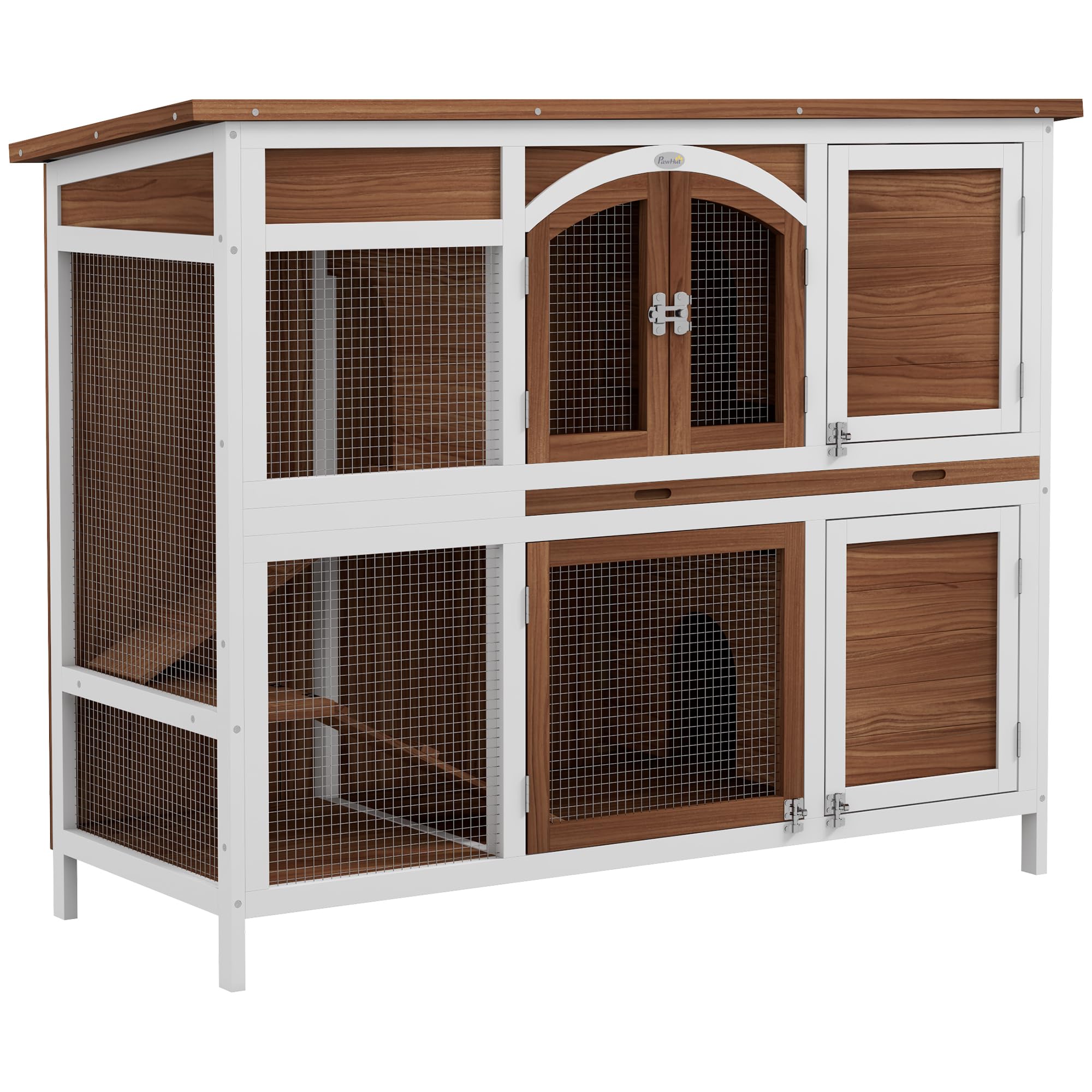
Trixie’s natura range is a sensible compromise for owners who want a wooden outdoor hutch without paying handcrafted-British prices. The natura two-storey 116 cm hutch with attached run gives guinea pigs a sheltered upper sleeping area and a floor-level mesh run for daytime grazing — useful when you can’t supervise free-time. Construction is glazed pine with a felted, sloped roof and an integrated wire run; assembly is straightforward and well-documented.
We’d treat it as a starter outdoor home rather than a forever cage. The pine is thinner than UK-handcrafted equivalents, and the felt roofing typically needs replacing every two to three years. Pair it with a thick straw bedding layer, a waterproof hutch cover and a draught-blocking position against a wall or fence, and most healthy adult guinea pigs will be perfectly happy in a typical UK winter.
What we like:
- Affordable for a wooden outdoor hutch with run
- Two-tier design — separates sleeping and grazing
- Felted roof and pull-out tray are useful for cleaning
- Available across most large pet retailers
Worth knowing:
- Pine is thinner than UK-handcrafted alternatives
- Felt roof typically needs replacing within 2–3 years
- Wire run alone isn’t fox-proof — supervise or upgrade
- Annual wood treatment recommended
Specifications:
- Dimensions: 116 × 97 × 95 cm
- Materials: glazed pine, galvanised wire, felted roof
- Suitable for: 2 guinea pigs (just within RSPCA minimum with run)
- Indoor/outdoor: outdoor
Buying Guide: How to Choose the Best Guinea Pig Cage
What to Look For
Floor space is the single most important factor — height and accessories matter much less than uninterrupted ground for popcorning and zoomies. Aim for a minimum 120 cm × 60 cm for two guinea pigs (the RSPCA standard), and 150 cm × 60 cm or more if you have the room. Alongside space, look for: solid, easy-to-clean flooring (coroplast, ABS plastic or sealed wood); 14-gauge or stronger welded wire if the cage is open-top; secure latches on every door; and good ventilation without large gaps that allow draughts.
Types of Guinea Pig Cage
Plastic-base cages (Cavie 100, Living World) are budget pet-shop classics — affordable but limited on space. C&C cages (Kavee and others) use modular grids and a coroplast base — the gold standard for indoor welfare and the cage most rescues use. Multi-tier indoor cages (Liberta Retreat, Pets at Home Mansion) trade footprint for height, suiting flats and small houses. Outdoor wooden hutches (Trixie natura, Home & Roost) suit gardens and sheds; insulated plastic hutches (Omlet Eglu Go) are the easiest-clean outdoor option.
Size Guide
- Single guinea pig (rare — pairs are recommended): 120 × 60 cm minimum
- Bonded pair: 120 × 60 cm minimum (RSPCA), 150 × 60 cm preferred
- Trio: 150 × 60 cm minimum, 180 × 60 cm preferred
- Quartet: 180 × 60 cm minimum, larger preferred
If you’re considering one guinea pig on its own, please reconsider — guinea pigs are sociable herd animals, and welfare bodies across the UK consider a pair the welfare minimum. Most rescues will only adopt to homes prepared to keep them in groups of two or more.
How Much Should You Spend?
- Budget (under £80): plastic-base pet shop cages (Cavie 100) — single pig only, used as a starter while you upgrade.
- Mid-range (£80–£170): C&C 2×4 grid cages, Pets at Home Mansion, Liberta Retreat — the realistic baseline for a pair indoors.
- Premium (£170+): Kavee C&C 2×5 with stand, Omlet Eglu Go with run, handcrafted UK outdoor hutches.
Frequently Asked Questions
Can a single guinea pig be kept on its own in a smaller cage?
Strongly not recommended. Guinea pigs are herd animals — UK welfare bodies including the RSPCA and RWAF treat keeping a single guinea pig as a welfare concern. Even if you’re around all day, you can’t replace another guinea pig’s company. If you only have space for a single 120 cm cage, please consider whether it’s the right pet, or commit to a slightly larger setup that allows for a pair.
Should the cage go indoors or outdoors?
Either can work. Indoor cages are easier for daily contact, less exposed to weather and predators, and let guinea pigs be part of family life. Outdoor hutches free up indoor space and give pigs more outdoor stimulation, but require careful predator-proofing, weather covers and bedding adjustments through winter. Most welfare experts would lean indoors for first-time owners.
Do guinea pigs need a hidey-hole inside the cage?
Yes — at least one hidey per pig, plus one extra. Guinea pigs are prey animals, and without a quiet retreat they can develop chronic stress that shows up as overgrooming, weight loss or aggression between cage mates. Wooden hideys, fabric tunnels and even cardboard boxes all work; the rule is that every pig should be able to vanish into cover whenever they choose.
How often should I clean a guinea pig cage?
Spot-clean wet patches and toilet corners daily, replace soiled bedding two to three times a week, and do a full strip-down (everything out, surfaces wiped with a pet-safe disinfectant, fresh bedding) once a week. Guinea pigs are sensitive to ammonia from urine, and respiratory infections are far more common in cages that aren’t cleaned often enough. A pull-out tray or coroplast base is the single feature that makes weekly cleaning manageable.
Final Verdict
For most UK households with a bonded pair of indoor guinea pigs, the Kavee C&C 2×5 Indoor Cage with Stand is the cage we’d choose — it gets closest to welfare guidelines out of the box, the build quality is genuinely good, and the system is endlessly extendable as your setup grows. If you want a high-street pick you can see and bring home the same day, the Pets at Home Mansion Indoor Guinea Pig Cage at around £95 is the most sensible mid-range option, provided you understand it’s right at the welfare minimum. For year-round outdoor housing, the Omlet Eglu Go is worth every penny of its premium.
Related posts:
Best Rabbit Hutch UK 2026,
Best Hamster Cage UK 2026,
Best Small Pet Bedding UK 2026