Quick Verdict
A cat tree gives your cat somewhere to climb, scratch, perch and nap, and there are two main types. A floor-to-ceiling tree is a tall, slim tower that braces between the floor and ceiling, while a freestanding tree stands on a wide base and does not need to touch the ceiling.
Floor-to-ceiling trees are best for small rooms and for cats that love height. Freestanding trees are best for large or heavy cats, for rented homes and for owners who want a bed, a cave and a scratching post in one. Both are good options, and the right one depends on your room and your cat.
What Is a Floor-to-Ceiling Cat Tree?
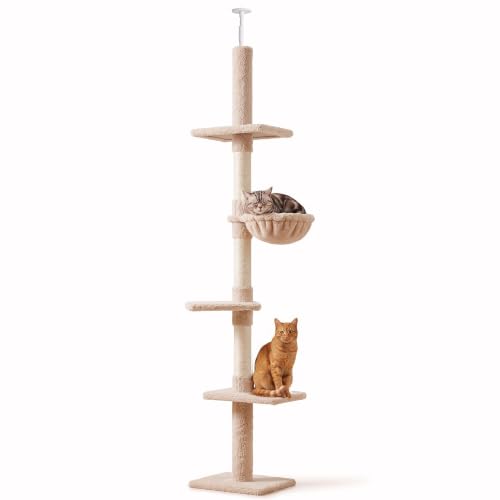
A floor-to-ceiling cat tree is a tall, narrow tower that extends from the floor to the ceiling, held in place by a spring-loaded or screw-adjustable pole. It usually has several platforms and scratching posts, and it takes up very little floor space.
It is a good choice for small flats and for cats that love to climb. It needs a sturdy ceiling, and it is not suitable for every home, especially where ceilings are textured, sloped or fragile.
What Is a Freestanding Cat Tree?
A freestanding cat tree has a wide, heavy base and stands on its own. It usually has a mix of platforms, condos, hammocks and scratching posts, and it can be moved around the house.
It suits large cats and multi-cat homes, and it is easy to set up, since it does not touch the ceiling.
Feature Comparison
Feature | Floor-to-ceiling | Freestanding |
Floor space | Very small | Larger base needed |
Height | Up to ceiling height | Fixed, usually 1 to 2 metres |
Stability | Very stable if fitted well | Depends on the base |
Suitable for large cats | Sometimes | Yes, with a wide base |
Renting | Can mark ceilings | No contact with walls |
Portability | Needs re-adjusting | Can be moved easily |
Specs at a Glance: Popular UK Models
FUKUMARU 6-Level Floor-to-Ceiling Cat Tree
A tall, six-level tower with an adjustable height of 6 to 10 feet. It is a premium floor-to-ceiling choice, and it costs around £99. It averages 4.6 out of 5, although it has fewer than 200 ratings.
No products found.
CA&T Luxury Floor-to-Ceiling Cat Tree
A height-adjustable tower with scratching posts and platforms. It is a lower-cost option at around £35, and it averages 4.2 out of 5 across more than 1,500 ratings.

PawHut Floor-to-Ceiling Cat Tree (230 to 260cm)
A five-tier, height-adjustable tower that fits ceilings from 230 to 260cm. It costs around £37 and averages 4.3 out of 5 across more than 1,200 ratings.

Feandrea Cat Tree Tower (137.7cm)
A multi-level freestanding tower with plush platforms, a condo and four scratching posts. It costs around £33 and averages 4.7 out of 5 across more than 23,000 ratings.

Feandrea Cat Tree (203.5cm, 5 Levels)
A large freestanding tower with two caves and two perches, designed for bigger cats and households. It costs around £52 and averages 4.7 out of 5 across more than 12,500 ratings.

Who Should Buy Which?
Choose a floor-to-ceiling tree if you have limited floor space, a cat that loves height and a sturdy, flat ceiling. It is a good way to give your cat a vertical territory in a small home.
Choose a freestanding tree if you have a large cat, several cats or a rented home where you cannot risk marking the ceiling. It is also the better choice if you want caves, hammocks and beds in one place.
What to Watch Out For
With a floor-to-ceiling tree, measure your ceiling height carefully and check the ceiling is strong enough. Fit it firmly, and check the tension regularly. With a freestanding tree, look for a wide, heavy base and check that the platforms are big enough for your cat.
For both types, sisal-wrapped posts last longer than carpet, and sturdy construction matters more than the number of levels.
Final Verdict
For most homes, a freestanding tree is the safer, simpler choice, and the Feandrea towers are excellent value with outstanding review records. A floor-to-ceiling tree is the better choice for small rooms and climbers, with the FUKUMARU as the premium pick and the CA&T and PawHut as lower-cost options.
Many cat owners end up with both, one in the living room and one in another room.
This roundup is part of our Cat Furniture Buying Guide.