Best Cat Laser Toy UK 2026: Automatic, Handheld and Battery-Free Picks

A red dot scooting across the skirting board is, for most cats, irresistible — it triggers the same prey-stalk-pounce sequence as a mouse in the long grass, but on demand and indoors. Laser toys are one of the cheapest ways to give a bored indoor cat a proper cardio workout, and the better ones can buy you a quiet half-hour while you finish work.

This guide covers six laser toys worth buying in 2026 — a mix of simple handhelds, automatic units that play on their own, and a couple of clever picks that combine lasers with other features. We’ve focused on UK availability, sensible battery life, and toys that are safe to use around cats and other pets. All prices are approximate and aimed at UK buyers; expect to find these at Amazon UK, Pets at Home, or Zooplus UK.

Quick Comparison

ProductBest ForPrice RangeRating
PetSafe Bolt Interactive LaserAutomatic play while you’re out£25–£354.6/5
FroliCat Dart DuoTwo random dots for multi-cat homes£20–£304.4/5
Petlibro Pixi Smart LaserApp-controlled, scheduled play£35–£504.5/5
PetDroid Boltz Cat Laser ToyLong battery life and timer modes£25–£354.4/5
Classic Handheld Laser Pointer (PetSafe Zoom)Budget pick, hands-on play£8–£124.5/5

Our Top Picks

1. PetSafe Bolt Interactive Laser

Best for: automatic, hands-free play when you can’t be in the room.

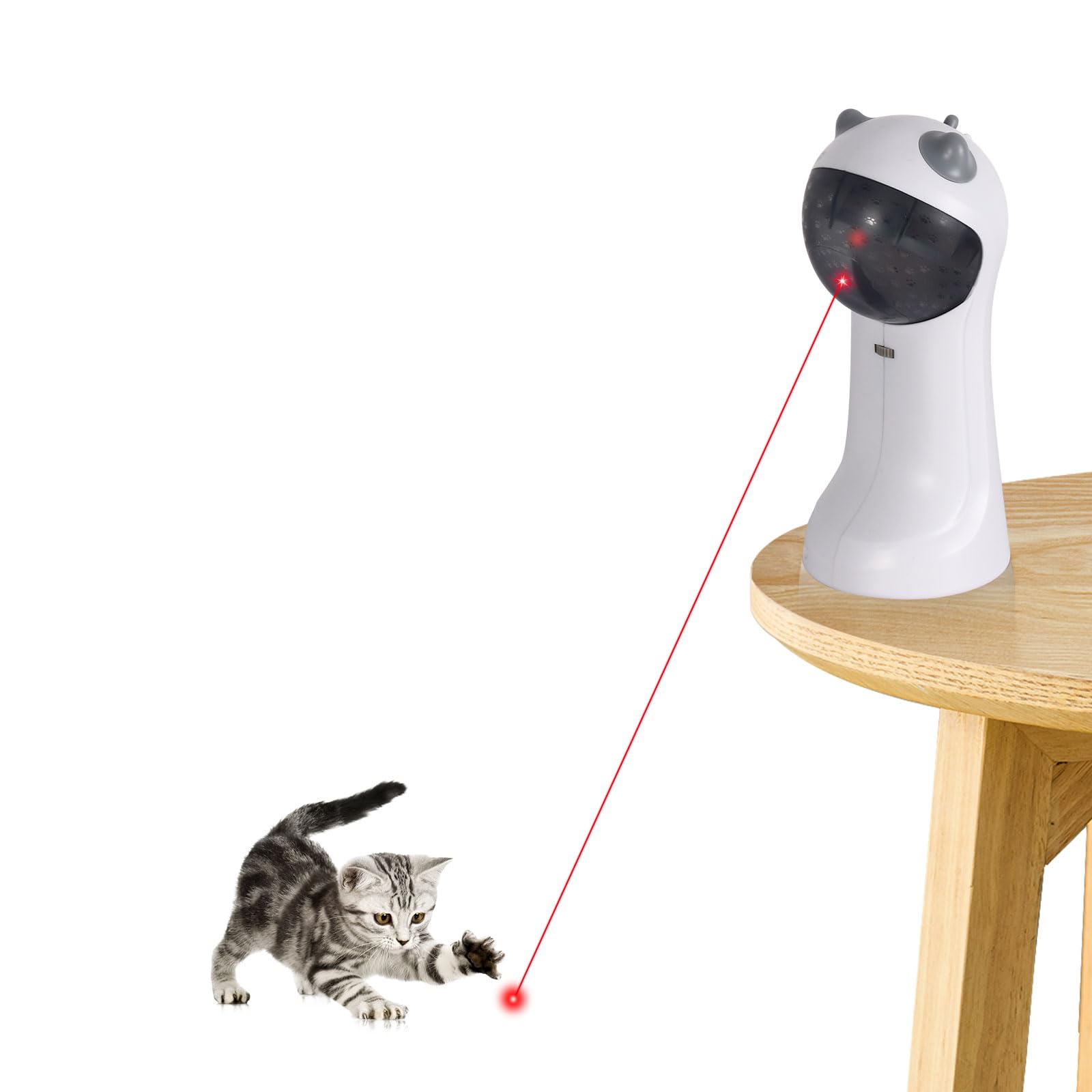
The PetSafe Bolt is the laser most cat owners settle on if they want something that plays with the cat while they’re working or out. It sits on a flat surface, projects a Class IIIA red laser through a series of rotating mirrors, and traces unpredictable patterns across the floor and walls. The randomness is the key — cats stop chasing predictable dots quickly, but the Bolt’s pattern stays interesting for weeks.

There are two modes: a 15-minute auto-play timer (which stops to avoid over-stimulation) and a manual mode where you steer the dot using a small adjustment dial on top. Run on four AA batteries; alkaline cells last around three months of daily 15-minute sessions, and it also accepts rechargeable AAs. Place it on a tabletop or shelf above floor level so the dot stays on flat surfaces and away from furniture you’d rather not chase a cat across.

A handful of cats lose interest in lasers because they never catch anything — to counter that, follow a session with a physical toy or treat so the prey sequence ends in a ‘catch’. The Bolt doesn’t move on its own, so the placement is everything; experiment until the pattern covers an area your cat can actually access.

What we like:

  • Genuinely random patterns hold cats’ interest longer than handhelds
  • 15-minute auto-shutoff is the right length — avoids over-stimulation
  • Battery operated, no cable to gnaw on
  • Adjustable mirror lets you steer the dot in manual mode

Worth knowing:

  • Needs to sit on a flat, raised surface — not floor-friendly
  • Eats AA batteries if used daily; rechargeables are the smart play
  • Some cats become laser-frustrated if play never ends in a physical catch — pair with a treat or toy
  • Class IIIA laser — never aim at eyes, human or pet

Specifications:

  • Laser class: IIIA (under 5mW)
  • Power: 4 x AA batteries (not included)
  • Auto-shutoff: 15 minutes
  • Modes: automatic and manual aim
  • Suitable for: adult cats and kittens over 12 weeks

2. FroliCat Dart Duo

Best for: homes with two or more cats who’d otherwise compete over one dot.

The Dart Duo is FroliCat’s two-laser version of their original Dart — two independently moving red dots dance across the floor at the same time. For multi-cat households that turns laser time from a turn-taking exercise into a proper group chase, which keeps tempers calmer and burns more energy.

It’s a squat puck-shaped unit, about the size of a coffee mug lid, with a slow and fast speed setting and a 10-minute auto-shutoff. There’s no built-in randomness like the Bolt — instead the two dots track independently in straight-ish lines that change direction at the edges, which most cats find more than enough variety. Powered by four AA batteries; expect roughly two months of daily play on alkalines.

It works best on hardwood, tile, or short-pile carpet where the dots are clearly visible; deep shag carpet eats the contrast. Like all laser toys, finish the session with a physical reward or a feather wand to give the cat a ‘catch’.

What we like:

  • Two dots — perfect for multi-cat homes
  • Two speed settings let you dial the intensity
  • 10-minute auto-shutoff stops over-stimulation
  • Compact, sits on the floor without needing a shelf

Worth knowing:

  • Pattern is less random than the PetSafe Bolt
  • Battery hungry with daily use
  • Slightly noisy motor — sensitive cats may need a few sessions to adjust
  • Not refillable, sealed unit — if the motor goes, the toy goes

Specifications:

  • Lasers: 2 x Class IIIA (under 5mW each)
  • Power: 4 x AA batteries (not included)
  • Auto-shutoff: 10 minutes
  • Speeds: slow and fast
  • Suitable for: multi-cat households, adult cats and kittens

3. Petlibro Pixi Smart Laser

Best for: tech-minded owners who want scheduled play and remote control.

The Pixi sits at the smart end of the market — a circular base with a tilting laser head, controlled either by physical buttons or via the Petlibro app on your phone. It’s the laser to buy if you want to schedule sessions for while you’re at work, or trigger a play burst remotely when your cat sends you a 3pm ‘I’m bored’ face.

Three intensity modes (gentle, moderate, intense) change the speed and range of the dot, and you can set up to three daily auto-play sessions of 5, 10 or 15 minutes via the app. USB-C rechargeable battery lasts roughly 7–10 days between charges with daily use. The laser tilts up to about 45 degrees and rotates 360°, so a single unit can cover a whole open-plan room.

Setup needs a 2.4GHz Wi-Fi network and the Petlibro account; the app is the same one used for their feeders and fountains, so existing Petlibro owners will find it familiar. As with any networked device, weigh up whether you want one more thing on your home network — manual mode works fine without app pairing.

What we like:

  • App scheduling means cats get play sessions at consistent times
  • Three intensity levels adjust to active or older cats
  • USB-C rechargeable — no AA battery cycle
  • 360° rotation covers larger rooms from a single position

Worth knowing:

  • Needs 2.4GHz Wi-Fi and a Petlibro account
  • App has occasional connection hiccups — manual mode is the reliable fallback
  • More expensive than non-smart automatic lasers
  • Like all lasers, pair with a physical reward to avoid frustration

Specifications:

  • Laser class: IIIA (under 5mW)
  • Power: USB-C rechargeable lithium battery
  • Modes: 3 intensity levels, manual or app-scheduled
  • Connectivity: 2.4GHz Wi-Fi, Petlibro app (iOS/Android)
  • Suitable for: indoor cats of all ages, single or multi-cat homes

4. PetDroid Boltz Cat Laser Toy

Best for: owners who want a no-app, set-and-forget automatic laser.

The PetDroid Boltz is one of the most reliable mid-range automatic lasers on Amazon UK. It’s a small dome that sits on a shelf and projects a red dot that moves in curves and zig-zags across the floor and lower walls. Where it stands out from the PetSafe Bolt is a 7-hour interval mode: switch it on, and it runs a 15-minute play session every couple of hours throughout the day, so the cat gets multiple bursts of activity rather than one long session.

Three speed levels handle anything from a senior cat (slow) to a kitten on a tear (fast). It runs on 4 x AA batteries or a USB cable (not included), so you can position it on a shelf and run power down behind furniture if you don’t want to swap batteries. The auto-off ensures cats don’t get over-fixated or burn themselves out.

Build quality is a step above the cheapest dome-shaped lasers — the motor is quieter than the FroliCat Dart Duo, and the angles are designed to keep the dot off the ceiling and out of cats’ eyes. Place it high enough that the cat can’t bat it off the shelf mid-session.

What we like:

  • Interval mode runs short play sessions through the day automatically
  • Three speed settings — works for senior cats and kittens
  • Quieter motor than budget rivals
  • Runs on AA batteries or USB cable

Worth knowing:

  • USB cable not included
  • Pattern is less truly random than the PetSafe Bolt
  • No app control or scheduling beyond the built-in interval
  • Battery door is a touch fiddly

Specifications:

  • Laser class: IIIA (under 5mW)
  • Power: 4 x AA batteries or USB (cable not included)
  • Auto-shutoff: 15 minutes per session
  • Interval mode: session every 2 hours over 7 hours
  • Suitable for: indoor cats, single or multi-cat homes

5. PetSafe Zoom Handheld Laser Pointer

Best for: interactive play between owner and cat — and the budget pick.

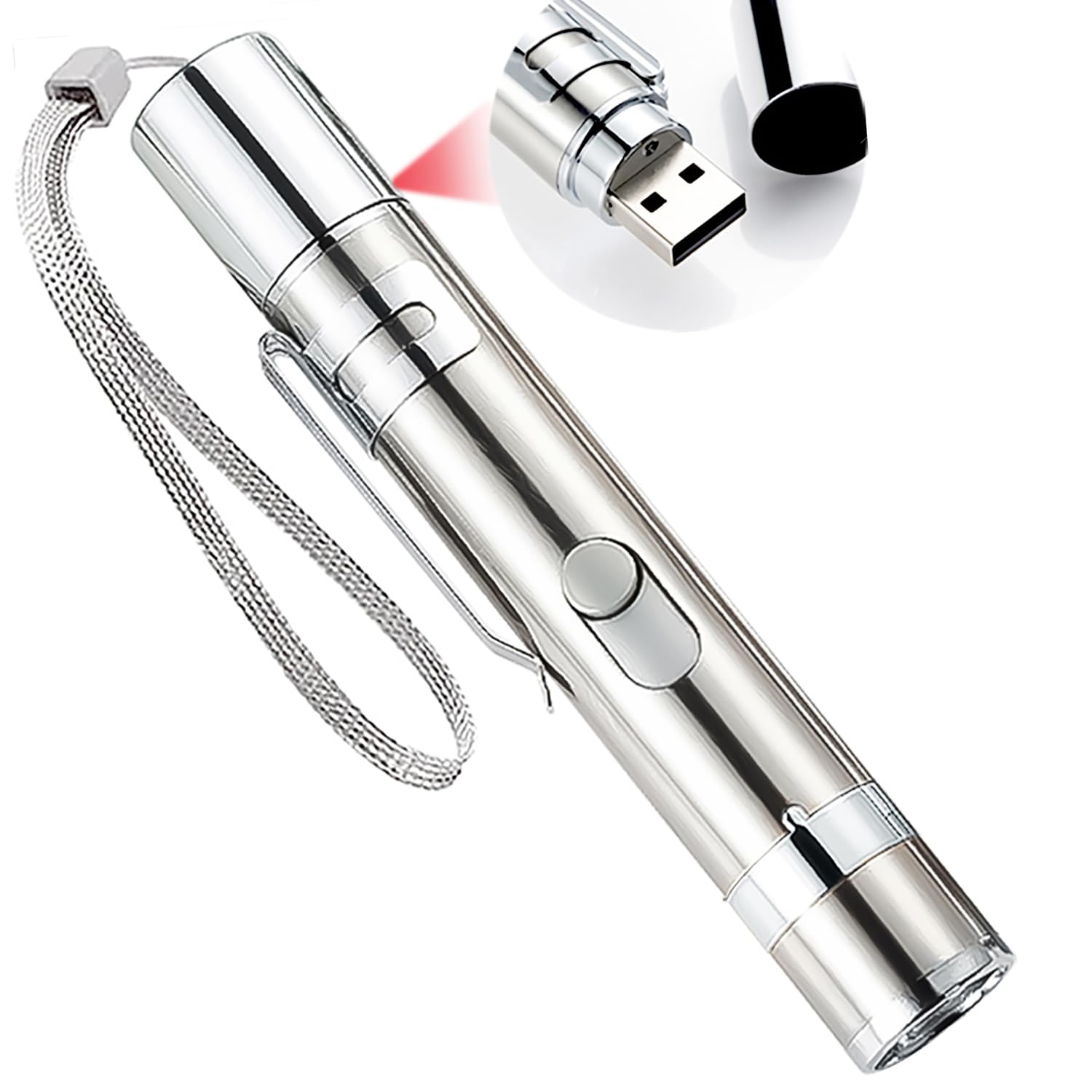
If you want a laser toy and you also want to be the one playing with your cat, a simple handheld pointer is hard to beat. The PetSafe Zoom is a well-built pen-style laser — sturdy aluminium body, a single side button, and a clip so it lives on a desk or in a drawer without getting lost. It’s the laser most cat owners actually use most often, because nothing beats steering the dot yourself for tailoring play to your cat’s mood.

Handhelds let you build a proper hunt sequence — slow stalk, sudden dart, brief pause, escape under furniture, final ‘catch’ on a feather toy. Automatic lasers can’t read the room like that. You can also stop instantly if the cat gets too over-the-top or knocks into something.

Powered by two AAA batteries that last for ages, since you’re not running a motor. Class IIIA laser — same brightness as the automatic models but with a single, steady dot. As always, never shine it directly into eyes, and finish play with a tangible reward.

What we like:

  • Cheapest pick — solid build for under £15
  • You control the play — best for tailored sessions
  • Tiny, lives in a drawer or pocket
  • Long battery life, no motor to wear out

Worth knowing:

  • You have to be present to use it
  • Easy to over-play if you’re not paying attention
  • Class IIIA — keep well clear of eyes
  • Plain — no features beyond the dot

Specifications:

  • Laser class: IIIA (under 5mW)
  • Power: 2 x AAA batteries (often included)
  • Body: aluminium with pocket clip
  • Activation: side button, no auto modes
  • Suitable for: all ages of cat, supervised play only

6. SereneLife Automatic Cat Laser Toy with Random Pattern

Best for: owners who want a wider random pattern and a low price point.

SereneLife’s automatic laser is the value pick in the automatic category — usually £5–£10 below the PetSafe Bolt with a broadly similar feature set. A weighted base, an angled top, and a Class IIIA laser projected through a rotating mirror system that throws the dot across roughly 4 square metres of floor. Three speeds let you ramp it up for kittens or wind it down for older cats.

Auto-shutoff is 15 minutes, with a 90-minute resting interval before it’ll run again, which is sensible — you can’t accidentally leave it running all day. Powered by 4 x AA batteries (not included). Like other automatic units, it lives best on a shelf or end table where the dot can travel freely across the floor.

Build quality is one tier below the PetSafe Bolt — the mirror occasionally judders on the fastest setting after a few months of heavy use — but at this price you can replace it twice and still be ahead. Worth picking up if you want to trial automatic lasers before committing to a pricier model.

What we like:

  • Affordable entry into the automatic category
  • Three speed settings cover kittens through senior cats
  • Sensible 15-minute on / 90-minute off cycle
  • Wide pattern coverage for a small unit

Worth knowing:

  • Mirror mechanism can get noisier over time
  • Build quality not in the same league as PetSafe Bolt
  • AA batteries not included
  • Plain plastic finish — looks budget

Specifications:

  • Laser class: IIIA (under 5mW)
  • Power: 4 x AA batteries (not included)
  • Auto-shutoff: 15 minutes
  • Interval before restart: 90 minutes
  • Suitable for: indoor cats, single-cat homes especially

Buying Guide

What to look for when buying a cat laser toy

Start with the laser class. Anything sold legitimately for pet use in the UK will be Class IIIA (under 5mW) — bright enough to see clearly on most floor surfaces, dim enough to be safe at a glance. Avoid anything labelled Class IIIB or above, which exists for industrial use and can damage eyes.

Next, decide between automatic and handheld. Automatic units excel when you can’t be in the room — work calls, errands, school runs — and they keep an indoor cat from going stir-crazy. Handhelds win when you want to play with your cat directly, and they’re cheaper and far more durable because there’s no motor. Most owners end up with one of each.

Look for an auto-shutoff on any automatic toy. Fifteen minutes is the right length — long enough for a real cardio session, short enough that cats don’t tip into the over-stimulated frustration zone. Avoid any automatic toy without a shutoff.

Types of laser toy explained

Handheld laser pointers are the simplest and cheapest — a single steady dot you steer with your hand. Best for interactive play and building proper hunt sequences. Automatic dome units sit on a surface and project a moving dot via a rotating mirror; pattern randomness varies by brand. Smart lasers add app scheduling, remote triggering, and intensity modes, useful if you want sessions to run while you’re at work. Combination toys pair a laser with a feather wand or treat dispenser, giving the cat a physical ‘catch’ to end the sequence.

Cat-specific considerations

For kittens, stick to lower speeds and shorter sessions — they tire fast and overdo it given the chance. For senior cats, the slowest speed setting matters most; some older cats lose interest if the dot moves too fast. Multi-cat households tend to do best with two-dot units like the FroliCat Dart Duo, or with a single laser plus a separate physical toy so the less-dominant cat has something to chase too.

If your cat shows signs of laser frustration — stalking shadows long after the session, obsessive behaviour, or stress vocalising — stop using the laser for a couple of weeks and switch to wand toys. Some cats just don’t suit lasers, and that’s fine. For the rest, always finish a session with a real-world catch: a treat, a feather toy, or a kibble toss the laser ‘lands’ on. The point is to close the prey sequence.

How much should you spend?

A solid handheld pointer runs £8–£15. Decent automatic units start around £20 and top out around £35 for the PetSafe Bolt or PetDroid Boltz. Smart, app-connected lasers sit in the £35–£50 range. Above £50, you’re paying for combination features (laser plus treat dispenser, pet camera integration) rather than a better laser. For most households, a £25 automatic plus a £10 handheld covers every situation.

Frequently asked questions

Are laser toys safe for cats? Yes, when used sensibly. Stick to Class IIIA toys, never aim at eyes, and finish sessions with a physical reward to avoid frustration. Most cats benefit from the cardio.

How long should a laser play session be? Ten to fifteen minutes is plenty for one session; two or three short sessions across a day works better than one long one. Most automatic units enforce this with their built-in shutoff.

Why does my cat seem frustrated after laser play? Cats are built for the full prey sequence — stalk, chase, catch, kill, eat. A laser only delivers stalk and chase, never catch. Pair the session with a treat or a feather toy so the cat ends on a ‘catch’ and the loop closes.

Will a laser toy work on a senior cat? Often yes, on the slowest speed. If a senior cat has joint issues, watch they’re not over-leaping or twisting hard on hard floors — rugs and carpet help.

Can I leave an automatic laser on while I’m out all day? Use the auto-shutoff and interval features — a 15-minute session every couple of hours is the sweet spot. Don’t override the shutoff.

Conclusion

For most UK cat owners the PetSafe Bolt Interactive Laser is the right buy — random patterns, sensible shutoff, and the kind of build quality that lasts years rather than months. If you have two or more cats, the FroliCat Dart Duo’s twin-dot trick keeps the peace at play time.

Tech-minded owners who want scheduled sessions should look at the Petlibro Pixi Smart Laser, and anyone who wants a cheap, reliable handheld for owner-led play won’t go wrong with the PetSafe Zoom. Whatever you pick, finish every session with a real-world catch — a treat or a feather toy — to give your cat the satisfying close to the hunt that lasers alone can’t deliver.

Some More Reviews Here..