Few things test a cat owner’s patience like the sound of claws working their way down the side of a new sofa. Scratching is not bad behaviour, though — it is how cats shed old claw sheaths, stretch out their shoulders and leave scent marks on the things they care about. The trick is redirecting it rather than stopping it, and for a lot of cats a flat mat works where an upright post never did.
Plenty of cats simply prefer to scratch horizontally, stretched out along the floor, and a mat suits homes where a full cat tree would be one piece of furniture too many. Below we have rounded up the best cat scratching mats available in the UK for 2026, covering hard-wearing cardboard loungers, sisal mats, door-hanging designs and cheap replaceable pads for multi-cat households.
Quick Comparison Table
| Product | Best For | Price Range | Rating |
| PetFusion Cat Scratcher Lounge | Overall durability and heavy scratchers | £45-65 | ⭐⭐⭐⭐⭐ |
| Catit Style Scratcher Lounge | Design-conscious homes | £25-40 | ⭐⭐⭐⭐ |
| SmartCat Sisal Scratching Mat | Cats that reject cardboard | £20-32 | ⭐⭐⭐⭐ |
| Trixie Sisal Scratching Mat | Door hanging and small spaces | £12-20 | ⭐⭐⭐⭐ |
| Kong Naturals Incline Scratcher | Budget pick and catnip appeal | £8-15 | ⭐⭐⭐⭐ |
The Best Cat Scratching Mats Reviewed
PetFusion Cat Scratcher Lounge
Best for: households with a determined scratcher who destroys cheaper pads in weeks.
The PetFusion lounge is the mat most often recommended by people who have already worked their way through three cheap ones. It is a broad, gently curved slab of recycled corrugated cardboard set into a solid frame, and the curve is the point — a cat can scratch along the flat section, then stretch up the rise, which covers both scratching styles in one object.
The cardboard is denser than the supermarket equivalents, so it sheds noticeably less and lasts a good deal longer. It doubles as a bed for most cats, which is usually what sells it to them in the first place. The frame is genuinely furniture-grade and looks fine left out in a living room rather than hidden behind a door.
The catch is the price, which is several times that of a basic pad, and the fact that the cardboard insert is not replaceable on its own — when it eventually wears through you are buying the whole thing again. It is also large, so measure your floor space before committing.
What we like:
- Dense cardboard that lasts far longer than budget pads
- Curved profile suits both flat and angled scratching
- Sturdy frame that looks like furniture, not a cat product
- Doubles as a bed, which encourages cats to use it
Worth knowing:
- Expensive compared with a basic cardboard pad
- Insert cannot be replaced separately
- Takes up a fair amount of floor space
Specifications:
- Suitable for: kittens through to senior cats; large breeds included
- Material: recycled corrugated cardboard, wood-composite frame
- Approximate size: 87cm long
- Catnip included
Catit Style Scratcher Lounge
Best for: owners who want a scratcher that does not look out of place in the room.
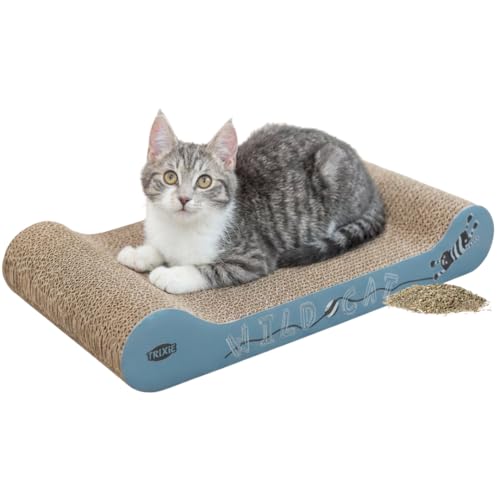
Catit’s take on the cardboard lounger leans harder on looks, with patterned surrounds and a chaise-style shape that reads more as a small piece of furniture than a cat accessory. The scratching surface is corrugated cardboard, reversible when one side wears down, which effectively doubles the life of the pad.
Cats take to it readily, helped by the catnip sachet in the box, and the raised end gives them something to drape over — a detail that matters more than it sounds, since a mat a cat sleeps on is a mat a cat keeps coming back to. It sits low and stable, so nervous cats are not put off by any wobble.
It is less dense than the PetFusion, so a serious scratcher will get through it faster, and the cardboard shedding is more noticeable. Assembly is minimal but the cardboard surround can dent if knocked about.
What we like:
- Attractive design that suits a living room
- Reversible cardboard surface doubles its life
- Low and stable — good for cautious cats
- Catnip supplied to encourage first use
Worth knowing:
- Cardboard is softer than premium alternatives
- Sheds more cardboard bits onto the floor
- Surround dents if knocked
Specifications:
- Suitable for: adult cats and kittens
- Material: corrugated cardboard with printed card surround
- Reversible scratching insert
- Catnip included
SmartCat Sisal Scratching Mat
Best for: cats that ignore cardboard entirely and want a rougher texture.
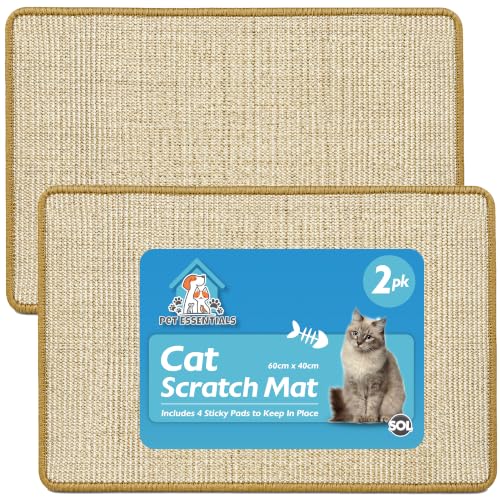
Some cats look at a cardboard pad with complete indifference, and for those the answer is usually sisal. This SmartCat mat is woven sisal rather than the loose sisal rope wrapped around most posts, and the flat weave gives a firm, coarse surface that holds up to hard use without unravelling.
It lies flat on the floor and can also be hung from a door handle or fixed to a wall, which makes it flexible if you are still working out where your cat actually wants to scratch. Sisal sheds almost nothing compared with cardboard, so it is the tidier choice for anyone who is tired of hoovering up shavings.
It offers nothing in the way of comfort — no cat is going to nap on it — so it lacks the built-in appeal of a lounger and may need catnip to get things started. It is also a plain-looking thing that will not win any awards for appearance.
What we like:
- Tough woven sisal that resists unravelling
- Barely sheds compared with cardboard
- Can be laid flat, hung on a door or wall-mounted
- Works for cats that reject cardboard
Worth knowing:
- No comfort value — cats will not lie on it
- May need catnip to attract interest initially
- Plain appearance
Specifications:
- Suitable for: adult cats, including large breeds such as Maine Coons
- Material: woven sisal
- Use: floor, door-hung or wall-mounted
Trixie Sisal Scratching Mat
Best for: flats and small spaces where floor room is tight.
Trixie’s sisal mat is a simpler, cheaper take on the same idea — a rectangular sisal panel, usually with a hanging loop or cord so it can go over a door handle or onto a wall. For a flat where every square metre counts, taking the scratcher off the floor entirely is a sensible move.
Vertical mounting also suits cats that scratch by stretching upwards, which is the more common instinct, and hanging it beside the spot a cat already targets is often enough to redirect them. It is light and easy to reposition while you experiment.
Being thinner than the SmartCat, it wears through sooner under a heavy scratcher, and the hanging cord can swing about, which some cats dislike — fixing it flat to the wall solves that. Sizes vary by version, so check the dimensions before ordering.
What we like:
- Cheap and widely available in the UK
- Hangs on a door or wall to save floor space
- Suits cats that prefer to stretch upwards
- Light enough to move around while testing spots
Worth knowing:
- Thinner sisal wears out faster than premium mats
- Swinging on a cord puts some cats off
- Sizes vary between versions
Specifications:
- Suitable for: kittens and adult cats
- Material: sisal panel with backing
- Use: floor or hanging
Kong Naturals Incline Scratcher
Best for: a budget pick, and for tempting a reluctant cat into scratching at all.
Kong’s incline scratcher is a corrugated cardboard pad set at a slope, and at well under £15 it is the easiest way to find out whether your cat is a horizontal scratcher before spending real money. The angle splits the difference between floor and post, which is why it converts cats that have refused both.
It comes with a generous helping of North American catnip, and Kong’s catnip is stronger than most, so uptake tends to be quick. The pad is reversible, and replacements are sold separately — unusual at this price and a genuine saving over time.
It is small, so a large cat will overhang it, and the light frame slides on hard floors unless it is pushed against something. Durability is fair rather than good; a heavy scratcher will work through a side in a couple of months.
What we like:
- Very cheap — comfortably under £25
- Sloped angle converts cats that refuse posts and flat pads
- Strong catnip included
- Reversible, with replacement pads available
Worth knowing:
- Small — large cats will hang over the edges
- Slides on laminate and wood floors
- Wears out faster than premium cardboard
Specifications:
- Suitable for: kittens and adult cats up to medium size
- Material: corrugated cardboard
- Reversible pad, replacements sold separately
- Catnip included
Ancol Cardboard Scratcher Pad
Best for: multi-cat households that need several scratchers at once.
The plain rectangular cardboard pad is the workhorse of the category, and Ancol’s version is a reliable UK-available example. There is no frame and no styling — just a block of corrugated cardboard you drop on the floor, which is exactly what is wanted when you need four of them.
Behaviourists generally suggest one scratching surface per cat plus a spare, and at this price that advice is actually affordable. Scattering cheap pads near the places cats already scratch — sofa corners, doorways, the end of the bed — tends to work better than one expensive scratcher in the wrong room.
They are disposable by design and will need replacing every few months. Being frameless they slide easily, and they shed cardboard freely. Treat them as consumables rather than furniture and they make good sense.
What we like:
- Cheap enough to place several around the home
- Simple to swap out when worn
- Easy to position near problem scratching spots
- Reversible for a longer life
Worth knowing:
- Short lifespan — a consumable, not furniture
- Slides on hard floors without a frame
- Sheds cardboard as it wears
Specifications:
- Suitable for: all ages, multi-cat homes
- Material: corrugated cardboard
- Reversible
Cat Scratching Mat Buying Guide
What to look for when buying a cat scratching mat
Material comes first. Cardboard is cheap, widely accepted and sheds; sisal is tougher, tidier and lasts longer but has no comfort value. If a cat has already rejected one, try the other rather than buying more of the same.
Stability matters more than most buyers expect. A mat that skids away mid-scratch teaches a cat the sofa is the more reliable option, so look for a frame, a rubber backing, or plan to wedge the mat against a wall or furniture leg.
Check whether the surface is reversible and whether replacement inserts are sold. A reversible pad lasts roughly twice as long, and replaceable inserts change the long-term cost of an expensive lounger considerably.
Cat scratching mat types explained
- Flat cardboard pads — cheapest, disposable, good for scattering around the home in multiples.
- Cardboard loungers — larger, framed, curved or angled; double as a bed and last much longer.
- Incline scratchers — sloped cardboard that suits cats caught between horizontal and vertical scratching.
- Sisal mats — woven sisal for cats that dislike cardboard; tidy, durable, no comfort value.
- Hanging or wall-mounted mats — free up floor space and suit cats that stretch upwards to scratch.
Size guide
A mat should be at least as long as your cat from nose to base of tail when stretched out, since the stretch is half the reason they are scratching in the first place. For most adult cats that means roughly 45-50cm as a minimum.
Large breeds such as Maine Coons and Ragdolls need noticeably more — 60cm and upwards is a better target, which rules out most small incline pads. Kittens manage fine on anything, but buying to adult size saves replacing it in a year.
For hanging mats, position the top of the mat at roughly the height your cat currently reaches when scratching a door frame or sofa arm. Matching the height of the existing habit is what makes the swap work.
How much should you spend?
Around £6-15 buys a basic cardboard pad or incline scratcher. This is the sensible starting point if you do not yet know whether your cat prefers to scratch horizontally, and it is cheap enough to buy several for a multi-cat home.
Between £20 and £40 covers styled loungers and decent sisal mats — the range most owners settle in, offering a real step up in durability and something that can be left on show.
Above £45 you are paying for dense, long-lasting cardboard and furniture-grade frames. Worth it for a heavy scratcher who gets through cheap pads quickly, and questionable for a gentle cat who barely uses one.
Frequently asked questions
Do cats prefer horizontal or vertical scratching?
It varies by cat. Vertical scratching on posts and door frames is more common, but a fair number of cats prefer to stretch out flat, and some do both depending on mood. Watching where a cat already scratches is the quickest way to tell — matching the angle they have chosen themselves is far easier than retraining them.
How do you get a cat to use a scratching mat?
Place it directly next to whatever they are currently scratching rather than somewhere tidy and out of the way, then sprinkle catnip on it. Cats scratch to scent-mark visible, well-used parts of the home, so a mat hidden in a spare room will be ignored. Once it is in regular use, it can be moved a short distance at a time.
How often should a scratching mat be replaced?
Cheap cardboard pads typically last two to four months with regular use, loungers six months to a year, and sisal mats often several years. Replace any mat once the surface has gone smooth — a worn mat gives no resistance, and cats will look elsewhere for something with more grip.
Are scratching mats a substitute for a cat tree?
Not quite. A mat covers scratching, but cats also want height and a vantage point, which a mat cannot provide. In a small flat a mat plus a high shelf or windowsill perch covers most of what a tree would. Where floor space allows, the two work well together.
Do scratching mats stop cats scratching furniture?
They help considerably, but only when placed where the unwanted scratching is already happening. A mat on its own rarely fixes the problem; a mat next to the targeted sofa arm, with catnip on it, usually does. Keeping claws trimmed reduces the damage in the meantime.
Conclusion
For most UK homes the PetFusion Cat Scratcher Lounge is the pick of the group — dense cardboard that survives a serious scratcher, a curve that covers both scratching styles, and enough comfort that cats choose it over the sofa. It costs more upfront and repays it in the pads you do not end up buying.
If the budget is tighter, the Kong Naturals Incline Scratcher is the smart first buy, cheap enough to test whether your cat is a horizontal scratcher at all. And for cats that turn their nose up at cardboard, the SmartCat Sisal Scratching Mat is the one to reach for instead.