Agility is one of the most rewarding things you can do with a dog. It builds fitness, focus and confidence, it tires out an energetic dog in a healthy way, and it deepens the bond between the two of you. The good news is that you do not need a training club or a field to begin. A few well-chosen pieces of equipment in the garden or a quiet park are enough to get started.
We have compared five agility products currently available on Amazon UK, covering complete starter kits, tunnels, weave poles, adjustable jumps and low cavaletti poles. Each one is suited to a slightly different stage of training, and we explain who it is best for, what we like and what to watch out for, so you can choose the kit that fits your dog and your space.
Quick Comparison Table
Product | Best For | Price Range | Rating |
PawHut 8-Piece Agility Set with Tunnel | Complete starter course | £45-£55 | 4.7/5 |
PawHut Weave Poles and Jump Ring Set | Focused skills practice | £30-£36 | 4.2/5 |
lionto Agility Tunnel (300 x 50 cm) | Popular, well-reviewed tunnel | £20-£25 | 4.3/5 |
PawHut Three-Piece Adjustable Hurdle Set | Adjustable jumps | £17-£21 | 4.5/5 |
Zazafolora Cavaletti Pole Set | Low-impact jump training | £22-£28 | 4.5/5 |
The Best Dog Agility Equipment Reviewed
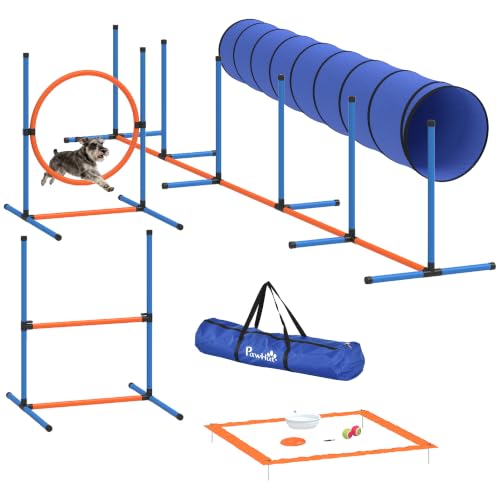
PawHut Dog Agility Equipment Set (8-Piece, with Tunnel)
Best for: a complete starter course in one box
If you want to set up a proper little course in the garden without buying obstacles one at a time, an all-in-one kit is the simplest way to start. The PawHut eight-piece set brings together a tunnel, jumps and weave poles, so your dog can try several different obstacles in the same session.
A mixed set is useful because you quickly learn what your dog enjoys. Some dogs love flying through a tunnel and ignore the weave poles, while others are more cautious and need time on the low jumps first. Having everything to hand means you can change the layout every few days, which keeps training fresh.
It costs around £52 and averages 4.7 out of 5, although it is a newer listing with only a handful of ratings so far. It is best for small to medium dogs in a garden or a park, and the pieces pack down for storage.
What we like:
- Tunnel, jumps and weave poles in one kit
- Good variety for keeping training interesting
- Packs away for storage
Worth knowing:
- A newer listing with few ratings so far
- Lightweight pieces need pegging down on windy days
Specifications:
- Type: multi-piece agility set
- Includes: tunnel, weave poles and jumps
- Brand: PawHut
- Best for: small to medium dogs
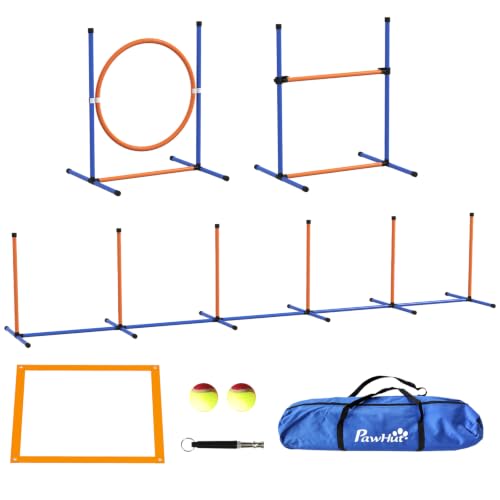
PawHut Dog Agility Training Equipment with Weave Poles and Jump Ring
Best for: weave poles and a jump ring for focused skills
This PawHut set concentrates on two of the most popular agility skills: weaving and jumping through a ring. It is a good step up from a basic jump when your dog is already confident and you want something a little more challenging.
Weave poles teach a dog to turn and bend, and they are surprisingly tiring for the brain as well as the body. The jump ring gives a fun target to aim for and encourages a clean, straight approach. Both are made to be set up quickly and packed away again.
It costs around £33 and averages 4.2 out of 5 across more than 40 ratings. It suits small and medium dogs, and it comes with a carry bag, which is handy if you want to take it to a park or a friend’s garden.
What we like:
- Weave poles and a jump ring together
- Quick to assemble and dismantle
- Portable
Worth knowing:
- Fewer obstacle types than a full kit
- May be too small for large breeds
Specifications:
- Type: weave poles and jump ring set
- Brand: PawHut
- Colour: orange
- Best for: small to medium dogs

lionto Outdoor Dog Agility Tunnel (300 x 50 cm)
Best for: the most popular tunnel, with thousands of ratings
A tunnel is often the first obstacle dogs fall in love with, and the lionto is one of the best-reviewed tunnels available. At three metres long and 50 centimetres across, it suits small and medium dogs and is long enough for a real run-through.
It folds flat when not in use and is made from a tough, tear-resistant fabric over a flexible frame. Peg it down with the anchor points provided so it does not roll when a dog charges through, and be careful to keep it away from sharp stones and thorns.
It costs around £23 and averages 4.3 out of 5 across more than 2,600 ratings, which is a very strong record for a budget tunnel. It is also a good choice for puppies learning confidence, provided you start with the tunnel shortened.
What we like:
- Huge number of positive ratings
- Folds flat for storage
- Long enough for a proper run-through
Worth knowing:
- Needs pegging down outdoors
- Not suited to very large dogs
Specifications:
- Type: collapsible agility tunnel
- Size: 300 x 50 cm
- Colour: blue
- Brand: lionto

PawHut Dog Agility Equipment Set (Three-Piece Adjustable Height)
Best for: adjustable jumps for growing confidence
Jumps are the backbone of most agility training, and an adjustable set lets you raise the difficulty as your dog gains confidence. This three-piece PawHut set has hurdles that can be set at different heights, so you can begin low and build up gradually.
Starting low is important. Young dogs and older dogs should not jump high, and even fit adult dogs should be introduced to jumping slowly. Being able to adjust the bar height means one set will serve you for a long time.
It costs around £19 and averages 4.5 out of 5 across more than 90 ratings. It is a very affordable way to start, and the lightweight construction makes it easy to set up wherever you have space.
What we like:
- Adjustable heights
- Very affordable
- Easy to set up and store
Worth knowing:
- Only jumps, no tunnel or weave poles
- Light frame can be knocked over easily, which is good for safety but frustrating in wind
Specifications:
- Type: adjustable hurdle set
- Pieces: 3
- Brand: PawHut
- Colour: orange
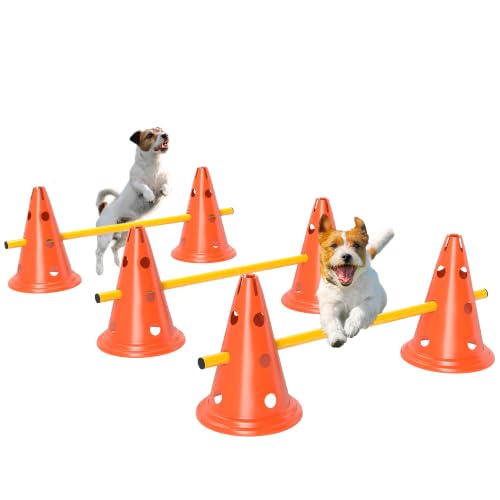
Zazafolora Dog Agility Equipment Set (Cavaletti Poles)
Best for: low cavaletti poles for jump training and fitness
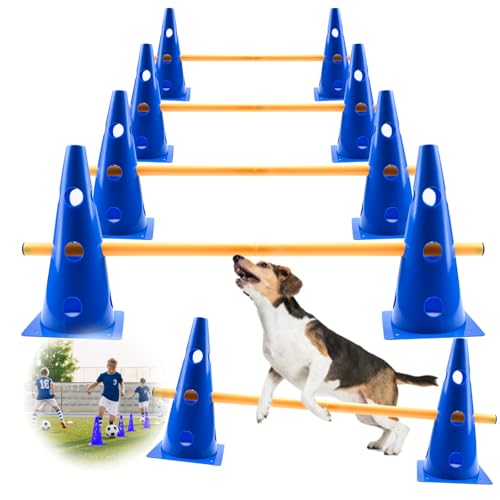
Cavaletti poles are low, evenly spaced poles that a dog steps or trots over. They are used in agility and canine fitness to improve coordination, stride and body awareness, and they are gentler than high jumps.
This Zazafolora set gives you a selection of poles at a low working height, and you can lay them out in a line for trotting or set them up as simple jumps. They are a good option for dogs that are not ready for high obstacles, as well as for older dogs that need gentle exercise.
It costs around £26 and averages 4.5 out of 5, though the review count is still small. It is best for small to medium dogs.
What we like:
- Gentle, low-impact jump training
- Useful for fitness and coordination
- Adjustable layouts
Worth knowing:
- A newer listing with a small number of ratings
- Not a full course on its own
Specifications:
- Type: cavaletti pole set
- Height: around 32 cm
- Use: jumps and fitness
- Brand: Zazafolora
Buying Guide
What to look for when buying dog agility equipment
Safety comes first. Look for equipment that is stable, has no sharp edges and is designed so that a jump collapses or knocks down if a dog hits it. Poles should be smooth, tunnels should be wide enough for your dog to run through comfortably, and everything should be suitable for the size of your dog.
Portability is worth thinking about. Most home kits fold or pack down into a carry bag, which makes them easy to store in a shed or take to a park. Weather resistance also matters if the equipment will live outdoors, and it is worth choosing pieces that can be pegged down or weighted for windy days.
The main obstacles explained
Jumps are the simplest place to begin. A single bar raised slightly above the ground teaches a dog to leap over something. Tunnels are usually the easiest obstacle for a dog to love, since running through is natural and fun. Weave poles are the hardest to teach and take the most patience, since the dog learns to bend from one side to another around a line of poles.
Cavaletti poles are low poles that a dog trots over. They are used to improve coordination and body awareness, and they are excellent for older dogs and puppies, or as a warm-up before higher work.
Size and age guide
Match the equipment to your dog’s size. Small dogs need low jumps and narrower tunnels, while larger dogs need wider tunnels and higher bars. Never ask a dog to jump high before they are physically mature, which is generally around 12 to 18 months depending on breed, and take care with older dogs and those with joint problems.
Puppies can enjoy low-level fun, such as walking through a short tunnel or stepping over a pole on the ground, but avoid repetitive jumping while their bones and joints are still developing.
How much should you spend?
A single tunnel or jump set costs around £15 to £25. Mid-range multi-obstacle kits are around £30 to £55. Spending more buys a wider range of pieces and sturdier build, but there is no need to spend heavily for a backyard hobby.
Frequently asked questions
At what age can my dog start agility?
You can introduce a puppy to very low, fun obstacles from a few months old, such as walking through a short tunnel, but avoid jumping until they are physically mature. For most dogs that is around 12 to 18 months. Ask your vet if you are unsure.
Do I need a big garden for agility equipment?
No. Many pieces are compact, and you can set up a simple course of three or four obstacles in a small garden. A tunnel and a couple of low jumps are enough to get started, and you can pack everything away afterwards.
Is home agility equipment safe for my dog?
It can be, provided you use it sensibly. Choose equipment made for dogs, set jumps at a suitable height, keep sessions short and stop at the first sign of tiredness. Use equipment on grass or another forgiving surface rather than concrete.
How do I get my dog started with agility?
Begin with one obstacle and use treats and praise to make it fun. A short tunnel and a low jump are the easiest places to start. Keep sessions to five or ten minutes, end on a success and add new obstacles gradually.
Can any breed do agility?
Any healthy dog can enjoy simple agility, from small terriers to large collies. Some breeds, including border collies and terriers, take to it particularly well, while heavy or short-legged breeds should stick to low obstacles. Mixed breeds are just as welcome as pedigrees.
Conclusion
For most owners, the PawHut eight-piece set is the best place to start, since it offers a tunnel, jumps and weave poles so your dog can try everything. If you want to begin with a single piece, the lionto tunnel is the standout, with thousands of positive ratings at a very low price.
The PawHut three-piece hurdle set is a good, cheap option for adjustable jumps, the weave pole set adds a fun skill challenge, and the Zazafolora cavaletti poles are ideal for low-impact fitness work. Whichever you choose, keep sessions short, keep jumps low and make it fun for your dog.
This roundup is part of our Dog Walking Gear: The Complete Guide.