Best Hamster Cage UK 2026: Spacious, Welfare-Friendly Homes for Syrians and Dwarfs

If you have ever stood in the small pet aisle and wondered why every cage on the shelf looks too small, you are not alone. UK hamster welfare guidance has shifted in recent years, and most of the cages still being sold in supermarkets and pet shops simply do not give a Syrian or dwarf hamster enough room to behave naturally — to dig, to forage, to run without bumping into the walls of a tiny tube.

We have spent a long time comparing the hamster cages UK owners can actually buy in 2026 — from the Savic Plaza range that almost every rescue recommends, to the modern Niteangel enclosures, to budget XL cages from Little Friends. We have looked at floor space, bar spacing, deep-bedding capacity, ease of cleaning and how well each one stands up to a determined gnawer. The picks below should give you a clear shortlist whether you are buying your first hamster cage or upgrading from a starter kit.

Quick Comparison

CageBest ForPrice RangeRating
Savic Plaza 120A welfare-friendly off-the-shelf cage£100–£130★★★★★
Niteangel Bigger World (Vista L)Modern glass-and-wood enclosure£130–£180★★★★★
Savic Plaza 100Best mid-size cage£75–£100★★★★
Little Friends Langham XLBest budget XL cage£60–£85★★★★
Ferplast Hamster Maxi DuoBest modular cage£90–£120★★★★

Our Top Picks

1. Savic Plaza 120

Best for: a welfare-friendly off-the-shelf cage that fits a Syrian without DIY.

Ask any UK hamster forum for a cage recommendation and the Savic Plaza 120 will come up within the first three replies. With internal floor measurements of around 118 × 64 cm and a height of 52 cm, it is one of the few mainstream cages sold in pet shops that comfortably exceeds the often-quoted minimum floor space of 100 × 50 cm and gives enough depth for a proper bedding layer.

The frame is sturdy plastic and metal with two large doors — one on the top and one on the front. That front door is the killer feature: it makes spot-cleaning, feeding and gentle handling far easier than fishing your hamster out from above through a top hatch. Bar spacing is 9 mm, which is fine for adult Syrians and most dwarfs, although very young or very small Roborovskis can occasionally squeeze through any 9 mm cage and may need a Niteangel-style enclosure instead.

It is bigger than it looks in photos, so measure your shelf or table before ordering. The base is deep enough for around 15–20 cm of bedding before you need to add a barrier, which is genuinely useful for natural digging and tunnelling behaviour.

What we like:

  • One of the few off-the-shelf cages that meets common UK welfare guidance
  • Large front door makes daily handling much easier
  • Deep base accepts 15–20 cm of bedding without modification
  • Solid build quality from a long-established brand
  • Stocked at Pets at Home, Jollyes and Amazon UK

Worth knowing:

  • Footprint is large — measure your space first
  • Plastic shelves and tubes that come included are not always usable for adult Syrians
  • Heavier than it looks; not easy to move once set up
  • Bar gnawing is possible — provide plenty of chews to redirect

Specifications:

  • Dimensions: approximately 118 × 64 × 52 cm
  • Bar spacing: 9 mm
  • Suitable for: Syrian and dwarf hamsters, small rats
  • Materials: powder-coated steel grids and moulded plastic base
  • Indoor use only

2. Niteangel Bigger World / Vista (Size L)

Best for: a modern glass-fronted enclosure with a large bedding depth.

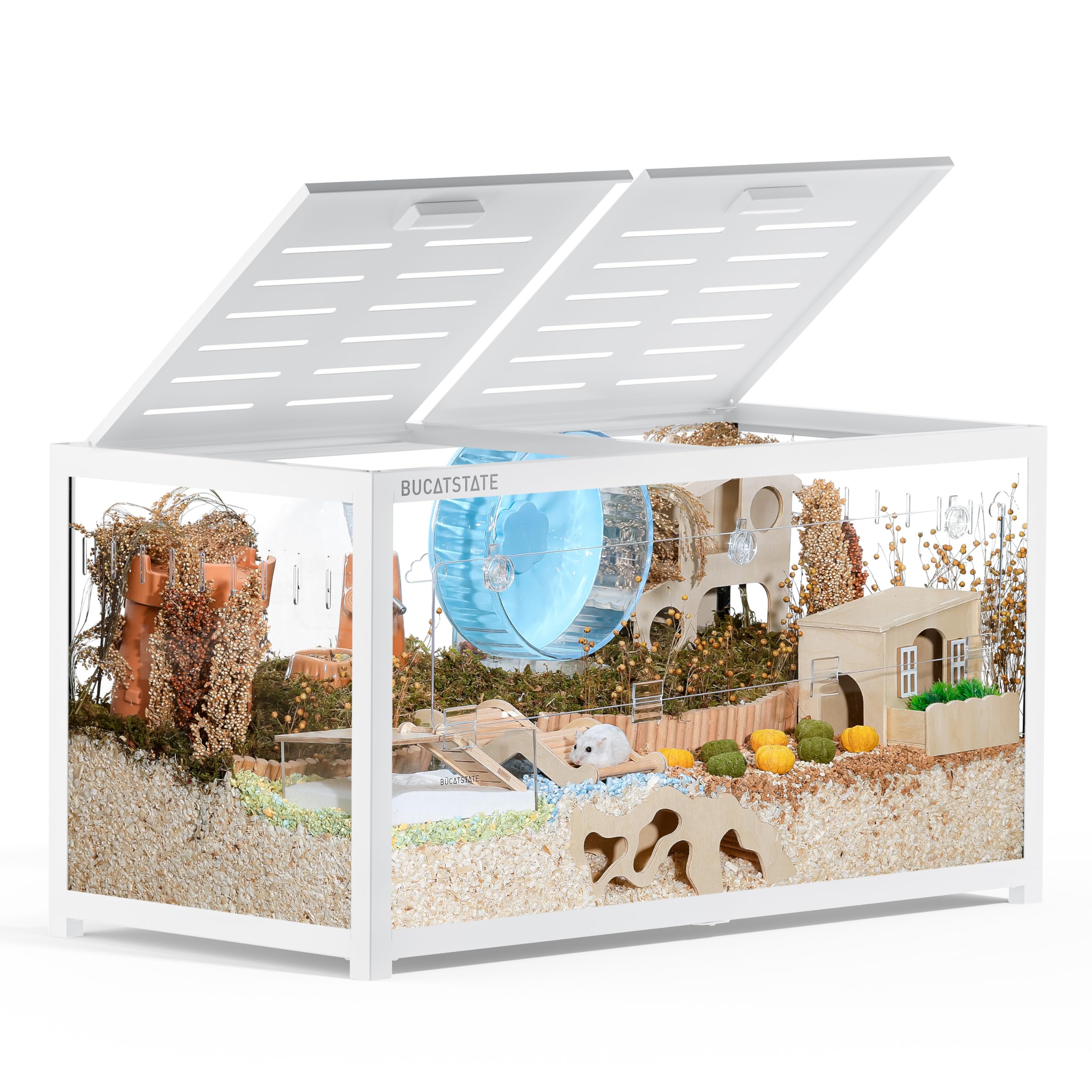
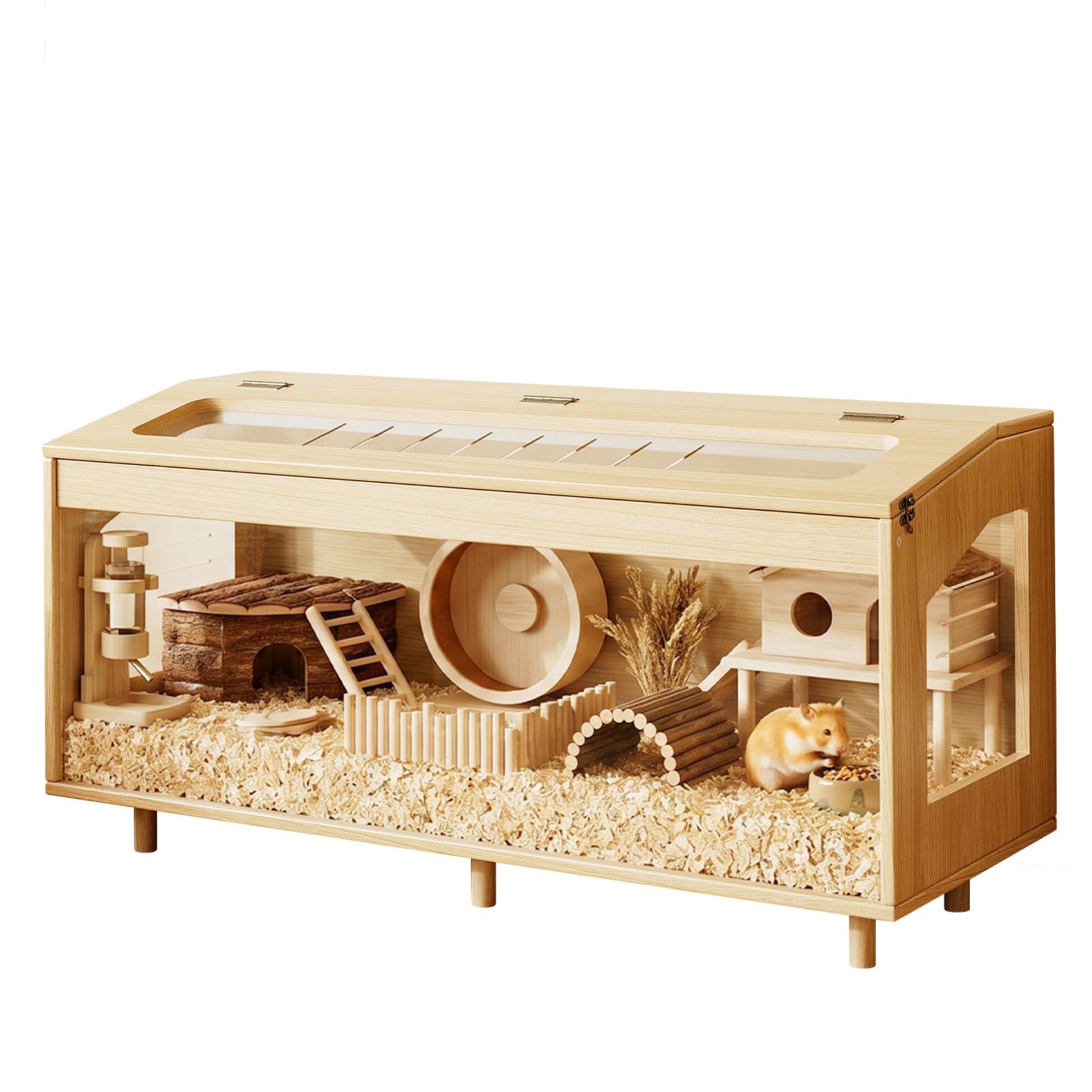
If you have spent any time on hamster YouTube or Instagram, you will have seen the Niteangel Bigger World series. The Size L is the one to look at for an adult Syrian, with a roughly 120 × 60 cm internal footprint, a wooden frame and large glass viewing panels at the front.

The wooden top is what makes this enclosure stand out. It is mesh-vented, so airflow is good, but it also means you can stack accessories, hang chews and create natural foraging set-ups without the visual clutter of bars. The glass front is brilliant for nervous hamsters that retreat when something looms over them — they get to see you coming at their level rather than always from above.

It is more of an investment than a Plaza 120, and it does require some assembly. The size and weight also mean you really do want to choose its forever location before you set it up.

What we like:

  • Roughly 120 × 60 cm of usable floor space
  • Large glass front is excellent for shy hamsters and bonding
  • Wooden top blends into a living room better than wire cages
  • Generous bedding depth supports natural digging
  • Strong UK availability via Amazon and Niteangel’s UK site

Worth knowing:

  • Higher upfront cost than wire cages
  • Heavy and awkward to move once assembled
  • Wood will absorb moisture if you over-soak the bedding
  • Glass front needs a quick wipe most days

Specifications:

  • Dimensions (L): approximately 120 × 60 × 51 cm
  • Materials: birch ply frame, tempered glass front, mesh-vented top
  • Suitable for: Syrian and dwarf hamsters, including Robos with mesh-spacing care
  • Bedding depth: easily 25 cm+
  • Indoor use only

3. Savic Plaza 100

Best for: a slightly smaller, slightly cheaper alternative to the Plaza 120.

Not everyone has the floor space for a full 120 cm cage, and not every household has the budget either. The Savic Plaza 100 is the same family of design as the 120 — same plastic base, same bar style, same large front and top doors — just scaled down to roughly 100 × 50 × 50 cm.

That floor area sits right on the commonly quoted welfare minimum, which makes it a sensible choice for a single dwarf hamster. For an adult Syrian we would push you towards the 120 or a Niteangel where possible, but the Plaza 100 is still a major upgrade over the small wire cages and tube modular kits you see in supermarkets.

The price point is its main draw — typically £75 to £100, depending on retailer and whether it is on offer at Pets at Home or Zooplus.

What we like:

  • Meets the commonly cited 100 × 50 cm welfare minimum
  • Same useful front-door design as the Plaza 120
  • Easier to fit on a standard sideboard or wide desk
  • Widely stocked in the UK
  • Good price for the quality of build

Worth knowing:

  • On the small side for a happy Syrian — go larger if you can
  • Stock plastic accessories are mostly decorative for adult hamsters
  • Top section adds height but limited usable floor space

Specifications:

  • Dimensions: approximately 100 × 50 × 50 cm
  • Bar spacing: 9 mm
  • Suitable for: dwarf hamsters; minimum-spec for Syrian
  • Bedding depth: around 12–15 cm
  • Indoor use only

4. Little Friends Langham XL Small Animal Cage

Best for: the best budget XL cage if you cannot stretch to a Plaza or Niteangel.

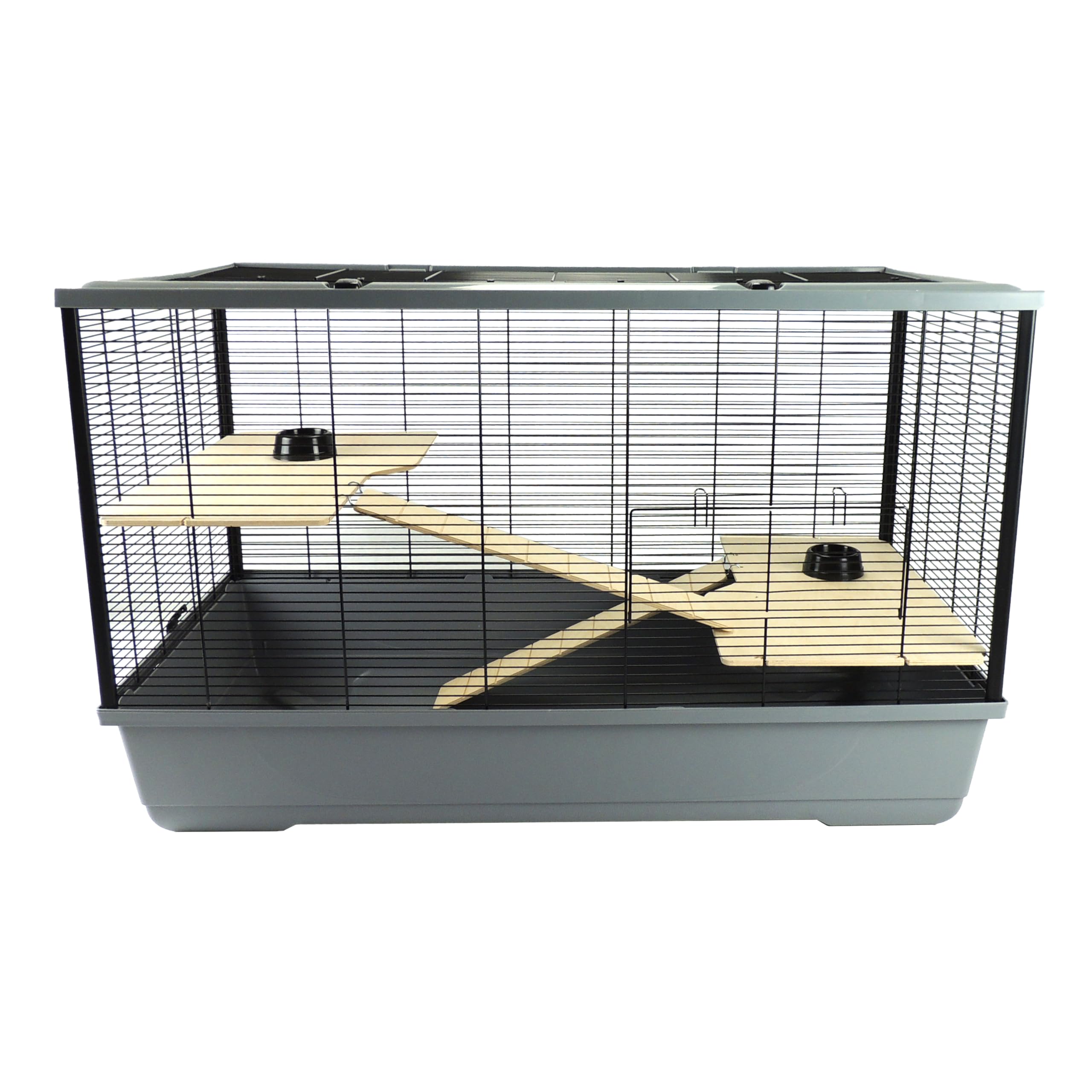
Not everyone has £130 to spend on a starter cage, and the Little Friends Langham XL is the cage we would point first-time owners towards on a budget. It comes in black or grey, with narrow bar spacing to stop dwarf hamsters slipping through, and it includes a wooden shelf, ladder and small starter accessories.

It is not as deep-based as the Savic or Niteangel options, which is its main weakness — you can layer 8–10 cm of bedding before it tips over the lip. Many owners solve this with a clip-on perspex bedding extender, which keeps the deeper bedding contained without spending another £80 on a new cage entirely.

Build quality is a step below Savic — some owners report rusting if the cage is wiped down too damp — but for a beginner who wants to test the water before committing to a premium cage, it does the job.

What we like:

  • XL footprint at a budget-friendly price
  • Narrow bar spacing suits dwarf hamsters
  • Comes with a few starter accessories
  • Easy to assemble — under 30 minutes
  • Solid Amazon UK reviews across thousands of buyers

Worth knowing:

  • Shallow base limits bedding depth without an extender
  • Powder coating can chip if scrubbed with abrasive sponges
  • Plastic shelf is not very chew-resistant
  • Smaller front door than the Savic Plaza models

Specifications:

  • Dimensions: approximately 100 × 54 × 45 cm
  • Bar spacing: 9 mm
  • Suitable for: dwarf hamsters; Syrians benefit from a deeper bedding extender
  • Materials: powder-coated steel and moulded plastic
  • Indoor use only

5. Ferplast Hamster Maxi Duo

Best for: a modular two-tier cage with a generous front opening.

Ferplast is best known in the UK for its small pet ranges, and the Hamster Maxi Duo is one of its larger options. Floor space is roughly 100 × 50 cm — comparable to the Savic Plaza 100 — but the Maxi Duo adds a clip-in upper level and a deep moulded base.

The deep base is the standout feature for natural-set-up fans. There is enough depth to layer paper-based bedding generously without worrying about it spilling out every time the hamster digs. The two-tier layout suits owners who want to add a sand bath or hideout up top while keeping the main bedding area clear below.

It is heavier than the Plaza 100, slightly more awkward to disassemble for deep cleaning, and the upper plastic shelf is not always loved by adult Syrians. But for owners who want a deep base out of the box, it is worth a look.

What we like:

  • Deeper moulded base than most wire cages
  • Two-tier layout adds usable vertical space
  • Wide front opening for easy access
  • Strong build that handles years of use
  • Frequently discounted at Zooplus UK and Amazon

Worth knowing:

  • Heavier than the Savic Plaza 100
  • Plastic top shelf is mostly decorative for Syrians
  • Bar spacing is fine for dwarfs but check on Roborovskis
  • Cleaning the moulded corners takes longer

Specifications:

  • Dimensions: approximately 100 × 50 × 50 cm
  • Bar spacing: 9.5 mm
  • Suitable for: Syrian and dwarf hamsters
  • Bedding depth: around 18 cm in the deepest part of the base
  • Indoor use only

Buying Guide: How to Choose the Best Hamster Cage

What to Look For

The single most important number is unbroken floor space. UK welfare advice has been moving steadily towards a minimum of 100 × 50 cm of continuous, single-level floor for any hamster — Syrian or dwarf. Tall multi-storey cages with tiny footprints look fun in the box, but they are not the same as real horizontal space, which is what hamsters actually use.

After floor space, look at bedding depth. A cage with a 5 cm lip will never hold the 15–20 cm of bedding hamsters use to dig and tunnel naturally. Look for deep moulded bases, glass tanks or wooden enclosures with high sides.

Bar spacing matters too. 9 mm is the standard for hamsters; anything wider risks a Roborovski escape. Mesh tops on glass or wooden enclosures must be welded, not woven, to avoid gnawed gaps.

Types of Hamster Cage

Wire cages with plastic bases are the most common — easy to clean, well ventilated, but limited on bedding depth. Wooden enclosures with glass fronts give the deepest bedding and the calmest environment, but they cost more and are heavier to handle. Glass tanks (often repurposed aquariums) work brilliantly but require a bespoke mesh lid.

Modular tube systems sold in pet shops are best avoided for adult hamsters. The narrow tubes can cause back issues for adult Syrians and are very difficult to clean.

Sizing Guide

  • Welfare minimum: 100 × 50 cm of continuous floor space
  • Recommended for Syrians: 120 × 60 cm or larger
  • Recommended for dwarfs: 100 × 50 cm minimum, more is always better
  • Bedding depth: 15 cm or more in at least one section
  • Bar spacing: 9 mm, no wider

How Much Should You Spend?

Budget (under £80): the Little Friends Langham XL is the most defensible budget option, especially if you add a clip-on bedding extender. Avoid anything smaller than 100 × 50 cm at any price.

Mid-range (£80–£120): the Savic Plaza 100 and Ferplast Hamster Maxi Duo both sit comfortably in this range and represent the sweet spot for most first-time owners.

Premium (£120+): the Savic Plaza 120 and Niteangel Bigger World L are the cages we would buy ourselves. They cost more, but they last for years and are far less likely to be replaced once you realise the starter cage is too small.

Frequently Asked Questions

How big should a hamster cage be?

A reasonable working minimum in the UK is 100 × 50 cm of continuous, single-level floor space for any hamster — Syrian or dwarf. Bigger is almost always better. Multi-storey cages with tiny footprints do not count the upper floors towards that minimum.

Are wire or wooden cages better for hamsters?

Both can work. Wire cages are easier to ventilate and clean but limit bedding depth. Wooden enclosures (such as the Niteangel Bigger World) hold deeper bedding and give a calmer, glass-fronted environment, but they cost more and are heavier. Either is fine, provided the floor space is adequate.

Can two hamsters live in one cage?

Syrians are strictly solitary and must always be housed alone. Some dwarf hamster pairs (Russian Campbell or Winter White) can be kept together if they are bonded littermates, but most experienced owners now recommend solo housing for dwarfs as well to avoid injury from later fights.

Do I need a special cage for a Syrian hamster?

Not a different type of cage, but a larger one. Syrians benefit from at least 120 × 60 cm of floor space because they grow significantly bigger than dwarfs. The Savic Plaza 120 and Niteangel Bigger World L are both designed with Syrian-sized residents in mind.

How often should I clean a hamster cage?

Spot-clean wet patches and food bowls daily. A full bedding change every 2–4 weeks is usually plenty for a well-sized cage with deep bedding. Cleaning too often actually stresses hamsters because it removes their familiar scent.

Final Verdict

Our top pick is the Savic Plaza 120 — it is the cage we point most UK first-time hamster owners towards, because it is large enough to meet welfare guidance straight out of the box, well-built, and widely stocked. If you want a more modern look and even more bedding depth, the Niteangel Bigger World L is worth the extra spend.

On a stricter budget, the Little Friends Langham XL paired with a clip-on bedding extender will give your hamster a far better life than any sub-£40 starter cage on the high street.

Some More Reviews Here..