If your cat wolfs down dinner in seconds and then brings it straight back up on the carpet, a slow feeder bowl is one of the cheapest fixes you can buy. By turning mealtime into a small puzzle, these bowls and mats force your cat to eat around ridges, tubes or bristles instead of gulping from an open dish, which eases the vomiting that fast eaters are prone to. They also add a welcome dose of mental stimulation to the day, which matters a great deal for indoor cats.
The trick is matching the design to your cat, because a ridged maze bowl, a foraging feeder, a lick mat and a rolling ball feeder all work differently. Below we round up the best slow feeder cat bowls in the UK for 2026, from budget to premium, with a buying guide to help you choose.
Quick Comparison Table
| Product | Best For | Price Range | Rating |
| Catit Senses 2.0 Digger | Best all-rounder for dry food | £12-16 | ⭐⭐⭐⭐⭐ |
| Northmate Catch Interactive Cat Feeder | Fast eaters and gulpers | £20-28 | ⭐⭐⭐⭐⭐ |
| LickiMat Buddy for Cats | Wet food and anxious cats | £5-9 | ⭐⭐⭐⭐ |
| Trixie Slow Feeding Bowl | Budget pick under £10 | £6-9 | ⭐⭐⭐⭐ |
| PetSafe SlimCat Feeder Ball | Play and portion control | £6-10 | ⭐⭐⭐⭐ |
The Best Slow Feeder Cat Bowls Reviewed
Catit Senses 2.0 Digger
Best for: most cats on dry food that need slowing down and a bit of a challenge.
The Catit Senses 2.0 Digger is the slow feeder most cat owners should try first, because it slows fast eating and adds mental work in one neat unit. Instead of an open bowl, it uses a cluster of upright tubes of different heights fixed to a stable base. You drop the kibble into the tubes and your cat has to fish it out with a paw or nose, which naturally stretches a thirty-second meal into several minutes of gentle effort.
It taps into a cat’s instinct to dig and swat for food, so it works as much for enrichment as for portion control, which is a real plus for bored indoor cats. The base is weighted and grippy enough that it does not skid across the kitchen floor while your cat works at it, and it comes apart for washing without any fiddly corners. Because the tubes come in tall and short heights, you can start easy and make it harder as your cat gets the hang of it.
It is designed around dry food, so it is not the tool for wet food or pate, and a truly determined cat may eventually learn to tip smaller portions out rather than dig. It also takes up more worktop space than a flat bowl. For everyday dry feeding with a side of brain work, though, it is excellent value and hard to fault.
What we like:
- Slows dry feeding and adds real mental stimulation
- Adjustable difficulty with tall and short tubes
- Weighted, non-slip base stays put
- Comes apart easily for washing
Worth knowing:
- Built for dry food, not wet or pate
- A clever cat may learn to tip it
- Takes up more space than a flat bowl
Specifications:
- Type: upright tube digger feeder
- Suitable for: dry food, most adult cats
- Feature: adjustable-height tubes, non-slip base
- Care: dishwasher-safe, splits for cleaning
Northmate Catch Interactive Cat Feeder
Best for: serious gulpers and fast eaters that vomit after wolfing meals.
If your cat inhales food and regularly sicks it back up, the Northmate Catch is the feeder built to stop exactly that. It is a sturdy tray covered in soft, grass-like plastic bristles, and you scatter the kibble down among them so your cat has to nose and paw through the blades to reach each piece. That mimics foraging in long grass and slows even the most determined gobbler right down.
Because the food is spread across a wide area rather than sitting in one heap, there is no way to take a big mouthful, which is what makes it so effective for vomiting-prone eaters. The bristles are gentle on the nose and chin, the base is broad and stable so it does not tip, and the whole thing rinses clean under the tap or goes in the dishwasher. It is a favourite of owners whose cats had defeated every ridged bowl they tried.
It is the priciest option here and, like the Catit, it is made for dry food rather than wet. It also takes up a fair footprint, so it suits a permanent feeding spot more than a tucked-away corner. For a hard-core fast eater where gentler bowls have failed, though, it is the one that finally works, and that peace of mind is worth the extra outlay.
What we like:
- Stops even the most determined gulpers
- Grass-like bristles spread food over a wide area
- Broad, stable base that will not tip
- Rinses clean or goes in the dishwasher
Worth knowing:
- The most expensive feeder on this list
- Designed for dry food, not wet
- Needs a decent-sized permanent spot
Specifications:
- Type: grass-bristle foraging feeder
- Suitable for: fast eaters, dry food
- Feature: soft flexible bristles, wide tray
- Care: dishwasher-safe
LickiMat Buddy for Cats
Best for: wet food, pate and anxious cats that need calming at mealtimes.
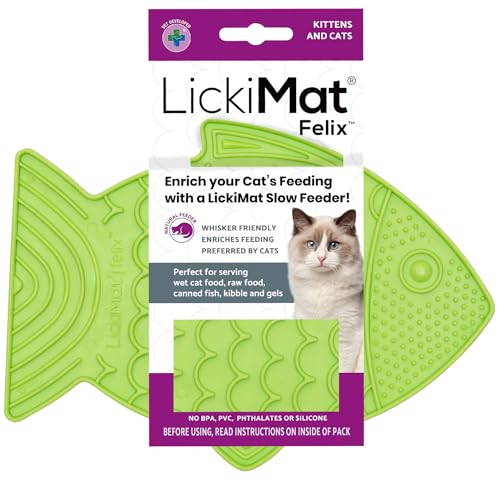
Not every slow feeder is a bowl, and for cats fed on wet food the LickiMat Buddy is the gentlest way to stretch a meal out. It is a flexible rubber mat covered in a textured pattern of soft nubs and grooves designed for cats. You spread wet food, pate, a lick-friendly topper or a little plain yoghurt across the surface and your cat has to work it out of the texture with their tongue, which turns a few licks into several soothing minutes.
The repetitive licking action is naturally calming, so it is a lovely tool for nervous or anxious cats and for keeping a cat settled during something stressful like a vet visit or fireworks. It suits wet food, which most maze bowls handle badly, and the soft base can be pressed onto a floor or the side of a crate to hold it steady. It rinses easily and is a doddle to keep clean, so it slots into daily routines without fuss.
It is a licking mat rather than a bowl, so it is not the answer for measuring out dry kibble portions, and a rough chewer should be supervised in case they try to bite chunks off. Coverage varies a little between the different LickiMat textures. As a gentle, calming slow feeder for wet food, though, it is inexpensive and genuinely useful.
What we like:
- Ideal for wet food and pate
- Repetitive licking soothes anxious cats
- Sticks to floor or crate to stay put
- Cheap and very easy to clean
Worth knowing:
- A mat, not a bowl for measured dry portions
- Supervise rough chewers with any rubber mat
- Coverage varies between textures
Specifications:
- Type: textured licking mat
- Suitable for: wet food, pate, anxious cats
- Feature: soft grip base, cat-specific texture
- Care: hand wash or top rack dishwasher
Trixie Slow Feeding Bowl
Best for: a low-cost ridged maze bowl from a familiar UK brand.
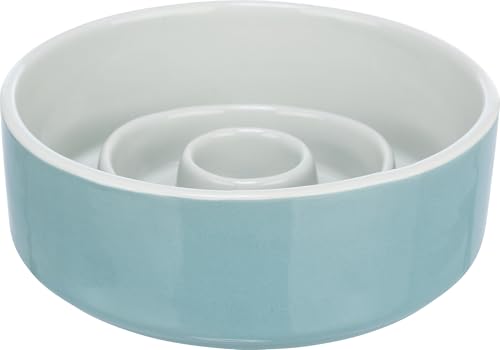
Trixie is a name you will see in most UK pet shops, and its slow feeding bowl is the sensible budget way into puzzle feeding. It is a compact plastic bowl moulded with a pattern of raised ridges and channels, so instead of a clear pool of food your cat has to nudge kibble out from between the bumps. That simple change is often enough to add a minute or two to a fast eater’s meal for only a few pounds.
It is a good first slow feeder if you are not sure how your cat will take to the idea and would rather not spend much finding out. The low profile suits cats that dislike reaching into deep bowls, most versions have a non-slip base or foot to stop it sliding, and being a common high-street brand it is easy to replace or pick up on a normal shopping trip. The ridges are gentle enough not to put off a cautious eater.
At this price the slowdown is milder than a digger or a bristle feeder, so a hardcore gulper may need something tougher, and the moulded channels take a moment more to scrub than a plain bowl. It is best for dry or semi-moist food rather than sloppy wet. As an affordable, no-risk introduction to slow feeding, though, it is great value.
What we like:
- Very affordable and widely stocked
- Low profile suits cats that dislike deep bowls
- Non-slip base on most versions
- Gentle ridges won’t put off a cautious eater
Worth knowing:
- Milder slowdown than a digger or bristle feeder
- Moulded channels take longer to scrub
- Best for dry or semi-moist, not sloppy wet
Specifications:
- Type: ridged maze slow-feeder bowl
- Suitable for: dry and semi-moist food
- Feature: raised ridges, non-slip base
- Brand: Trixie, widely available in the UK
PetSafe SlimCat Feeder Ball
Best for: adding play and exercise to dry feeding and portion control.
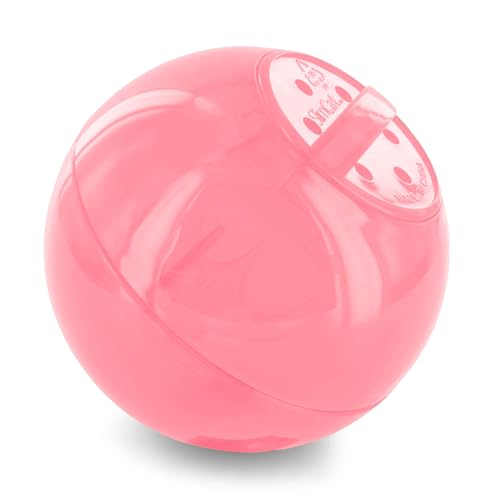
For a cat that needs to move more as well as eat more slowly, the PetSafe SlimCat turns dinner into a game. It is a hollow plastic ball with an adjustable opening that you fill with dry kibble, and as your cat bats and chases it around the floor a few pieces fall out at a time. Feeding this way builds gentle activity into the day, which is a real help for indoor and overweight cats that would otherwise laze by the bowl.
The opening adjusts, so you can make the food fall easily while your cat learns and then tighten it up to keep them working once they have the idea. It doubles neatly as portion control, since a measured scoop of the daily ration goes in and is dispensed slowly through play rather than gobbled at once. It comes apart to fill and wash, and it is light and cheap enough to be an easy first try.
Because it rolls around the floor it makes a bit of noise on hard flooring and can end up under the sofa, and it only works with dry kibble of the right size, not wet food. Very timid cats may take a while to warm to a moving feeder. For an active, food-motivated cat that benefits from exercise and slower eating together, though, it is brilliant value.
What we like:
- Builds exercise into every meal
- Adjustable opening sets the difficulty
- Doubles as simple portion control
- Light, cheap and easy to fill
Worth knowing:
- Rolls noisily on hard floors and hides under furniture
- Dry kibble only, not wet food
- Timid cats may take time to warm to it
Specifications:
- Type: rolling kibble-dispensing ball
- Suitable for: dry food, active cats
- Feature: adjustable dispensing hole
- Care: splits open to fill and wash
Slow Feeder Cat Bowl Buying Guide
What to look for when buying a slow feeder cat bowl
Start with what your cat eats and why they need slowing down, because that decides the design more than anything. For dry food and a determined gulper, a digger or a bristle foraging feeder gives the biggest slowdown, while a ridged maze bowl is a gentler nudge. If your cat is fed wet food or pate, a licking mat is the tool that actually works, and an active or overweight cat can benefit from a rolling ball feeder that adds exercise.
After that, look at stability, cleaning and material. A non-slip base or a weighted design stops the feeder skidding across the floor while your cat works at it, which otherwise turns dinner into a chase. Dishwasher-safe or smooth, easy-rinse surfaces matter because puzzle feeders trap food in their crevices, and food-safe, sturdy plastic or rubber lasts far longer than flimsy moulded bowls. A low profile also helps cats that dislike reaching into deep dishes.
Slow feeder types explained
Maze and ridged bowls are the simplest, using raised ridges and channels to break up an open dish, and they suit cats that need only a mild slowdown on dry or semi-moist food. Digger feeders such as the Catit use upright tubes your cat must reach into, adding more challenge and mental work. Foraging feeders like the Northmate scatter food among grass-like bristles for the strongest slowdown, ideal for serious gulpers.
Licking mats are a different animal, spreading wet food or pate across a textured surface so your cat licks rather than gulps, which also calms anxious cats. Ball and rolling feeders dispense dry kibble through play, combining slower eating with exercise. Many owners end up with two: a bowl or mat for everyday meals and a ball feeder or digger to keep an indoor cat busy.
Size and portion guide
Match the feeder to your cat’s face and portion. Flat-faced breeds such as Persians and Exotics struggle with deep tubes and tight ridges, so a shallow maze bowl or a licking mat is kinder for them, whereas a long-nosed cat manages a digger or bristle feeder easily. Kittens and senior cats do best starting with an easy, low-effort design and building up, so mealtimes do not become frustrating.
Portion size matters too. A puzzle feeder should hold your cat’s normal measured meal without overflowing, so check the capacity if your cat eats larger portions, and in a multi-cat home give each cat their own feeder to avoid squabbles and to keep an eye on who is eating what. Start any new slow feeder on its easiest setting so your cat succeeds early and stays keen.
How much should you spend?
You do not need to spend much for a good slow feeder. Budget maze bowls and licking mats start from around £5 to £9, and a quality digger such as the Catit Senses 2.0 sits at roughly £12 to £16, which covers most cats comfortably. For a mild-to-moderate fast eater, that is really all you need, and a cheap ball feeder adds play for a few pounds more.
Premium foraging feeders such as the Northmate Catch cost £20 or more, and the extra is worth it only if you have a serious gulper that has defeated cheaper bowls or a cat that vomits after wolfing meals. Many owners settle on an inexpensive maze bowl or lick mat for everyday feeding and add a digger or foraging feeder only if their cat truly needs the bigger challenge.
Frequently asked questions
Do slow feeder bowls really stop cats being sick?
For cats that vomit because they eat too fast, yes, a slow feeder often helps a great deal, because spreading the food out stops them taking big gulps and swallowing air. If the sickness continues once eating has slowed, or happens away from mealtimes, it is worth a chat with your vet to rule out other causes rather than assuming the bowl alone will fix it.
Can I use a slow feeder for wet food?
Most maze bowls, diggers and ball feeders are designed for dry kibble and cope badly with sloppy wet food. For wet food or pate, a licking mat such as the LickiMat Buddy is the right tool, since your cat licks the food out of the texture. Some silicone slow-feeder mats also handle soft food if you prefer a larger surface.
How do I get my cat to use a new slow feeder?
Start on the easiest setting so your cat wins quickly and does not give up, using a shallow bowl, wide tube spacing or a loose ball opening. Feed a favourite food from it at first, let your cat watch and sniff, and make it harder only once they have the hang of it. Patience in the first few meals pays off.
Are slow feeders suitable for kittens and senior cats?
Yes, as long as you choose a gentle design and start easy. A shallow maze bowl or a licking mat suits kittens and older cats better than a deep digger or a bristle feeder, which can be frustrating for little paws or stiff joints. Keep an eye on early sessions and step up the difficulty only if your cat is clearly enjoying the challenge.
How do I keep a slow feeder clean?
Puzzle feeders trap food in their ridges and tubes, so rinse them after each meal and give a proper wash daily, especially with wet food. Choose a dishwasher-safe design if you can, and take apart any feeder that splits into pieces so you can reach every crevice. Letting food dry in the grooves is the main reason cats go off a feeder.
Conclusion
For most cats and owners the Catit Senses 2.0 Digger is the slow feeder to buy first: it slows dry feeding, adds proper mental stimulation, stays put on the floor and costs very little. Pair it with a cheap LickiMat Buddy if your cat is fed wet food and you have a kit that handles almost every mealtime.
For a serious gulper that has beaten every other bowl, the Northmate Catch is worth the extra to finally stop the wolfing and the vomiting, while an active or overweight cat benefits from the exercise of the PetSafe SlimCat ball. On the tightest budget, the Trixie slow feeding bowl introduces puzzle feeding for next to nothing.