Cardboard scratchers are the cheapest piece of cat furniture you will ever buy and, judged by hours of use per pound, easily the best value. Corrugated cardboard shreds satisfyingly under claws in a way carpet and rope do not, which is why a cat that has ignored an expensive sisal post for months will settle onto a £10 cardboard pad within an hour of it appearing.
They are not all the same, though. Density of the corrugation, the direction of the flutes, whether the board is glued edge-on or laid flat, and whether the thing stays put when a cat throws its weight at it all make a real difference to how long one lasts. Below are the best cat cardboard scratchers in the UK, with a buying guide on placement, refills and stopping the mess.
Quick Comparison Table
| Product | Best For | Price Range | Rating |
| Flat Corrugated Scratch Pad | Best all-rounder for most cats | £8-18 | ⭐⭐⭐⭐⭐ |
| Reversible Lounger Scratcher | Best for cats that sleep where they scratch | £15-30 | ⭐⭐⭐⭐⭐ |
| Inclined Ramp Scratcher | Best for a natural stretching angle | £12-25 | ⭐⭐⭐⭐ |
| Vertical Cardboard Post | Best for upright scratchers and furniture-savers | £15-30 | ⭐⭐⭐⭐ |
| Cardboard Scratcher House | Best for hiding, playing and scratching in one | £20-45 | ⭐⭐⭐⭐ |
The Best Cat Cardboard Scratchers Reviewed
Flat Corrugated Scratch Pad
Best for: most cats, most homes, and anyone buying their first cardboard scratcher.
The plain rectangular pad is the format that started all this and it remains the one to buy first. Strips of corrugated board are glued together on edge so the open flutes face upwards, giving a dense field of cardboard channels for claws to sink into. Most come with a sachet of dried catnip to sprinkle into the grooves, and the better ones sit inside a stiff card frame that keeps the block square as it wears.
Its strength is that it fits how cats actually behave. A horizontal pad on the floor lets a cat plant its back feet and pull backwards through the board, which is the natural motion for most cats after a nap, and because it is flat it can go anywhere — beside the sofa, at the foot of the bed, in a hallway. Being cheap, you can put three around the house rather than one, and covering the routes a cat already uses is far more effective than trying to redirect it to a single spot. Most flat pads are also reversible, so flipping the block over once one face is chewed out roughly doubles the working life.
The compromises are shedding and drift. Every cardboard scratcher produces a scattering of small shreds, and a flat pad on a hard floor slides across the room as the cat works on it, which some cats find off-putting enough to abandon. A cheap pad with loose, low-density corrugation will hollow out in weeks rather than months. Choosing one with a heavier frame and putting it on a rug or against a wall fixes most of that.
What we like:
- Matches the natural backwards-pull scratching motion
- Cheap enough to place several around the house
- Reversible, which roughly doubles its life
- Fits anywhere, including tight gaps beside furniture
Worth knowing:
- Slides on laminate and tile without a mat under it
- Sheds cardboard shreds around it
- Low-density board hollows out quickly
Specifications:
- Material: double-wall corrugated cardboard in a card frame
- Typical size: 40-55cm long, 20-25cm wide
- Orientation: horizontal, usually reversible
- Suitable for: cats of all ages, including kittens and seniors
- NATURAL CLAW CARE: This sturdy corrugated cardboard scratcher provides the right resistance for daily, instinctive claw maintenance
- WITH CATNIP: Included catnip encourages your cat to scratch, play and settle – adding extra appeal straight out of the box
- VERSATILE: Compact enough to use on its own or alongside existing cat furniture as an additional scratching surface
- FURNITURE PROTECTION: An appealing alternative to sofas, carpets and wallpaper, helping to redirect unwanted scratching
- ECO-FRIENDLY AND LIGHTWEIGHT: Made from natural, renewable materials – easy to position and simple to replace when needed

Reversible Lounger Scratcher
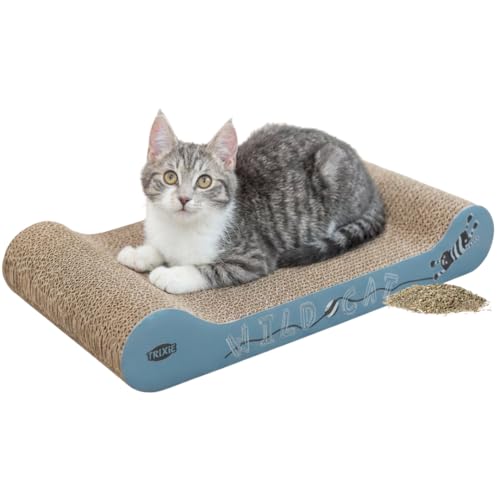
Best for: cats that want to scratch and then immediately sleep on the same thing.
The lounger is a long curved or S-shaped block of corrugated board, wide enough for a cat to lie along and shaped so there is a raised end to rest a chin on. Most are reversible, with the curve working as a shallow bed one way up and a steeper scratching ramp the other. It is the format that most often gets adopted as a permanent sleeping spot rather than just a bit of equipment.
That dual use is the point. Cats scratch most enthusiastically immediately after waking, so a surface that is both the bed and the scratcher captures that moment better than a post on the other side of the room ever will. The larger footprint also means far more board, so a good lounger outlasts several flat pads, and the curve gives a cat a choice of angles to work at rather than a single flat plane. They sit stably on their own weight, so sliding is much less of an issue.
The downsides are size and price. A lounger takes up as much floor as a small side table and there is no folding it away, which matters in a flat, and it costs two or three times a basic pad. Cheaper versions use thin board and a flimsy outer wrap that splits along the seam within a couple of months. It is also the format most likely to end up covered in fur, so it needs vacuuming regularly to stay pleasant.
What we like:
- Doubles as a bed, capturing the post-nap scratch
- Far more board than a flat pad, so it lasts longer
- Curved shape offers several scratching angles
- Heavy enough not to slide about
Worth knowing:
- Takes up a permanent chunk of floor space
- Cheap versions split along the outer wrap
- Collects fur and needs regular vacuuming
Specifications:
- Material: high-density corrugated cardboard, card or wood-effect surround
- Typical size: 50-65cm long, 22-30cm wide
- Orientation: reversible, curved lounge one way and ramp the other
- Suitable for: single cats and bonded pairs, all ages

- GREAT VALUE: 15 x 8 x 2 inches. Two Reversible 1" thick inserts housed inside the outer box for 4x the use. Premium quality material offers a long-lasting experience
- WIDE DESIGN: Large surface area to hold multiple or larger cats & provide generous scratching space
- PROTECT YOUR HOUSE AND FURNITURE: Helps train cats away from furniture and carpet
- CATNIP INCLUDED: for added enticement
- International products have separate terms, are sold from abroad and may differ from local products, including fit, age ratings, and language of product, labeling or instructions.
Inclined Ramp Scratcher
Best for: cats that stretch out fully, and homes short on floor space.
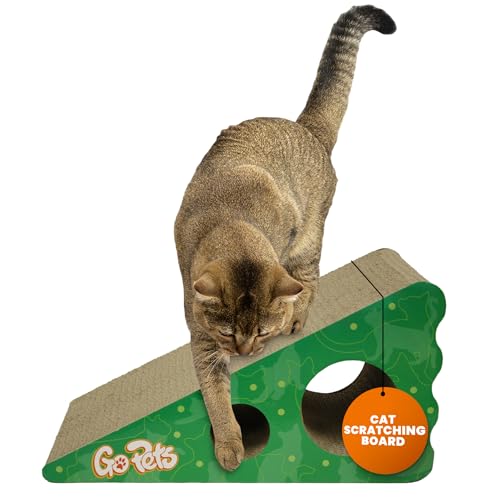
An inclined scratcher props the board at roughly forty-five degrees, usually on a simple wooden or heavy card wedge frame. That angle sits between the horizontal pad and the vertical post, and for a lot of cats it is the sweet spot: they can reach up and forward, get a full body stretch through the shoulders and back, and still dig in with real force because the base is braced against the floor.
It is also efficient with space. A ramp pushed against a wall or the side of a sofa occupies a narrow strip rather than a rectangle of open floor, which makes it a sensible choice in a small flat, and placing one against a sofa arm that is already being scratched is the most reliable way of redirecting that behaviour. Many ramps take standard replaceable cardboard inserts, so you keep the frame and buy refills, which works out cheaper over a couple of years and produces less waste.
Two things to watch. The frame needs enough weight or grip at the base, because a light ramp on a hard floor will skate away under a determined cat and put it off entirely. And the angled board tends to wear unevenly, with the middle third hollowing out while the top and bottom stay untouched, so you get less usable life out of each insert than a flat pad of the same size. Rotating the insert end for end when it starts to dish helps.
What we like:
- Angle allows a full shoulder and back stretch
- Narrow footprint against a wall or sofa
- Frame takes cheap replaceable inserts
- Good for redirecting cats from sofa arms
Worth knowing:
- Light frames slide on hard floors
- Board wears unevenly in the middle
- Frame quality varies a lot at the budget end
Specifications:
- Material: corrugated insert on a wood or heavy card frame
- Typical size: 45-55cm long, set at 40-50 degrees
- Orientation: inclined, refillable on most models
- Suitable for: adult cats, particularly enthusiastic stretchers
- Great cat scratcher, save money and protect your house and furniture from eyesores. Extra thick, long lasting, and reversible cat scratcher last 2-3X longer than traditional cat scratchers.
- Give your cats an acceptable place to feed their scratching urges. Comfortable natural incline scratcher for your cat is more ergonomic than other cat scratching products such as a cat scratching post, cat tree, or cat tower.
- Environmentally friendly and recyclable. Made with recycled corrugated cardboard the cat scratcher is recyclable even after your cat is done with it to minimize your carbon footprint compared to cat trees, cat towers, or cat scratching posts
- Includes free catnip. Attracts your cat and helps you entice your cats to have good scratching habbits. Additional cut outs to place a cat toy to help keep your cats interested and entertained for hours!
- Buy now with confidence. You'll be completely taken care of if for any reason you are unhappy with your purchase!
Vertical Cardboard Post
Best for: cats that scratch upright, and protecting door frames and wallpaper.
Some cats are horizontal scratchers and some are vertical, and there is little point arguing with which one you have. A vertical cardboard post wraps or stacks corrugated board around a column on a weighted base, giving the full upward stretch of a sisal post but with the surface cats generally prefer. Heights vary, and the useful ones are tall enough that a cat can reach up on its back legs without hunching.
The reason to choose cardboard over sisal here is uptake. Plenty of owners have a perfectly good sisal post being ignored while the cat works on the wallpaper, and swapping the surface for corrugated board frequently solves it overnight. A vertical post also serves the territorial marking side of scratching better than a floor pad, since visible claw marks at height are part of the point for a cat. Placing one immediately next to whatever is currently being damaged, rather than in a tidy corner, is what makes the swap work.
The engineering is the weak spot. Cardboard has less structural strength than a sisal-wrapped timber post, so a tall cardboard column needs a genuinely heavy base or it rocks, and a wobbling post is one a cat will not trust its weight to. They also wear fastest at exactly the height a cat uses most, leaving a scalloped section halfway up while the rest is pristine. Larger cats are better served by a hybrid with a solid core.
What we like:
- Gives the full upright stretch cats want
- Cardboard surface tempts cats that ignore sisal
- Suits the territorial, visible-marking side of scratching
- Easy to site directly next to a damaged door frame
Worth knowing:
- Needs a heavy base or it rocks and gets abandoned
- Wears into a scallop at the cat’s favourite height
- Less sturdy than sisal for large or heavy cats
Specifications:
- Material: layered corrugated cardboard on a weighted base
- Typical size: 40-60cm tall, 15-25cm base
- Orientation: vertical, some models rotatable
- Suitable for: upright scratchers, cats up to about 6kg
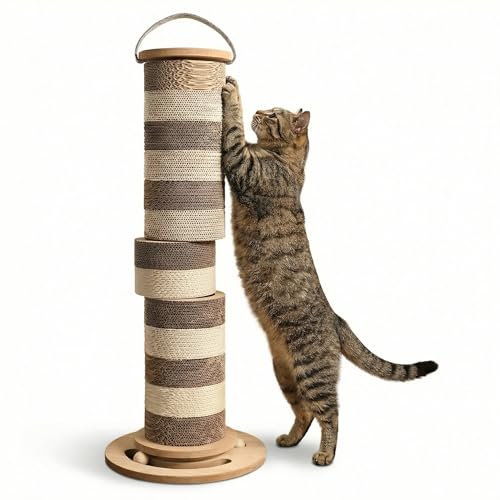
- Modular Replaceable Design: Features stackable corrugated cardboard blocks that can be rotated or individually replaced when worn—extending the life of your scratching post without discarding the entire unit. The innovative modular system targets the "one-spot scratching" problem by allowing you to refresh heavily used sections while keeping the rest intact, reducing waste and saving money over traditional single-piece scratchers.
Cardboard Scratcher House
Best for: kittens, playful cats and anyone who wants one item to do three jobs.
The scratcher house is a flat-pack cardboard box with a scratching surface built into the floor, the roof or both, often with a couple of cut-out windows and a doorway. Some are plain and functional, others are made to look like a bus, a cottage or a rocket, and there is no real performance difference between them beyond how much you like looking at it.
As enrichment it works because it stacks three cat needs into one object. Cats want somewhere enclosed to hide, somewhere raised to sit, and something to scratch, and a house with a scratch pad in the base and a flat roof provides all three in the footprint of a large shoebox. Kittens in particular take to them fast, and the cut-out windows turn into a game with anything dangled through them. Being cardboard, they cost a fraction of a cat tree and can be recycled without guilt when they wear out.
The compromises are strength and lifespan. A cardboard house holds a cat sitting on the roof but not a heavy cat launching onto it, and the walls soften and bow if the room is damp or if a cat decides the corners are also scratchable. Assembly on the cheaper ones can be fiddly and the tabs tear easily. Expect months rather than years, and buy it as a fun, replaceable item rather than a permanent piece of furniture.
What we like:
- Combines a hide, a perch and a scratcher in one
- Excellent value against a cat tree
- Kittens take to them almost immediately
- Fully recyclable at the end of its life
Worth knowing:
- Walls bow under a heavy cat or in a damp room
- Assembly tabs tear if forced
- Months of life rather than years
Specifications:
- Material: double-wall cardboard with corrugated scratch inserts
- Typical size: 45-60cm long, 30-40cm tall
- Orientation: horizontal base pad, some with roof pad
- Suitable for: kittens and adult cats up to about 5kg
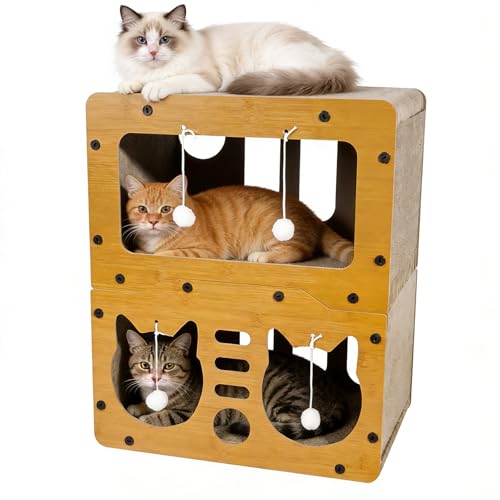
- 【Note】: Suitable for kittens and young kittens! Maximum weight capacity is 22 lbs.
- 【Unlimited Scratching House】Unlimited fun for furry kids! Multifunctional cardboard cat scratchers house provide your adorable cats with space to scratch, hide, comfortably play and rest. 4 hanging ball toys allow cats to play and relieve boredom, while also protecting furniture. Great for kittens and young cats!
- 【Double-Layer Large Cat Scratch House】: This cat scratcher measures 16.5 inches L x 11 inches D x 20 inches H, providing ample and comfortable stretching, scratching, and resting space for your cat. The double-layer design allows multiple cats to use it simultaneously, creating a fun-filled play area for your beloved pet.
- 【Premium Materials】: This cat scratch pad is made of high-density corrugated cardboard and a sturdy wooden frame, ensuring durability, structural stability, and minimal paper lint shedding. It provides a comfortable scratching experience for your cat and is suitable for frequent daily use.
- 【Furniture Protection】 Cat scratching boards provide your pet with a dedicated scratching and resting area, effectively protecting your furniture from unnecessary scratches, helping your cat relieve stress and maintain healthy claws, making them ideal for families looking to reduce furniture damage.
Bulk Refill Pack
Best for: multi-cat households, and keeping the running cost down.
Once you know which frame your cat uses, buying the corrugated inserts in a multipack rather than buying whole new scratchers is a straightforward saving. Refill packs of three to six plain blocks, sized to the common frame dimensions, typically cost little more than two individual scratchers and mean you always have a fresh one to hand rather than leaving a hollowed-out block down because you have not got round to replacing it.
The practical benefit goes beyond money. In a multi-cat house, cats are reluctant to share a scratching surface that another cat has heavily marked, so having several fresh blocks placed in different rooms genuinely reduces friction and cuts down on furniture damage. Refills are also the low-waste option, since the frame — often the only part with any plastic or wood in it — stays in use.
The obvious catch is compatibility. Frames are not standardised, and a refill that is two centimetres too wide simply will not seat, so measure the internal dimensions of your existing frame before ordering rather than trusting a product listing. Plain refills also usually arrive without catnip, so buy a shaker separately. And they need somewhere dry to be stored, as cardboard left in a garage or shed goes soft and loses its bite.
What we like:
- Much cheaper per block than buying whole scratchers
- Fresh surfaces in several rooms reduce multi-cat tension
- Keeps the frame in use, so less waste
- Means a worn block actually gets replaced
Worth knowing:
- Frame sizes are not standardised — measure first
- Usually supplied without catnip
- Needs dry storage or the board goes soft
Specifications:
- Material: corrugated cardboard blocks, no frame
- Typical pack: 3-6 blocks
- Orientation: to suit flat and inclined frames
- Suitable for: multi-cat households and heavy scratchers
No products found.
Cat Cardboard Scratcher Buying Guide
What to look for when buying a cardboard scratcher
Density is the single biggest factor in how long a scratcher lasts, and it is the one manufacturers say least about. Press a thumb into the exposed flutes: a dense block resists and springs back, a cheap one crushes. Tightly packed, double-wall board with narrow flutes takes months of daily work, while loose single-wall board hollows out in weeks and ends up costing more over a year. Weight is a decent proxy — of two scratchers the same size, the heavier one is almost always the better buy.
Then consider stability and glue. Anything a cat can push across the floor will be abandoned, so look for a heavy base, a wide frame or a non-slip underside, and be prepared to add a rubber mat underneath on laminate. Check too that the adhesive holding the strips together is a plain non-toxic starch or PVA type, since cats will inevitably ingest small amounts of board. Finally, look for a reversible or refillable design, which is the easiest way to double the value of the same purchase.
Cardboard scratcher types explained
Horizontal formats — flat pads, loungers and ramps — suit the majority of cats, because most domestic cats scratch on the floor after waking and pull backwards through the surface. Flat pads are the cheap, flexible option, loungers add a bed and much more board, and inclined ramps give a fuller stretch in a narrower footprint while usually taking replaceable inserts.
Vertical formats — cardboard posts and wrapped columns — suit the minority of cats that stretch upwards against door frames and wallpaper, and they serve the visible territorial marking side of scratching better. Houses and boxes combine a scratch surface with a hide and a perch, which works particularly well for kittens. If you do not know which your cat is, watch what it currently damages: the surface and angle of the damage tells you exactly which format to buy.
Size guide
The rule that matters is that a scratcher must be longer than your cat’s fully stretched body, not its curled-up length. For an average domestic shorthair that means at least 45cm of usable surface; for a Maine Coon, Ragdoll, Norwegian Forest or other large breed, look for 60cm or more. A scratcher a cat cannot stretch out on gets a few token swipes and is then ignored in favour of the sofa, which is the most common reason a perfectly good scratcher fails.
Height matters equally for vertical posts. A cat should be able to reach up onto its back legs and still have board above its front paws, which for most cats means a minimum of 50cm and preferably 60cm. Kittens can use adult-sized scratchers perfectly well, so there is no need to buy small and replace later. In multi-cat homes, plan on one scratching surface per cat plus one spare, spread across different rooms rather than lined up together.
How much should you spend?
A basic flat pad costs about £8 to £18 and is the right place to start, especially as buying two or three cheap pads for different rooms usually beats one expensive scratcher. Refill multipacks bring the per-block cost down further and are the sensible move once you know what your cat uses. Inclined ramps run roughly £12 to £25.
Loungers and vertical posts sit at £15 to £30, and scratcher houses at £20 to £45. Above about £45 you are generally paying for looks — wood-effect surrounds, designer shapes, novelty forms — rather than for more or better cardboard, so it is worth being clear about which you are buying. A reasonable setup for a single-cat home is a £15 lounger plus a couple of £10 flat pads, replaced as they wear, at a running cost of perhaps £30 to £40 a year.
Frequently asked questions
Why do cats prefer cardboard to sisal?
Corrugated board gives way under a claw and shreds, which provides the resistance and the sensory feedback cats seem to want, whereas sisal is harder and springs back. Scratching also serves to strip the loose outer sheaths from claws, and the open flutes of cardboard do that job well. It is not universal — some cats genuinely prefer rope or carpet — but if a sisal post is being ignored, swapping the surface to cardboard is the first thing worth trying.
How long does a cardboard scratcher last?
A dense, well-made flat pad used by one cat typically lasts two to four months per side, so six to eight months if you flip it. Loungers, with far more board, often run past a year. Cheap low-density pads may be hollowed out within a month. In a multi-cat house, expect roughly to divide those figures by the number of cats using it. Replace a scratcher once the surface has dished right through, because at that point cats tend to move on to the furniture.
How do I stop the cardboard mess?
Some shedding is unavoidable, but it is easy to contain. Put the scratcher on a washable mat or a low-sided tray, which catches the majority of the shreds and lets you tip them straight into the bin. Choosing a scratcher with a surrounding frame rather than a bare block helps too, as does vacuuming around it as part of the normal routine. Denser board sheds noticeably less than cheap board, which is another argument for spending a little more.
Is cardboard safe if my cat eats it?
Small amounts of swallowed cardboard generally pass through without trouble, and most cats shred rather than eat. Persistent eating of non-food items is different and worth a vet conversation, since it can point to an underlying issue. Buy scratchers made from plain, undyed board with non-toxic adhesive, avoid anything with glossy printed coatings on the scratching surface, and remove a scratcher that has broken up into large loose pieces.
Where should I put a cardboard scratcher?
Where the cat already scratches, and where the cat already sleeps. Those two locations account for most successful placements, and a scratcher tucked into a spare corner for tidiness is usually a scratcher that gets ignored. Beside the sofa, next to the bed, in a hallway the cat patrols and by a favourite window are all reliable spots. In a multi-cat home, spread them out so no cat has to cross another’s space to reach one.
Does catnip actually help?
For roughly two thirds of cats, yes — sprinkling dried catnip into the flutes is a quick way to draw attention to a new scratcher, and it is worth repeating once a fortnight for the first couple of months. The remaining third have no response to catnip at all, which is inherited and nothing to worry about. Silvervine is a good alternative for those cats and often works where catnip does not. Kittens under about six months generally do not respond either.
Conclusion
For most homes, a dense flat corrugated pad at around £8 to £18 is the one to buy, and buying two or three of them for different rooms beats spending the same money on a single fancier scratcher. They match how cats naturally scratch, they cost little enough to replace properly when they wear out, and they can be tucked in exactly where a cat already works on the furniture.
Step up to a reversible lounger at around £15 to £30 if your cat likes to nap where it scratches, since capturing that first post-nap stretch is what actually saves the sofa. Choose a vertical cardboard post instead if yours is an upright scratcher going at the door frames, and keep a refill multipack in the cupboard either way.
This roundup is part of our Cat Furniture Buying Guide.